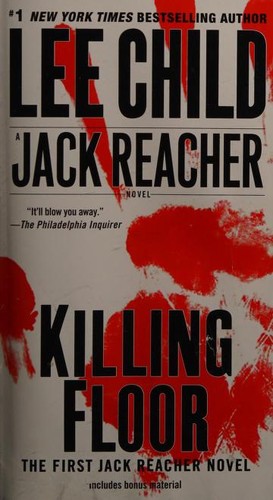
Talk to Killing Floor like its author wrote you back.
Get the ideas that fit your life — not generic summaries.
- Chat with the book
- Audiobook-style main ideas
- Adapts to your life and goals
- Helps you take action
What it argues
Jack Reacher has just left the Army after thirteen years as a military policeman. He has no plans, no address, no car, and no particular destination. On a whim, he takes a bus to Margrave, Georgia, a small, quiet town mentioned in an old blues song. Within hours of arriving, he is arrested for a murder he didn't commit. By the time the police clear him, his brother — who had been living under a different name in the same town — is dead, and Reacher is not the kind of man who walks away from that.
Killing Floor introduces one of the most successful characters in thriller fiction and does so at a full sprint. Reacher is not a detective: he is a predator who happens to be pointed at deserving targets. The investigation reveals a counterfeiting operation that has corrupted the entire town government, and Reacher dismantles it with a combination of military intelligence training, physical violence, and a cold logic that reads as both satisfying and slightly terrifying.
What it gets right
- 1.
Reacher's freedom from possessions, address, and obligations is not presented as tragic; it is the source of his effectiveness, because there is nothing to threaten and nothing to protect.
- 2.
Child's prose style — measured, tactical, physically precise — is as distinctive as Ellroy's compression and functions similarly: it keeps you inside a specific cognitive mode.
- 3.
The novel is partly about the American fantasy of the individual who can right wrongs that institutions cannot or will not. Reacher is that fantasy made flesh.
What it covers
Who wrote it
Lee Child is the pen name of Jim Grant, born in Coventry, England in 1954 and educated at Birmingham University. He worked in regional television production for eighteen years before being made redundant in 1995, at which point he wrote Killing Floor in three months. The Jack Reacher series has sold more than 100 million copies worldwide and has been adapted for two Tom Cruise films and an Amazon Prime series with Alan Ritchson. Child passed the series to his brother Andrew (writing as Andrew Child) in 2020 while remaining involved as co-author on select entries.
