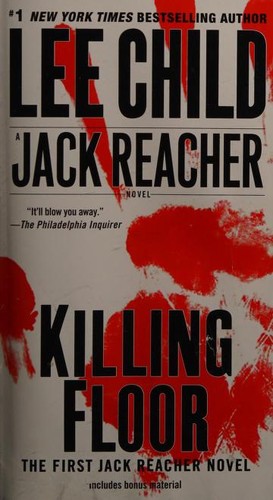
Killing Floor by Lee Child is a 1997 thriller book about justice outside institutions, american mythology and violence, brotherhood and loss. Reacher's freedom from possessions, address, and obligations is not presented as tragic; it is the source of his effectiveness, because there is nothing to threaten and nothing to protect.
Summary
Jack Reacher has just left the Army after thirteen years as a military policeman. He has no plans, no address, no car, and no particular destination. On a whim, he takes a bus to Margrave, Georgia, a small, quiet town mentioned in an old blues song. Within hours of arriving, he is arrested for a murder he didn't commit. By the time the police clear him, his brother — who had been living under a different name in the same town — is dead, and Reacher is not the kind of man who walks away from that.
Killing Floor introduces one of the most successful characters in thriller fiction and does so at a full sprint. Reacher is not a detective: he is a predator who happens to be pointed at deserving targets. The investigation reveals a counterfeiting operation that has corrupted the entire town government, and Reacher dismantles it with a combination of military intelligence training, physical violence, and a cold logic that reads as both satisfying and slightly terrifying.
Lee Child's prose is terse and rhythmic — short sentences, tactical thinking rendered in real time, extremely detailed attention to physical confrontation. The Reacher formula is present fully formed in this debut: protagonist arrives in a place with a secret, is immediately endangered, removes the danger with overwhelming force, and leaves. What makes the formula work is Reacher's psychology: he is genuinely free in a way most thriller protagonists are not, with nothing to protect and nothing to lose, and that freedom makes the violence feel less escapist than it might in other hands.
Killing Floor is genre entertainment executed at a very high level. It is not literary fiction, and does not try to be. The plot mechanics are clean, the villain is adequately menacing, and the ending delivers. If the Reacher formula appeals at all, this is the right starting point: it established everything the later novels iterate on.
Talk to Killing Floor like its author wrote you back.
Get the ideas that fit your life — not generic summaries.
- Chat with the book
- Audiobook-style main ideas
- Adapts to your life and goals
- Helps you take action
Key takeaways
- 1.
Reacher's freedom from possessions, address, and obligations is not presented as tragic; it is the source of his effectiveness, because there is nothing to threaten and nothing to protect.
- 2.
Child's prose style — measured, tactical, physically precise — is as distinctive as Ellroy's compression and functions similarly: it keeps you inside a specific cognitive mode.
- 3.
The novel is partly about the American fantasy of the individual who can right wrongs that institutions cannot or will not. Reacher is that fantasy made flesh.
- 4.
Small-town corruption as a setting is traditional in American crime fiction, but Child uses the specific isolation of a wealthy Georgia town to make the stakes feel real.
- 5.
Reacher's military police background gives him investigative skills, but the novel is honest that he primarily solves problems with force rather than deduction.
- 6.
The villain is a systemic operator — a man who has bought an entire civic infrastructure rather than operating outside it. That structure is more frightening than a lone killer.
- 7.
Brotherhood is the emotional engine: Reacher is not a man who typically feels things, and the murder of his brother is the one wound that bypasses his defenses.
- 8.
The Reacher series succeeds across forty-plus books because the formula is honest about what it is: wish fulfillment executed with craft and discipline.
Discussion questions
Use these on your own, with a book club, or as chat starters in Superbook. Book club version, ready to copy or print →
- 1.
Reacher's response to his brother's death is violent and decisive. Does the novel frame that response as justice, revenge, or something it refuses to distinguish between?
- 2.
The town of Margrave is complicit in its own corruption — bought at every level. How does that collective guilt compare to a single villain's individual responsibility?
- 3.
Reacher is a fantasy figure in obvious ways. Does the fantasy feel troubling, cathartic, or both? Where does wish fulfillment end and something more interesting begin?
- 4.
Child describes physical confrontation with unusual precision and length. Does that specificity make the violence more or less disturbing than in novels that summarize it?
- 5.
Reacher has no home, no family, no address. Is that freedom or damage? Does the novel take a position?
- 6.
The counterfeiting operation corrupts civic institutions from the inside. How does that model of systemic crime compare to the random individual violence of other crime novels?
- 7.
Roscoe, the local detective who becomes Reacher's ally, is one of the more competent law enforcement figures in the series. How does her presence change the lone-wolf dynamics?
- 8.
Reacher is a former military policeman investigating a case involving military connections. Does his background feel like an asset to the story, or primarily a justification for his skill set?
- 9.
The novel's setup — wrongful arrest, murdered brother — is fairly conventional. What does Child do in the execution that makes it feel less conventional than its skeleton?
- 10.
If Reacher called the FBI immediately after his brother was identified, the case would presumably have proceeded differently. Does the novel acknowledge that, and does it matter?
- 11.
Killing Floor was Child's first novel. Compared to what you know about the later Reacher books — does this feel like a first attempt, or fully formed?
- 12.
The ending resolves everything with finality. Is that satisfying or does it feel too clean given the scale of what happened?
Themes
Frequently asked questions
-
Do I need to read Killing Floor first in the Reacher series?
Not strictly — most Reacher novels stand alone. But Killing Floor is worth reading first because it establishes the character fully formed and contains the only significant piece of Reacher's personal history (his family) that the series develops further.
-
Is Killing Floor just a dumb action thriller?
The action is central and unapologetic. But the plotting is tighter than most comparisons give it credit for, the prose style is genuinely distinctive, and the character work on Reacher is more psychologically interesting than the genre usually bothers with.
-
How does the book compare to the Tom Cruise films?
The films are competent genre entries but physically miscasting Cruise as Reacher (who is described as 6'5" and 250 lbs) affects the dynamics. The Amazon series with Alan Ritchson is a much closer match to the books' version of the character.
-
Who shouldn't read Killing Floor?
Readers who are disturbed by extended, detailed depictions of violence — Reacher fights are described slowly and precisely. Also readers who find the lone-hero-outside-institutions fantasy ideologically irritating.
-
Is the counterfeiting plot realistic?
The financial mechanics are plausible and more researched than most thriller plots at that level. Child worked with Treasury officials on some details. The operational scale is somewhat fantastical but not absurdly so.