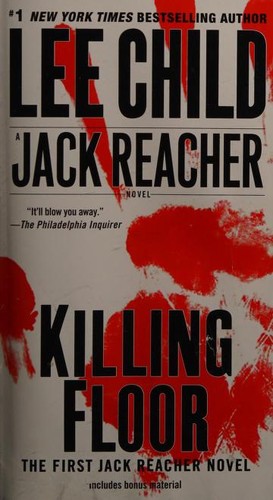
Talk to Killing Floor like its author wrote you back.
Get the ideas that fit your life — not generic summaries.
- Chat with the book
- Audiobook-style main ideas
- Adapts to your life and goals
- Helps you take action
Killing Floor, in detail
Jack Reacher has just left the Army after thirteen years as a military policeman. He has no plans, no address, no car, and no particular destination. On a whim, he takes a bus to Margrave, Georgia, a small, quiet town mentioned in an old blues song. Within hours of arriving, he is arrested for a murder he didn't commit. By the time the police clear him, his brother — who had been living under a different name in the same town — is dead, and Reacher is not the kind of man who walks away from that.
Killing Floor introduces one of the most successful characters in thriller fiction and does so at a full sprint. Reacher is not a detective: he is a predator who happens to be pointed at deserving targets. The investigation reveals a counterfeiting operation that has corrupted the entire town government, and Reacher dismantles it with a combination of military intelligence training, physical violence, and a cold logic that reads as both satisfying and slightly terrifying.
Lee Child's prose is terse and rhythmic — short sentences, tactical thinking rendered in real time, extremely detailed attention to physical confrontation. The Reacher formula is present fully formed in this debut: protagonist arrives in a place with a secret, is immediately endangered, removes the danger with overwhelming force, and leaves. What makes the formula work is Reacher's psychology: he is genuinely free in a way most thriller protagonists are not, with nothing to protect and nothing to lose, and that freedom makes the violence feel less escapist than it might in other hands.
Killing Floor is genre entertainment executed at a very high level. It is not literary fiction, and does not try to be. The plot mechanics are clean, the villain is adequately menacing, and the ending delivers. If the Reacher formula appeals at all, this is the right starting point: it established everything the later novels iterate on.
The big ideas
- 1.
Reacher's freedom from possessions, address, and obligations is not presented as tragic; it is the source of his effectiveness, because there is nothing to threaten and nothing to protect.
- 2.
Child's prose style — measured, tactical, physically precise — is as distinctive as Ellroy's compression and functions similarly: it keeps you inside a specific cognitive mode.
- 3.
The novel is partly about the American fantasy of the individual who can right wrongs that institutions cannot or will not. Reacher is that fantasy made flesh.
