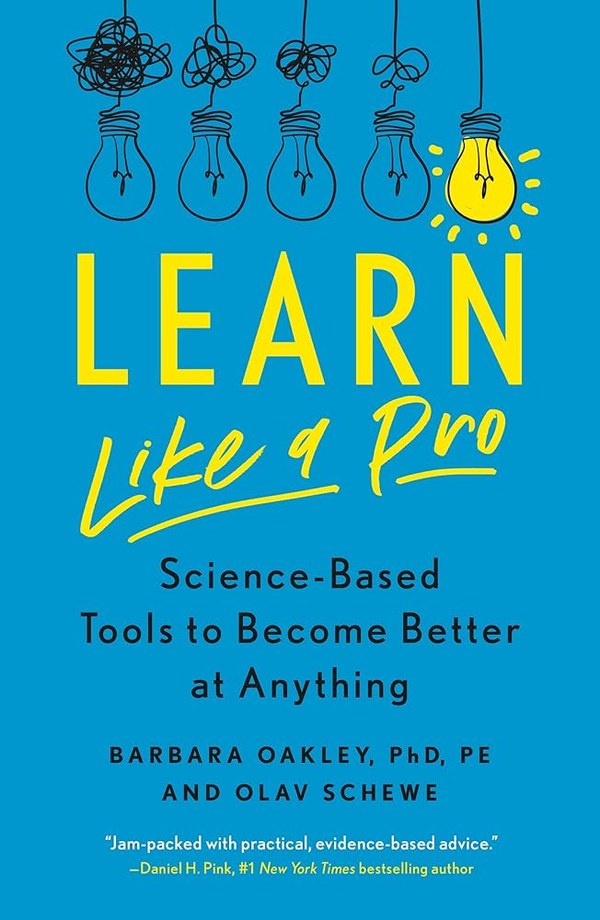
Learn Like a Pro by Barbara Oakley and Olav Schewe is a 2021 self-help book about learning, memory, study skills. Retrieval practice — testing yourself on material — produces stronger memory than rereading the same material. The effort of retrieval is what builds the memory.
Summary
Learn Like a Pro is a concise, evidence-based guide to studying more effectively, written by Barbara Oakley — the engineer-turned-neuroscientist best known for A Mind for Numbers and the Coursera course "Learning How to Learn" — and Olav Schewe, a student learning consultant. The book distills cognitive science research on learning into practical techniques that most students and self-directed learners are not using, despite their superiority to common study habits.
The central argument is that many widely practiced study approaches — rereading, highlighting, massed practice ("cramming") — are both comfortable and ineffective. The brain learns through challenge and retrieval, not passive exposure. The two most important techniques the book advocates are retrieval practice (testing yourself on material rather than re-exposing yourself to it) and spaced repetition (spreading study sessions over time rather than massing them before a deadline). Both are supported by decades of research and are consistently underused.
Oakley and Schewe also address motivation, procrastination, and focus. They bring in the Pomodoro Technique for managing procrastination, and they explain the distinction between focused mode (narrow, analytical thinking) and diffuse mode (broader, background processing) that Oakley developed in A Mind for Numbers. Interleaving — mixing problem types during practice rather than blocking similar problems together — is presented as a more advanced technique for building flexible problem-solving skills.
The book is short and direct. It does not have the narrative richness of some learning books, and it assumes the reader is primarily a student or someone preparing for exams. The research base is solid and well-cited. For readers already familiar with A Mind for Numbers or Make It Stick, much of the content will be familiar; for readers new to cognitive science approaches to learning, it is a very efficient introduction.
Talk to Learn Like a Pro like its author wrote you back.
Get the ideas that fit your life — not generic summaries.
- Chat with the book
- Audiobook-style main ideas
- Adapts to your life and goals
- Helps you take action
Key takeaways
- 1.
Retrieval practice — testing yourself on material — produces stronger memory than rereading the same material. The effort of retrieval is what builds the memory.
- 2.
Spaced repetition beats massed practice. Studying material across multiple sessions with gaps produces far more durable memory than cramming before a single deadline.
- 3.
Rereading and highlighting feel productive but generate an illusion of fluency. If you can recognize the answer when you see it, that is not the same as being able to produce it.
- 4.
The Pomodoro Technique — focused 25-minute work blocks with short breaks — addresses procrastination by reducing the cognitive barrier to starting.
- 5.
The brain processes in two modes: focused (analytical, narrow) and diffuse (background, broad). Difficult problems benefit from both — sustained focus plus breaks that allow diffuse processing.
- 6.
Interleaving — mixing problem types during practice — feels harder and slower than blocked practice but produces better transfer to novel problems.
- 7.
Sleep is not a passive break from learning. Memory consolidation happens during sleep, particularly during the night following new learning.
- 8.
Elaborative interrogation — asking 'why' and 'how' about material as you study it — produces more durable understanding than repeated exposure alone.
Discussion questions
Use these on your own, with a book club, or as chat starters in Superbook. Book club version, ready to copy or print →
- 1.
The book argues that the study methods most people use — rereading, highlighting — are ineffective. When you learned this, did it match your experience, or did it feel implausible?
- 2.
Retrieval practice is the most evidence-supported technique in the book. How often do you actually test yourself rather than re-expose yourself to material?
- 3.
Have you experienced the difference between cramming and spaced practice in your own learning? Which produced more durable memory?
- 4.
The book identifies an 'illusion of fluency' from rereading — thinking you know material because you can recognize it. Where has this fooled you?
- 5.
What subjects or skills in your current life would benefit from a more deliberate learning approach? What would you do differently?
- 6.
The Pomodoro Technique is presented as a procrastination tool. Have you tried it? Does the constraint help or frustrate you?
- 7.
Oakley came to mathematics and engineering as an adult after initially failing at them. Does knowing that affect how you think about your own learning limits?
- 8.
Interleaving feels harder and slower than blocked practice, but it produces better results. Are you willing to accept the short-term discomfort of a more effective method?
- 9.
The book is short and direct. Did you find that useful, or did you want more depth on any particular topic?
- 10.
If you had to implement exactly one technique from this book starting this week, which would it be and why?
- 11.
Sleep, exercise, and diet are mentioned as significant factors in learning. How seriously do you take them as learning tools rather than health tools?
Themes
Frequently asked questions
-
What is Learn Like a Pro about?
It applies cognitive science research on learning to practical study techniques. The core message is that common study habits like rereading and highlighting are ineffective, and that retrieval practice, spaced repetition, and interleaving produce far stronger and more durable learning.
-
Is Learn Like a Pro worth reading if I've already read A Mind for Numbers?
There is significant overlap, particularly in the focused/diffuse mode material and the core learning techniques. Learn Like a Pro is shorter and more directly practical, while A Mind for Numbers has more narrative and depth. Readers who've read the earlier book will find this a useful refresher but not a major expansion.
-
Who should read Learn Like a Pro?
Students at any level who want to study more efficiently, self-directed learners tackling new skills or knowledge, and professionals who take exams or need to absorb large amounts of new information. It is particularly useful for anyone who suspects their current study methods are not working well.
-
How long is Learn Like a Pro?
Short — around 160 pages. Most readers finish it in two to three hours. The brevity is intentional: the authors keep it usable as a reference as well as a one-time read.
-
What is the single most important technique in the book?
Retrieval practice: testing yourself on material rather than re-reading it. This single shift, consistently applied, is supported by more evidence than any other study technique and produces substantially better memory and understanding.
Similar books
Ultralearning
Scott Young
A Mind for Numbers
Barbara Oakley
Make It Stick
Peter C. Brown, Henry L. Roediger and Mark A. McDaniel
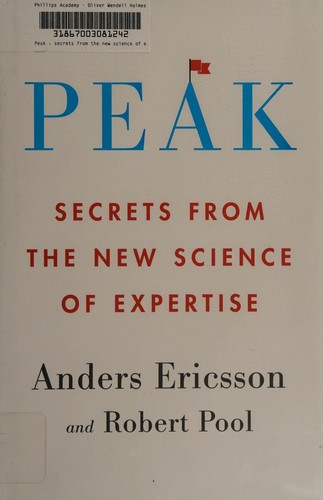
Peak: Secrets from the New Science of Expertise
Anders Ericsson and Robert Pool
