Biography · Book club
Leonardo da Vinci book club questions
Here are 12 book club questions for Leonardo da Vinci by Walter Isaacson, ordered to open easily and end somewhere worth arguing about. Copy them, print them, or bring them up one at a time.
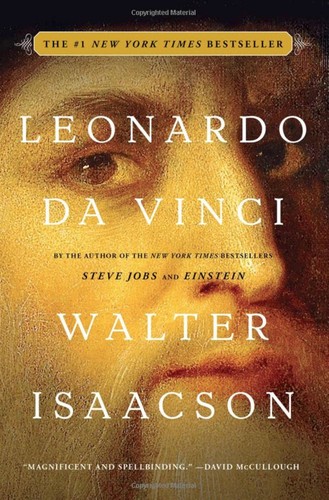
Walter Isaacson's biography of Leonardo da Vinci is built around a simple and provocative claim: Leonardo's genius was not a supernatural gift but an extreme version of a learnable quality — curiosity.
Walter Isaacson · 2017 · 11h 0m
Full summary and key takeaways →The 12 questions
- 1.
Isaacson argues Leonardo's curiosity was extreme but learnable. What would it mean in your own life to make a list of questions the way Leonardo did, without worrying whether they are practically useful?
- 2.
Leonardo left dozens of projects unfinished. Is that a failure of discipline or an expression of intellectual integrity? How do you draw that line in your own work?
- 3.
The notebooks were never published in Leonardo's lifetime. How does working without an audience change what someone is willing to explore?
- 4.
Isaacson says Leonardo's lack of formal schooling was an advantage because it meant he had to observe directly rather than inheriting received knowledge. Where in your field might formal training be limiting rather than enabling?
- 5.
Leonardo studied anatomy, geology, and optics not to make better paintings but because he couldn't help it. How much of your learning is genuinely curiosity-driven versus instrumentally motivated?
- 6.
The Mona Lisa's famous quality — the sense that the expression changes when you look from different angles — comes from techniques Leonardo developed through scientific observation. Does knowing that change how you experience the painting?
- 7.
Leonardo worked for powerful and sometimes brutal patrons — the Sforzas, the Medicis, Cesare Borgia — producing work on commission. How did patronage shape what he made? What's the modern equivalent of that tension?
- 8.
Isaacson describes Leonardo's seven decades as a series of relocations — Florence, Milan, Venice, Rome, France — each driven partly by necessity. How do different environments shape creative output?
- 9.
Leonardo made extremely detailed lists of things he wanted to know: 'describe the tongue of a woodpecker,' 'how do you walk on ice.' What would be on your list?
- 10.
The book ends with Leonardo dying in France, having accomplished less than he planned and more than almost anyone in history. How do you think about the relationship between ambition and completion in your own life?
- 11.
Isaacson connects Leonardo's approach directly to modern innovation and creativity. Does that connection feel earned by the book, or like overreach?
- 12.
Which of Leonardo's projects — paintings, engineering, anatomy, theatrical design — seems most alien to how we think about specialization today? What does that tell you?
How to run the discussion
- Pick six to eight, not all of them. An hour of real discussion covers fewer questions than anyone expects, and racing the list is what makes a book club feel like homework.
- Open with what people noticed, not what they concluded. Asking for a verdict first hardens opinions before anyone has heard each other.
- Let the disagreement run. The questions below that split a room are the ones worth the time; the ones everyone answers the same way can be skipped.
- Ask the quiet person a specific question. A direct, narrow question is far easier to answer than an open invitation to contribute.
Themes worth steering toward
If the conversation stalls, these are the threads that usually restart it.
Common questions
What are good book club questions for Leonardo da Vinci?
Here are 12 book club questions for Leonardo da Vinci by Walter Isaacson, ordered to open easily and end somewhere worth arguing about. The strongest openers ask what each reader noticed rather than what they concluded, and the discussion usually turns on creativity, curiosity, art and science.
How long should a book club discussion of Leonardo da Vinci last?
Most groups run 60 to 90 minutes of actual discussion. That is roughly six to eight questions, not all of them, so pick the ones that suit your group rather than working down the list in order.
What are the main themes in Leonardo da Vinci?
Creativity, Curiosity, Art and science, Renaissance, Observation. Those are the threads most likely to divide a room, which makes them the useful places to steer a discussion that has gone quiet.
Picking the next one? See books like Leonardo da Vinci or questions for other book club picks.
