Business · Book club
Lessons from the Titans book club questions
Here are 11 book club questions for Lessons from the Titans by Scott Davis, Carter Copeland & Rob Wertheimer, ordered to open easily and end somewhere worth arguing about. Copy them, print them, or bring them up one at a time.
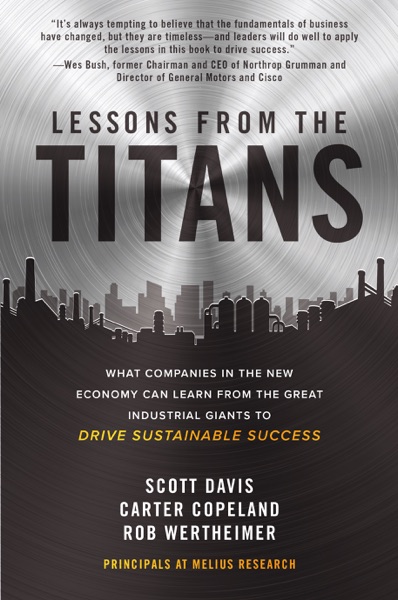
Lessons from the Titans is an equity research team's study of what separates great industrial companies from average ones.
Scott Davis, Carter Copeland & Rob Wertheimer · 2020 · 5h 15m
Full summary and key takeaways →The 11 questions
- 1.
The authors argue that industrial companies are better management laboratories than tech companies. Do you find that persuasive? What is lost by studying management through a technology-company lens?
- 2.
Danaher applies the same improvement system to every acquisition it makes. What does that consistency of method require of the people who run Danaher, and what does it prevent?
- 3.
Dave Cote's 'investing in the future while delivering today' formula sounds obvious. What makes it difficult in practice, and what pressures push organizations in the opposite direction?
- 4.
The GE case study is essentially a cautionary tale about Jack Welch's legacy as well as Immelt's. How do you think about crediting or blaming a previous CEO for a company's later problems?
- 5.
Capital allocation is described as the core skill of industrial management. Who in your professional life makes decisions most like capital allocation, and do they think about it systematically?
- 6.
The book is written by equity analysts. How does the investor's perspective on management quality differ from, say, a management consultant's or an operations researcher's?
- 7.
Many of the management principles here — discipline, consistency, measuring what matters — appear in other business books. What does the industrial context add to those ideas?
- 8.
The authors are critical of GE's financial engineering under Welch in a way that most business books of the Welch era were not. What made that critique possible to write after the fact and so difficult during the period?
- 9.
Lessons from the Titans is built on decades of analyst coverage. What kinds of knowledge accumulate from watching a company for fifteen years that can't be captured in a single research report?
- 10.
The book focuses on large, public industrial companies. How much of what it argues applies to smaller private businesses, and what is different?
- 11.
If you were advising a CEO of a mid-size industrial company, which single lesson from the book would you lead with?
How to run the discussion
- Pick six to eight, not all of them. An hour of real discussion covers fewer questions than anyone expects, and racing the list is what makes a book club feel like homework.
- Open with what people noticed, not what they concluded. Asking for a verdict first hardens opinions before anyone has heard each other.
- Let the disagreement run. The questions below that split a room are the ones worth the time; the ones everyone answers the same way can be skipped.
- Ask the quiet person a specific question. A direct, narrow question is far easier to answer than an open invitation to contribute.
Themes worth steering toward
If the conversation stalls, these are the threads that usually restart it.
Common questions
What are good book club questions for Lessons from the Titans?
Here are 11 book club questions for Lessons from the Titans by Scott Davis, Carter Copeland & Rob Wertheimer, ordered to open easily and end somewhere worth arguing about. The strongest openers ask what each reader noticed rather than what they concluded, and the discussion usually turns on industrial management, corporate turnaround, operational excellence.
How long should a book club discussion of Lessons from the Titans last?
Most groups run 60 to 90 minutes of actual discussion. That is roughly six to eight questions, not all of them, so pick the ones that suit your group rather than working down the list in order.
What are the main themes in Lessons from the Titans?
Industrial management, Corporate turnaround, Operational excellence, Leadership, Capital allocation. Those are the threads most likely to divide a room, which makes them the useful places to steer a discussion that has gone quiet.
Picking the next one? See books like Lessons from the Titans or questions for other book club picks.
