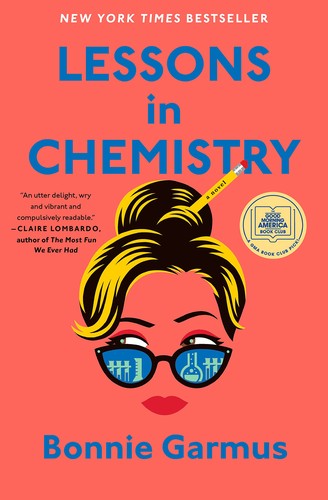
Lessons in Chemistry by Bonnie Garmus is a 2022 contemporary fiction book about gender and ambition, grief and resilience, science and rationalism. Elizabeth Zott refuses the social performance that allows women in her context to be tolerated, and the novel uses that refusal to expose exactly what the performance is covering for.
Summary
Elizabeth Zott is a chemist in early 1960s California who is exactly as capable as she knows herself to be and is surrounded by institutions that refuse to acknowledge it. She is sexually assaulted by her dissertation advisor and loses her PhD; she falls in love with Calvin Evans, a brilliant but socially oblivious colleague; she has a daughter she didn't plan for; and then Calvin dies. What follows is the novel's central premise and its sharpest joke: Elizabeth ends up as the host of a cooking show, and teaches chemistry under the guise of cooking to an audience of housewives who recognize in her precision, rigor, and refusal to condescend exactly the quality that the actual scientific establishment denied them.
Bonnie Garmus is writing a satirical novel about 1960s sexism with the tone of a fable: the prose is witty, slightly anachronistic in its knowingness, and completely uninterested in historical verisimilitude in the way literary fiction often demands. Elizabeth is not a rounded character in the conventional sense — she is a voice, a corrective, a thought experiment. What would a woman of genuine intelligence and no social maneuvering skills look like in an institution designed to exclude her? The answer is both comic and genuinely painful, and Garmus holds those registers with skill.
The novel was a publishing phenomenon: Garmus's debut, rejected repeatedly before sale, won the Pulitzer Prize shortlist and sold millions of copies globally. It became a television series on Apple TV+. The reason for its success is not difficult to identify: it is extremely funny, it takes female intelligence entirely seriously, and it does not make its protagonist suffer more than the premise requires. Elizabeth doesn't learn to soften herself or play the game; she simply continues being Elizabeth, and the people around her either rise to meet her or reveal themselves clearly.
What the novel does not do is pretend that the sexism it depicts has been resolved. The comedy is the comedy of recognition, not of relief. Readers who find the satire heavy-handed or the protagonist implausibly articulate may find it thin. But for readers who want a book that is both genuinely funny and genuinely angry about what it costs to be competent and female in an institution that won't admit it, Lessons in Chemistry is one of the best recent examples.
Talk to Lessons in Chemistry like its author wrote you back.
Get the ideas that fit your life — not generic summaries.
- Chat with the book
- Audiobook-style main ideas
- Adapts to your life and goals
- Helps you take action
Key takeaways
- 1.
Elizabeth Zott refuses the social performance that allows women in her context to be tolerated, and the novel uses that refusal to expose exactly what the performance is covering for.
- 2.
The cooking show premise is the book's central satirical device: cooking reframed as applied chemistry is not a joke about cooking but about what happens to scientific knowledge when it's allowed to reach the people the scientific establishment excludes.
- 3.
The novel is deeply skeptical of institutions — universities, television studios, churches, social groups — as mechanisms for managing rather than enabling the capabilities of the people inside them.
- 4.
Calvin Evans is written as the rare male character who encounters a brilliant woman and responds with pure recognition rather than competition; his function in the novel is partly to make that response legible as a choice.
- 5.
Harriet Sloane, Elizabeth's neighbor, represents the women who didn't have Elizabeth's education but have the same intelligence, and whose relationship with the show is the novel's most honest treatment of its premise.
- 6.
Garmus uses Six-Thirty — the dog — as a Greek-chorus figure with more genuine interiority than many human characters: comic, observant, and allowed to be directly right about things the human characters take longer to see.
- 7.
The novel argues that the women of the early 1960s who were consigned to domesticity were not intellectually inferior but institutionally excluded, and that the exclusion had real costs for everyone, not just the women.
- 8.
The satire is not targeted at men individually so much as at the structures men built and benefited from. Most individual male characters are either reformed, ridiculous, or minor.
Discussion questions
Use these on your own, with a book club, or as chat starters in Superbook. Book club version, ready to copy or print →
- 1.
Elizabeth refuses to perform the softness and self-deprecation that would make her more tolerable to the institutions around her. Is that presented as a strength, a flaw, or both?
- 2.
The cooking show allows Elizabeth to reach an audience the scientific establishment never would. Is that framed as victory, compromise, or simply coincidence?
- 3.
Harriet recognizes something real in Elizabeth's show that the producers don't see. What exactly is she recognizing, and what does the novel say about who is capable of that recognition?
- 4.
Calvin Evans is almost too supportive to be plausible as a 1960s male colleague. Is his function in the novel a realistic portrait or a deliberate fantasy of what recognition looks like?
- 5.
The novel is satirical in a way that requires the sexism it depicts to be somewhat cartoonish to work. Does that cartoonishness cost anything in emotional truth?
- 6.
Six-Thirty is written with genuine interiority and comic timing. Does the dog's perspective add something to the novel, or is it a gimmick?
- 7.
Elizabeth's daughter, Madeline, is in some ways the novel's most interesting character — a child raised by a scientist in a world designed to make children incurious. How does the novel handle her development?
- 8.
The church subplot involves a minister who begins teaching his congregation to question rather than accept. It's the most optimistic subplot in the novel. Did it feel earned to you, or too convenient?
- 9.
Garmus was reportedly rejected by dozens of publishers before selling this book. Does knowing that context change how you read a novel about institutional exclusion of women with ability?
- 10.
The novel ends with discovery and reconnection. Is that ending satisfying given the material that precedes it, or does it feel like the book choosing comfort over honesty?
- 11.
Lessons in Chemistry is very funny. Does the comedy make the anger underneath it more accessible or does it let readers off the hook?
Themes
Frequently asked questions
-
Is Lessons in Chemistry worth reading?
Yes, especially if you want fiction that is simultaneously funny and politically serious without being preachy. The comedy is real, the anger is real, and they coexist effectively. It's one of the few genuinely satirical novels to reach a mass audience in recent years.
-
Is Lessons in Chemistry appropriate for book clubs?
Exceptionally so. It has clear themes, generates strong reactions across different readers, and has enough humor to make the discussion enjoyable rather than heavy. One of the more reliable book-club picks of the last several years.
-
What is the TV adaptation like?
The Apple TV+ series with Brie Larson received strong reviews and is generally faithful to the novel's tone. The adaptation expands certain characters and storylines, particularly around the cooking show audience.
-
Who shouldn't read Lessons in Chemistry?
Readers who find satirical cartoonishness at the expense of psychological realism frustrating. Elizabeth is more emblem than person, and the novel is not trying to hide that. Readers who need complete interior access to characters to stay engaged will find her opaque.
-
Is the science in the novel accurate?
The chemistry is real enough to be credible but simplified for accessibility. Garmus has said she consulted scientists during writing. The novel is not a chemistry textbook; the science is present to establish Elizabeth's competence and the cooking show conceit, not to teach.