Letters and Papers from Prison by Dietrich Bonhoeffer is a 1953 philosophy book about faith in extremity, resistance, theology. Bonhoeffer's concept of 'religionless Christianity' challenges the church to address a world that no longer needs God as an explanation for gaps in human knowledge or a comfort for human weakness.
Summary
Letters and Papers from Prison is a posthumous collection of Dietrich Bonhoeffer's correspondence written during his imprisonment at Tegel military prison in Berlin between April 1943 and October 1944, along with some earlier papers and the poem "Who Am I?" written near the end. Bonhoeffer was arrested for his involvement in Operation 7, which smuggled Jews to Switzerland, and was later connected to the July 20 assassination plot against Hitler. He was transferred to Gestapo custody in October 1944 and executed at Flossenbürg in April 1945.
The letters were edited and first published by his friend Eberhard Bethge, who smuggled many of them out of the prison in visits. The collection is not a systematic work — it is a record of a mind thinking in real time under extreme pressure, and the quality of the thinking is remarkable. The later letters contain the fragments of what Bonhoeffer calls "religionless Christianity" or "Christianity for a world come of age": the idea that the church has too often presented God as a stopgap for human weakness, and that a mature faith should be able to operate in the world without that crutch.
These theological fragments are the book's most controversial and debated sections. Bonhoeffer writes in quick, suggestive notes rather than sustained arguments, and interpreters have gone in sharply different directions in reading them. Some see a proto-secular theology; others, a prophetic renewal of Christian witness. What is clear is that he was questioning whether the forms of religion he had grown up in could survive contact with the world as it actually was.
The personal letters are as important as the theological ones. Bonhoeffer writes to his parents, to his friend Bethge, and to his fiancée Maria von Wedemeyer with a composure that does not feel performed. He reads widely, discusses literature and music, makes plans, worries about others. The contrast between the normalcy of the tone and the conditions in which it was maintained is part of what makes the book devastating. The final poem, "Who Am I?" — in which he acknowledges the gap between his outward calmness and his inner unrest — is one of the most honest pieces of writing about prison to come out of the twentieth century.

Talk to Letters and Papers from Prison like its author wrote you back.
Get the ideas that fit your life — not generic summaries.
- Chat with the book
- Audiobook-style main ideas
- Adapts to your life and goals
- Helps you take action
Key takeaways
- 1.
Bonhoeffer's concept of 'religionless Christianity' challenges the church to address a world that no longer needs God as an explanation for gaps in human knowledge or a comfort for human weakness.
- 2.
The 'world come of age' means human beings have increasingly taken responsibility for their own lives and societies. Bonhoeffer sees this not as a threat to faith but as a challenge to find what Christian witness means in that context.
- 3.
The book is fragmentary by nature — these are letters and notes, not a finished argument. The incompleteness is not a defect; it reflects the genuine openness of Bonhoeffer's thinking at the end of his life.
- 4.
Bonhoeffer's composure in prison was both real and maintained by effort. The poem 'Who Am I?' is his most honest acknowledgment of the gap between the self others see and the self he experienced internally.
- 5.
The concept of 'suffering God' runs through the later letters: Bonhoeffer argues that God is known not in power and triumph but in weakness, suffering, and the cross. This is not consolation theology but a theological claim about where God is found.
- 6.
The letters show a man whose intellectual formation — music, literature, theology — remained active to the end. The prison did not narrow his mind; if anything, it concentrated it.
- 7.
Bonhoeffer rejects the idea of God as a 'working hypothesis' — something needed to explain what we cannot yet understand. A faith that depends on human inadequacy is vulnerable as human capacities grow.
- 8.
The friendship with Eberhard Bethge, who preserved and edited the letters, is itself evidence of Bonhoeffer's argument that Christian life is communal. Bethge's editorial work is a form of discipleship.
Discussion questions
Use these on your own, with a book club, or as chat starters in Superbook. Book club version, ready to copy or print →
- 1.
Bonhoeffer describes a 'world come of age' that no longer needs God as an explanation or a comfort. Does that description fit the world you live in, and does it seem like a problem or a clarification?
- 2.
What is 'religionless Christianity' as Bonhoeffer sketches it? Do you think it is coherent, or is it Christianity stripped of what makes it distinctive?
- 3.
The letters were written knowing they might be read by censors. How does that constraint affect how you read them? How do we read a text whose author was performing composure for multiple audiences?
- 4.
Bonhoeffer writes with apparent calm while facing execution. Do you read that calmness as genuine, as performed, or as something that resists that distinction?
- 5.
He argues that God should not be sought in human weakness or ignorance but at the center of life. What would it look like in practice to relate to God that way?
- 6.
The poem 'Who Am I?' describes the gap between Bonhoeffer's external presentation and his internal state. When have you maintained a public composure that masked something very different inside?
- 7.
These letters were written to be read by people Bonhoeffer trusted, not as public theology. Does knowing they were private correspondence change your relationship to the theological ideas in them?
- 8.
Bonhoeffer's execution came ten days before the end of the war in Europe. What does it mean to read these letters knowing that outcome?
- 9.
He was involved in an assassination plot against Hitler — an act of violence that contradicts his earlier theology of nonresistance. What does the fact that he never resolved that tension publicly tell us about the relationship between ethics and action under extreme conditions?
- 10.
The book is fragmentary. Do the incompleteness and the circumstances of its composition make it more or less credible as a theological document than a finished, systematized work?
- 11.
Which of the fragmentary theological ideas in the later letters do you find most generative? Most confusing?
- 12.
If you were writing letters from your own version of extremity, what would you find yourself thinking about most?
Themes
Frequently asked questions
-
What is Letters and Papers from Prison about?
It is a collection of Bonhoeffer's letters and theological notes written during his imprisonment in Berlin from 1943 to 1944. It contains his most exploratory theology — including the concept of 'religionless Christianity' — alongside personal correspondence with family and friends.
-
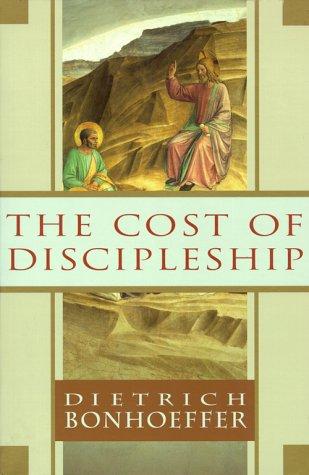
Should I read The Cost of Discipleship before Letters and Papers from Prison?
It helps. The earlier book represents Bonhoeffer's more confident, systematic theology; the prison letters show a mind revising and questioning that system under pressure. The contrast between the two is part of the value of reading both.
-
What is 'religionless Christianity'?
Bonhoeffer's fragmentary concept of a faith that does not rely on human weakness or ignorance as its point of entry — a Christianity that can speak to a world that has largely outgrown its need for God as a stopgap explanation. He died before developing it into a full argument.
-
How was this book published if Bonhoeffer died in prison?
His close friend Eberhard Bethge smuggled many of the letters out during prison visits, preserved them, and edited them into the volume first published in German in 1951. Bethge's editorial decisions shaped which Bonhoeffer posterity received.
-
Who should read this book?
Anyone interested in theology, philosophy, or what it means to maintain intellectual and spiritual life under extreme pressure. It speaks to readers outside religious contexts as a document of moral courage and honest thinking under threat.