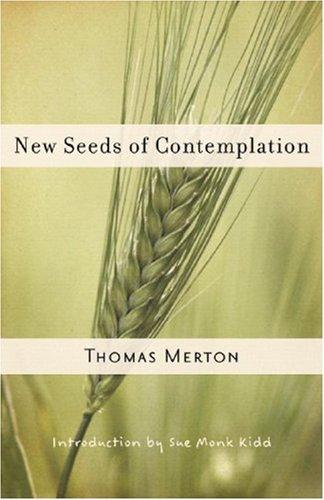
New Seeds of Contemplation by Thomas Merton is a 1961 religion & spirituality book about contemplation, silence, true self. The false self is the identity constructed to navigate social life — reputation, role, image — and it is the primary obstacle to contemplative depth. Merton argues we spend most of our lives defending a self that does not ultimately exist.
Summary
New Seeds of Contemplation is Thomas Merton's revised and expanded version of Seeds of Contemplation, which he published in 1949 when he was still new to monastic life. The 1961 revision reflects a decade more of experience as a Trappist monk at the Abbey of Gethsemani in Kentucky, and the differences are significant: the earlier book was sometimes strident and doctrinally narrow; the revision is more generous, more psychologically precise, and more honest about the difficulty of what Merton is describing.
The book is organized as a series of short, meditative chapters on aspects of the contemplative life. Merton writes about what contemplation is and is not, the nature of the true self versus the false self (the ego constructed to navigate the social world), the relationship between solitude and community, the uses and limits of liturgy, and the danger of mistaking spiritual performance for spiritual depth. He is hard on religious complacency, including his own. The chapter on the false self is the book's most durable contribution: Merton argues that the self most people spend their lives defending — their reputation, their image, their social identity — is not a self at all but a mask that prevents encounter with the God who waits behind it.
Merton is not primarily a systematic theologian. He writes in an essayistic, at times lyrical, register that sits closer to Augustine's Confessions than to scholastic theology. His prose is dense in places, but the density is earned. He is trying to describe experiences that language resists, and he is explicit about that difficulty. The book rewards slow reading; it does not summarize well.
The influence of mystical traditions outside Christianity is more evident in the 1961 version. Merton had been corresponding with Zen teachers and reading widely in Eastern thought, and while he does not abandon his Catholic frame, he writes about contemplation in terms that Zen practitioners would recognize. That openness was controversial in his time and remains the book's most distinctive quality. It suggests that the experience he is describing is not the exclusive property of any single tradition.
Talk to New Seeds of Contemplation like its author wrote you back.
Get the ideas that fit your life — not generic summaries.
- Chat with the book
- Audiobook-style main ideas
- Adapts to your life and goals
- Helps you take action
Key takeaways
- 1.
The false self is the identity constructed to navigate social life — reputation, role, image — and it is the primary obstacle to contemplative depth. Merton argues we spend most of our lives defending a self that does not ultimately exist.
- 2.
Contemplation is not a spiritual technique or a feeling. It is a direct, non-conceptual awareness of God that cannot be produced by effort but can be blocked by noise, distraction, and the need to perform.
- 3.
Solitude is not isolation. Merton insists that true solitude, which strips away the social self, is the ground for genuine love of others — not its enemy.
- 4.
The spiritual life's chief danger is not failure but success: becoming skilled at religious performance while remaining untransformed inside. Merton calls this spiritual greed.
- 5.
Prayer is not primarily asking for things. It is the orientation of the whole person toward reality — which Merton identifies with God — and it can happen in the middle of ordinary life as much as in formal liturgy.
- 6.
Merton draws on Zen, Sufism, and other traditions without abandoning his Christian framework, arguing that the contemplative experience points toward something that transcends the forms any tradition uses to describe it.
- 7.
The desert fathers — early Christian monastics who fled to Egypt — are Merton's primary models of the contemplative life. Their practice of silence and purgation informs the whole book.
- 8.
Union with God does not mean the dissolution of the person. Merton's version of mysticism preserves individual personality while transforming its orientation from self to other.
Discussion questions
Use these on your own, with a book club, or as chat starters in Superbook. Book club version, ready to copy or print →
- 1.
Merton describes the false self as the identity we construct to be accepted, admired, or safe. Where in your life do you recognize that construction most clearly?
- 2.
He argues that solitude is the precondition for genuine love, not its opposite. Does that claim match your experience, or does it feel like a rationalization for withdrawal?
- 3.
What is the difference between contemplation as Merton describes it and mindfulness practice as it is commonly taught today?
- 4.
Merton is critical of religious performance — the habit of going through spiritual motions while remaining inwardly unchanged. How would you know the difference in yourself?
- 5.
The book was written in a monastery, by a monk, for largely religious readers. Which of its ideas, if any, do you think apply outside that context?
- 6.
Merton draws parallels between Christian contemplation and Zen. Does that move feel like genuine insight or like a Western intellectual flattening of distinct traditions?
- 7.
He writes that the true self is not an achievement but a discovery — something you uncover by removing what is not you. What would it mean to approach your identity that way?
- 8.
Merton insists that contemplation cannot be produced by technique. Does that make the book useful, or does it make the whole project inaccessible?
- 9.
The chapter on spiritual greed describes people who pursue spiritual experience as another form of acquisition. Have you recognized that pattern in yourself or others?
- 10.
Merton was a public intellectual as well as a monk. How do you reconcile his argument for silence and withdrawal with his prolific writing and public engagement?
- 11.
What does it mean to say that a book about contemplation can only ever be seeds — that the reader must grow whatever it contains?
- 12.
If you were to practice one thing from this book for a month, what would it be?
Themes
Frequently asked questions
-
Is New Seeds of Contemplation a religious book?
It is written from within Catholic Christian theology but engages with Zen, Sufism, and other contemplative traditions. Readers without a religious background will find some passages inaccessible, but much of the psychological material — particularly on the false self — translates broadly.
-
Should I read Seeds of Contemplation or New Seeds of Contemplation?
New Seeds of Contemplation, published in 1961. Merton revised and substantially expanded the 1949 original, softened its more rigid passages, and incorporated twelve years of additional monastic experience. It supersedes the earlier version.
-
What is the main idea of New Seeds of Contemplation?
The book's central argument is that most people live at the surface of themselves, defending an ego-constructed identity, and that contemplative practice is the work of clearing that construction to encounter something truer and more fundamental beneath it.
-
How long does it take to read?
About four to four and a half hours at average reading pace for the 296-page book. Merton's prose rewards slow reading rather than efficient reading, so most people find it takes longer than the word count suggests.
-
Who should read this book?
People interested in Christian mysticism, contemplative spirituality, or the psychology of ego and identity. It works well alongside Zen literature, Julian of Norwich, or Meister Eckhart. Readers looking for practical technique will be frustrated — Merton is more interested in orientation than method.