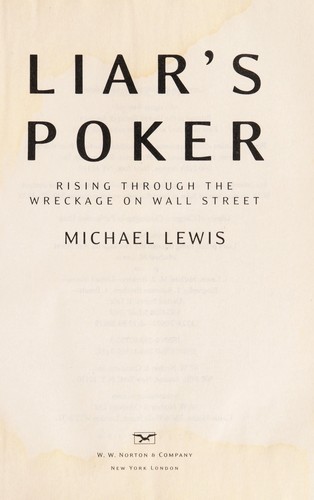
Liar's Poker by Michael Lewis is a 1989 business book about wall street culture, risk, greed. Salomon Brothers built the mortgage-backed securities market from scratch in the 1980s, handing enormous profits to those who understood the instruments first and enormous losses to those who didn't.
Summary
Liar's Poker is Michael Lewis's account of his years as a bond salesman at Salomon Brothers in the 1980s, the decade when Wall Street stopped being a gentleman's club and became something closer to a casino. Lewis arrived at the firm almost by accident after an awkward dinner placement next to a Salomon partner, and the book traces his education from clueless trainee to reasonably competent trader before he walked away at twenty-eight to write about it.
The firm Lewis joined was at the peak of its power. Salomon Brothers dominated the mortgage-backed securities market — a market it had largely invented — and its trading floor ran on a culture of controlled aggression, competitive hazing, and enormous bonuses. Lewis chronicles the rise of figures like John Gutfreund, Salomon's imperious CEO, and John Meriwether, the poker player and bond trader who gave the book its title. The game of liar's poker, in which traders bluff each other using the serial numbers on dollar bills, stands in for the entire ethos of the floor: information asymmetry weaponized for profit.
Lewis's real subject is the mortgage bond revolution. He explains, more clearly than most economic histories, how the bundling of home mortgages into tradeable securities transformed American finance and, eventually, destabilized it. The traders who understood these instruments first made fortunes. The clients who bought them often did not understand what they owned. Lewis's account of how Salomon salespeople moved product they privately doubted onto investors who trusted their advice remains one of the sharper portraits of a conflict of interest that would never fully go away.
The book holds up because Lewis writes with genuine wit and almost no moralizing. He implicates himself in the culture he describes. He enjoyed the money and the status. He left not from virtue but from a sense that the whole enterprise was absurd. That honesty makes Liar's Poker more persuasive than a straightforward exposé would have been, and it set the template for Lewis's entire career: embed yourself, tell the story from the inside, and trust that the facts are strange enough on their own.
Talk to Liar's Poker like its author wrote you back.
Get the ideas that fit your life — not generic summaries.
- Chat with the book
- Audiobook-style main ideas
- Adapts to your life and goals
- Helps you take action
Key takeaways
- 1.
Salomon Brothers built the mortgage-backed securities market from scratch in the 1980s, handing enormous profits to those who understood the instruments first and enormous losses to those who didn't.
- 2.
The trading floor ran on information asymmetry. Salespeople knew more than clients, and the system was designed to keep it that way.
- 3.
The 1980s Wall Street bonus culture created incentives that were radically disconnected from long-term client or firm outcomes. Individual traders were paid for short-term wins regardless of what happened after.
- 4.
Lewis's own trajectory — hired without financial knowledge, trained on the job, earning six figures within a year — illustrated how little talent the boom actually required and how much was pure timing.
- 5.
Liar's poker, the bluffing game played with dollar bills, captures the whole culture: the currency of the floor was nerve and deception, not analysis.
- 6.
The mortgage bond revolution democratized homeownership but also created a market whose complexity eventually outran the people managing it — a pattern Lewis would return to in The Big Short.
- 7.
Gutfreund's Salomon had a talent for recruiting smart people and then placing them in a culture that rewarded aggression over judgment, producing behavior none of them would have chosen individually.
- 8.
Lewis argues that the real scandal wasn't the rule-breaking but the rules themselves: a system where selling clients bad paper was legal, common, and celebrated.
Discussion questions
Use these on your own, with a book club, or as chat starters in Superbook. Book club version, ready to copy or print →
- 1.
Lewis describes being hired at Salomon without any relevant knowledge and quickly earning more than most professionals twice his age. What does that say about how financial markets were pricing talent in the 1980s?
- 2.
The liar's poker game is a metaphor for the entire floor. Can you think of equivalents in your own industry — situations where the formal game is a cover for something else entirely?
- 3.
Lewis implicates himself: he took the money, played the game, and enjoyed it for a while. How does that self-implication change the way you read his critique of the culture?
- 4.
The Salomon salespeople sold products to clients that they privately doubted. How do you draw the line between salesmanship and deception in your own work?
- 5.
Gutfreund's leadership style was built on intimidation and status competition. What makes cultures like that so self-sustaining even when most people inside them are uncomfortable?
- 6.
Lewis left Wall Street at twenty-eight because he felt the whole thing was absurd, not because he was wronged. What kind of disillusionment does that require — and is it more or less admirable than leaving after being treated unfairly?
- 7.
The mortgage bond traders made fortunes by exploiting complexity that clients didn't understand. Is this a problem with the people involved, the incentive structures, or the regulatory environment?
- 8.
Lewis writes with affection for some of the traders he worked alongside even while criticizing the system. Can you separate your view of individuals from your view of the institutions they work for?
- 9.
The boom Lewis describes depended on being early. How much of successful careers in competitive fields comes down to timing versus skill, and how honest are people typically about that ratio?
- 10.
Liar's Poker was published in 1989 as a cautionary tale, yet the culture it described intensified in the following decades and produced a much larger crisis. Why did the warning not land?
- 11.
Lewis says he left because he felt lucky to have gotten out before the music stopped. Have you ever made a significant career or life decision based on a similar intuition about timing?
- 12.
The book is a memoir, not a polemic, but it clearly has a point of view. Where do you think Lewis is being most fair, and where do you think his perspective is most limited?
Themes
Frequently asked questions
-
What is Liar's Poker about?
It's Michael Lewis's memoir of his years as a bond salesman at Salomon Brothers in the 1980s. The book is partly a coming-of-age story, partly a portrait of Wall Street's trading culture, and partly an explanation of how the mortgage bond market was invented and what it did to American finance.
-
Is Liar's Poker still worth reading?
Yes. The cultural portrait is sharper than most business books, the writing is genuinely funny, and the financial mechanisms Lewis describes — mortgage-backed securities, information asymmetry between salespeople and clients — remained central to the 2008 crisis. Reading it alongside The Big Short shows how little changed in twenty years.
-
How long does it take to read Liar's Poker?
Around six hours at average reading pace. The book is 290 pages and reads quickly; Lewis is a practiced storyteller and the chapters are short. Most readers finish it in two or three sittings.
-
Do I need to understand finance to enjoy Liar's Poker?
No. Lewis explains the mechanics as he goes, and he had limited financial knowledge when he arrived at Salomon himself. The book works as a workplace memoir and character study even for readers with no interest in bonds.
-
How does Liar's Poker relate to The Big Short?
The Big Short picks up roughly where Liar's Poker ends. Liar's Poker shows the creation of the mortgage bond market; The Big Short shows its collapse in 2008. The two books together form a single arc, and Lewis explicitly connects them in interviews and in The Big Short's prologue.
Similar books
Shoe Dog: A Memoir by the Creator of Nike
Phil Knight
The Hard Thing About Hard Things
Ben Horowitz
Fooled by Randomness
Nassim Nicholas Taleb
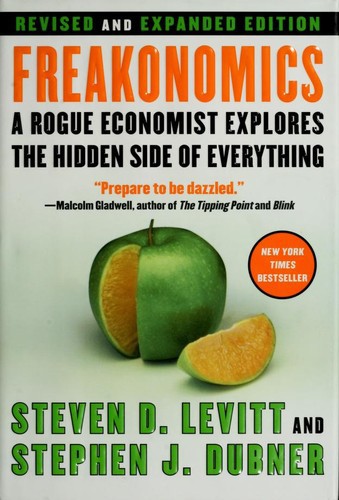
Freakonomics
Steven D. Levitt and Stephen J. Dubner
