Science · Book club
Life Ascending book club questions
Here are 11 book club questions for Life Ascending by Nick Lane, ordered to open easily and end somewhere worth arguing about. Copy them, print them, or bring them up one at a time.
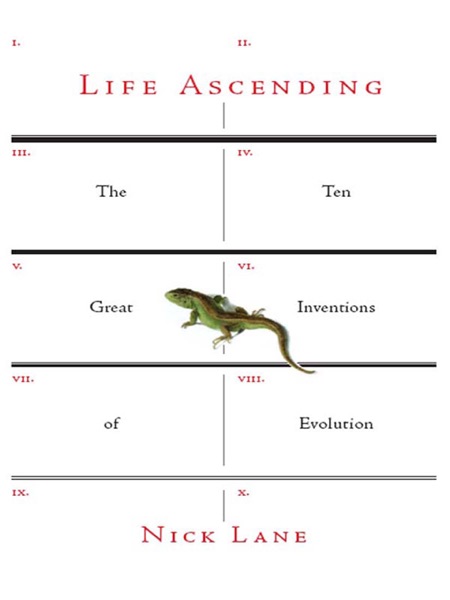
Life Ascending is Nick Lane's examination of what he calls evolution's ten greatest inventions: the origin of life itself, DNA, photosynthesis, the complex cell, sex, movement, sight, hot blood, consciousness, and death.
Nick Lane · 2009 · 7h 0m
Full summary and key takeaways →The 11 questions
- 1.
Lane argues that each of the ten inventions was improbable but, once achieved, essentially irreversible. Which invention do you find most surprising in its mechanism?
- 2.
The alkaline vent hypothesis for life's origin is detailed but not universally accepted. What level of biochemical plausibility would you need before treating a theory of life's origin as settled?
- 3.
The eukaryotic merger between archaeon and bacterium happened once. Does the rarity of that event change how you think about the probability of complex life elsewhere in the universe?
- 4.
Lane presents sex as solving a genetic conflict problem rather than simply providing variation. Does that reframing change the intuition that sex is 'obviously' good for a species?
- 5.
The Great Oxidation Event killed most existing life and enabled what followed. Are there analogues — transformative disruptions that destroy incumbents and clear the way for new forms — in human history or technology?
- 6.
Warm blood costs roughly ten times more energy than cold blood for the same body mass. What does that metabolic investment tell you about how natural selection values flexibility versus efficiency?
- 7.
Lane treats death as an evolved feature rather than a limitation. What are the implications of that view for how we think about aging research and life extension?
- 8.
Which of the ten inventions would you argue has had the greatest effect on the shape of the biosphere we currently inhabit?
- 9.
Lane writes deeply about molecular mechanisms. Did that level of detail enhance or impede your engagement with the big evolutionary questions?
- 10.
The book integrates chemistry, genetics, and evolutionary theory. Is there a question about life's history that Lane doesn't address that you would most want answered?
- 11.
If you were to add an eleventh great invention to Lane's list, what would it be, and how would you defend its significance?
How to run the discussion
- Pick six to eight, not all of them. An hour of real discussion covers fewer questions than anyone expects, and racing the list is what makes a book club feel like homework.
- Open with what people noticed, not what they concluded. Asking for a verdict first hardens opinions before anyone has heard each other.
- Let the disagreement run. The questions below that split a room are the ones worth the time; the ones everyone answers the same way can be skipped.
- Ask the quiet person a specific question. A direct, narrow question is far easier to answer than an open invitation to contribute.
Themes worth steering toward
If the conversation stalls, these are the threads that usually restart it.
Common questions
What are good book club questions for Life Ascending?
Here are 11 book club questions for Life Ascending by Nick Lane, ordered to open easily and end somewhere worth arguing about. The strongest openers ask what each reader noticed rather than what they concluded, and the discussion usually turns on evolution, origins of life, biochemistry.
How long should a book club discussion of Life Ascending last?
Most groups run 60 to 90 minutes of actual discussion. That is roughly six to eight questions, not all of them, so pick the ones that suit your group rather than working down the list in order.
What are the main themes in Life Ascending?
Evolution, Origins of life, Biochemistry, Natural selection, Biological complexity. Those are the threads most likely to divide a room, which makes them the useful places to steer a discussion that has gone quiet.
Picking the next one? See books like Life Ascending or questions for other book club picks.
