Self-help · Book club
Limitless book club questions
Here are 12 book club questions for Limitless by Jim Kwik, ordered to open easily and end somewhere worth arguing about. Copy them, print them, or bring them up one at a time.
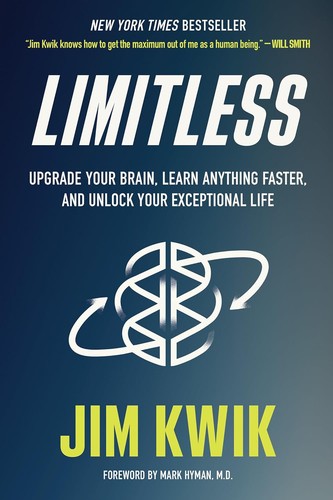
Limitless is Jim Kwik's account of how he overcame a childhood brain injury and learning difficulties to become a professional memory coach and reading accelerator, and what he learned about cognition along the way.
Jim Kwik · 2020 · 5h 0m
Full summary and key takeaways →The 12 questions
- 1.
What limiting belief about your own learning capacity have you carried the longest? Where did it come from, and have you ever tested whether it's actually true?
- 2.
Kwik argues that knowing your 'why' makes learning faster. When has having a clear, personal reason to learn something made the process noticeably easier?
- 3.
Have you ever deliberately used a memory technique — a mnemonic, a visualization, a story — to remember something? Did it work, and did you keep using it?
- 4.
What is one skill you've been putting off learning because you assume you're not good at it? What would you try if you assumed the constraint was a belief rather than a fact?
- 5.
Speed reading claims range from well-supported to pseudoscientific. What's your experience with reading speed, and what do you think the real bottlenecks are?
- 6.
Active recall is one of the most well-supported findings in learning science. How does it compare to how you actually study or learn new material?
- 7.
What does your post-learning behavior look like? Do you sleep, exercise, or go straight back to cognitively demanding work?
- 8.
Kwik emphasizes that he built his memory skills after a significant disadvantage. Does his personal story make the techniques feel more or less credible to you?
- 9.
Where in your professional life are you regularly expected to learn and retain new material? Which of Kwik's methods seems most directly applicable there?
- 10.
The book covers both mindset and practical technique. Which do you think is the bigger limiting factor for most adults — their beliefs or their methods?
- 11.
Kwik recommends teaching what you learn to someone else as a powerful retention tool. When have you experienced the effect of explaining something and discovering what you didn't actually understand?
- 12.
What is the most important thing you've wanted to memorize or learn in the last year that you haven't made real progress on? What got in the way?
How to run the discussion
- Pick six to eight, not all of them. An hour of real discussion covers fewer questions than anyone expects, and racing the list is what makes a book club feel like homework.
- Open with what people noticed, not what they concluded. Asking for a verdict first hardens opinions before anyone has heard each other.
- Let the disagreement run. The questions below that split a room are the ones worth the time; the ones everyone answers the same way can be skipped.
- Ask the quiet person a specific question. A direct, narrow question is far easier to answer than an open invitation to contribute.
Themes worth steering toward
If the conversation stalls, these are the threads that usually restart it.
Common questions
What are good book club questions for Limitless?
Here are 12 book club questions for Limitless by Jim Kwik, ordered to open easily and end somewhere worth arguing about. The strongest openers ask what each reader noticed rather than what they concluded, and the discussion usually turns on learning, memory, brain performance.
How long should a book club discussion of Limitless last?
Most groups run 60 to 90 minutes of actual discussion. That is roughly six to eight questions, not all of them, so pick the ones that suit your group rather than working down the list in order.
What are the main themes in Limitless?
Learning, Memory, Brain performance, Mindset, Habits. Those are the threads most likely to divide a room, which makes them the useful places to steer a discussion that has gone quiet.
Picking the next one? See books like Limitless or questions for other book club picks.
