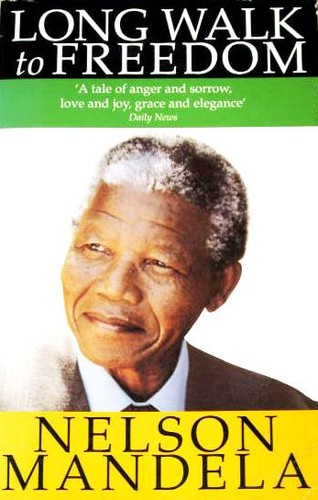
Long Walk to Freedom by Nelson Mandela is a 1994 memoir book about leadership, resistance, identity. Freedom is indivisible: Mandela argues that neither oppressor nor oppressed is free under a system of domination — that apartheid degraded its enforcers as well as its victims.
Summary
Nelson Mandela's autobiography traces his life from a rural Xhosa childhood in the Transkei to his release from prison in 1990 after twenty-seven years of incarceration, and ends with his election as South Africa's first democratically chosen president in 1994. It is one of the most significant political memoirs of the twentieth century, and also a searching account of a man who remade himself repeatedly across eight decades.
The early chapters establish Mandela's formation: his schooling in the Methodist mission tradition, his move to Johannesburg, his legal training, and his radicalization through the African National Congress. He describes the gradual closing off of any legal path to equality under apartheid, the government's systematic criminalization of Black political life, and his own evolution from a proponent of nonviolent protest to an advocate — eventually, the leader — of the ANC's armed wing, Umkhonto we Sizwe. The decision to embrace sabotage was not taken lightly, and Mandela writes about it with the caution of someone who knows the precedent it set.
The prison years occupy a substantial portion of the book. Robben Island, where Mandela spent eighteen of his twenty-seven years, is portrayed not just as deprivation but as a crucible. The prisoners organized, educated each other, and maintained a collective dignity that Mandela argues was itself a form of resistance. He writes about the warders with surprising generosity, noting that oppression had harmed the oppressors too, and that the relationship between prisoner and guard was not simple.
The final section covers the negotiations that ended apartheid and Mandela's emergence into a changed South Africa. He is candid about the cost to his family — his first marriage collapsed under the pressures of underground work and imprisonment, and his relationship with Winnie Mandela deteriorated in ways he struggles to fully explain. The book is honest about failure and contradiction alongside the public achievements, which is part of what distinguishes it from political hagiography.
Talk to Long Walk to Freedom like its author wrote you back.
Get the ideas that fit your life — not generic summaries.
- Chat with the book
- Audiobook-style main ideas
- Adapts to your life and goals
- Helps you take action
Key takeaways
- 1.
Freedom is indivisible: Mandela argues that neither oppressor nor oppressed is free under a system of domination — that apartheid degraded its enforcers as well as its victims.
- 2.
The decision to embrace armed resistance came after exhausting legal and nonviolent options. Mandela frames it not as inevitable but as a specific, painful choice made at a specific historical moment.
- 3.
Prison can be transformed into a site of resistance if the imprisoned maintain solidarity, dignity, and a commitment to educating themselves and others.
- 4.
Reconciliation requires acknowledging the humanity of one's opponents. Mandela's willingness to negotiate with the apartheid government was grounded in this conviction, not in forgiveness of the regime.
- 5.
Political leadership demands constant self-revision. The Mandela who walked out of prison in 1990 had developed positions on negotiation, compromise, and governance that the younger Mandela would not have recognized.
- 6.
The personal costs of political commitment are real and often irreversible. Mandela's family relationships were damaged by his choices in ways that the autobiography admits but cannot fully resolve.
- 7.
Charisma and strategy are not opposites. Mandela's effectiveness came from combining a commanding public presence with unusually patient, analytical political thinking.
- 8.
The long arc of a liberation struggle requires sustaining hope without self-deception — knowing that setbacks are inevitable while refusing to treat them as permanent.
Discussion questions
Use these on your own, with a book club, or as chat starters in Superbook. Book club version, ready to copy or print →
- 1.
Mandela describes the decision to take up armed resistance as agonizing. What conditions do you think justify crossing from nonviolent to violent political action?
- 2.
He argues that apartheid degraded its enforcers. Is there evidence in the book that this was true in practice, and does it change how you think about systemic oppression?
- 3.
How did the prison years change Mandela? What did he gain from confinement that he might not have gained otherwise?
- 4.
Mandela's public image is often simplified into sainthood. What in the autobiography complicates or challenges that image?
- 5.
He is strikingly candid about the failure of his marriage to Winnie. How does that section change the texture of the narrative around it?
- 6.
The negotiations that ended apartheid involved compromises that some ANC members considered betrayals. How does Mandela justify those compromises, and do you find the justification convincing?
- 7.
What does Mandela's formation — the Xhosa chieftain tradition, the mission school, the legal training — tell you about the kind of leader he became?
- 8.
Mandela spent twenty-seven years in prison and emerged without apparent bitterness. Is that psychologically plausible, and what does the book suggest made it possible?
- 9.
How does the autobiography handle the subject of violence? Does Mandela seem comfortable with the chapters on Umkhonto we Sizwe, or does his discomfort show through?
- 10.
The book ends with the 1994 election. What do you know about what happened afterward, and does that knowledge change how you read the final pages?
- 11.
Which relationship in the book — with Walter Sisulu, Oliver Tambo, or others — seems most formative to Mandela's political development?
- 12.
Mandela says he is not a saint unless a saint is a sinner who keeps trying. What do you make of that self-description?
Themes
Frequently asked questions
-
Is Long Walk to Freedom worth reading today?
Yes. It remains one of the most serious and self-aware political autobiographies ever written. The prison years and the negotiation sections in particular contain insights into leadership, strategy, and moral complexity that hold up independently of the historical context.
-
How long does it take to read Long Walk to Freedom?
The book is over 600 pages and will take most readers ten to fifteen hours. It rewards slow reading — the early chapters on Xhosa tradition and the ANC's formation are denser than the prison memoir sections, which read more fluidly.
-
Is the autobiography ghostwritten?
Mandela wrote substantial portions himself during imprisonment, smuggling drafts out of Robben Island. The journalist Richard Stengel helped organize and complete the manuscript after Mandela's release. It is more collaborative than most political memoirs, but the voice is recognizably Mandela's throughout.
-
What does the title mean?
Mandela uses 'the long walk to freedom' as a metaphor for the sustained, multigenerational effort required to dismantle apartheid. He also applies it to his personal journey, suggesting that the walk toward genuine freedom — internal as well as political — never fully ends.
-
How does Long Walk to Freedom compare to other liberation memoirs?
It is more analytical and less emotionally raw than most. Mandela is a precise thinker who tends to explain his decisions rather than dramatize them. Readers looking for intimate psychological disclosure should temper their expectations; readers interested in political strategy will find it unusually frank.