Business · Book club
Loonshots book club questions
Here are 12 book club questions for Loonshots by Safi Bahcall, ordered to open easily and end somewhere worth arguing about. Copy them, print them, or bring them up one at a time.
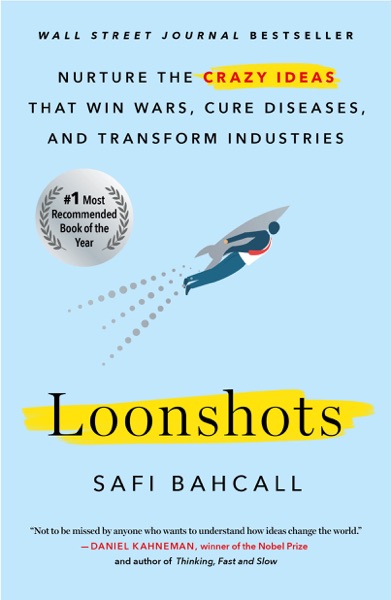
Loonshots is physicist and biotech CEO Safi Bahcall's argument that the most transformative innovations — the kind he calls loonshots, after the eccentric northern bird — are fragile ideas that look foolish or impossible until they suddenly aren't, and that organizations systematically kill them long before they get a chance to prove themselves.
Safi Bahcall · 2019 · 5h 30m
Full summary and key takeaways →The 12 questions
- 1.
Bahcall argues that the death of innovation is structural, not cultural. Does that match your experience of organizations you've worked in?
- 2.
His phase-transition analogy draws directly from physics. Does the scientific framing make the argument more convincing or does it give a false air of precision to organizational claims?
- 3.
The Bush-Vail transfer — the leader who bridges loonshot and franchise — is described as essential. Who in your organization plays that role, and what would happen if they left?
- 4.
Pan Am dominated aviation and still missed the jet age. What is the equivalent risk in a dominant organization you know well today?
- 5.
Bahcall says most loonshots look identical to bad ideas at the outset. How do you decide which fragile ideas deserve protection in your own work?
- 6.
Bell Labs sustained radical innovation for decades by separating basic research from product development. Could that model work in a startup or a mid-sized company?
- 7.
He argues that equity structure is more important than culture in determining innovation output. Do you agree? What evidence would change your mind?
- 8.
The book distinguishes between P-type loonshots (new products or technologies) and S-type loonshots (new strategies or business models). Which type is harder to protect, in your experience?
- 9.
Bahcall treats radical failure as valuable data. What failed loonshot in your field, in retrospect, carried information that was ignored?
- 10.
The 150-person phase transition threshold suggests that size itself is an innovation killer. Is staying small deliberately a viable strategy, or is growth always worth the tradeoff?
- 11.
The book is heavy with wartime examples — radar, sulfa drugs, the Manhattan Project. Does the military framing import assumptions that don't transfer well to commercial innovation?
- 12.
Bahcall ends with specific structural prescriptions. Which one would you most want to implement, and what organizational resistance would you expect?
How to run the discussion
- Pick six to eight, not all of them. An hour of real discussion covers fewer questions than anyone expects, and racing the list is what makes a book club feel like homework.
- Open with what people noticed, not what they concluded. Asking for a verdict first hardens opinions before anyone has heard each other.
- Let the disagreement run. The questions below that split a room are the ones worth the time; the ones everyone answers the same way can be skipped.
- Ask the quiet person a specific question. A direct, narrow question is far easier to answer than an open invitation to contribute.
Themes worth steering toward
If the conversation stalls, these are the threads that usually restart it.
Common questions
What are good book club questions for Loonshots?
Here are 12 book club questions for Loonshots by Safi Bahcall, ordered to open easily and end somewhere worth arguing about. The strongest openers ask what each reader noticed rather than what they concluded, and the discussion usually turns on innovation, organizational behavior, strategy.
How long should a book club discussion of Loonshots last?
Most groups run 60 to 90 minutes of actual discussion. That is roughly six to eight questions, not all of them, so pick the ones that suit your group rather than working down the list in order.
What are the main themes in Loonshots?
Innovation, Organizational behavior, Strategy, Science, Leadership. Those are the threads most likely to divide a room, which makes them the useful places to steer a discussion that has gone quiet.
Picking the next one? See books like Loonshots or questions for other book club picks.
