History · Book club
Lost in Shangri-La book club questions
Here are 11 book club questions for Lost in Shangri-La by Mitchell Zuckoff, ordered to open easily and end somewhere worth arguing about. Copy them, print them, or bring them up one at a time.
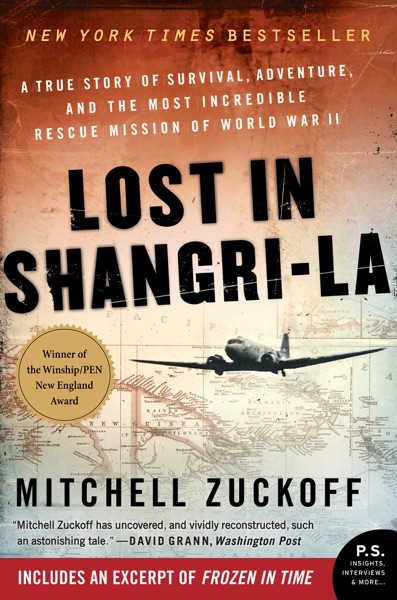
Lost in Shangri-La tells the story of a 1945 military plane crash in the Baliem Valley of New Guinea — a hidden highland region so remote and unknown to the outside world that the press called it Shangri-La.
Mitchell Zuckoff · 2011 · 6h 0m
Full summary and key takeaways →The 11 questions
- 1.
How does Zuckoff handle the Dani perspective in a book where the primary documentation comes from American sources?
- 2.
What does Margaret Hastings's experience reveal about gender and military service in World War II, and how does her account complicate simple narratives about women in the war?
- 3.
The rescue required improvising techniques that had never been tried in the field. What enabled that improvisation, and what conditions usually prevent organizations from operating that way?
- 4.
The press called the Baliem Valley 'Shangri-La.' What does that framing reveal about American assumptions in 1945, and what would be different about how media would cover a similar story today?
- 5.
The Dani had a fully developed society, governance, and culture. How did their encounter with the crash survivors and subsequent rescue operation affect them?
- 6.
Survivor accounts from extreme situations often reshape the identities of those who lived through them. What evidence of that do you see in the way the three survivors described their time in the valley?
- 7.
Zuckoff relies heavily on written records, which mostly reflect American perspectives. What questions about the crash and rescue do you feel the book couldn't answer?
- 8.
The institutional decision to allow a recreational sightseeing flight over an active war zone resulted in twenty-one deaths. How do you think about organizational responsibility in that kind of case?
- 9.
The glider extraction technique used to rescue the survivors was improvised under pressure. What does the story suggest about how new operational methods should be developed and tested?
- 10.
The Dani community's subsequent history involved disease, forced contact, and Indonesian colonial rule. Does knowing that history change how you read the book's ending?
- 11.
Zuckoff writes nonfiction with thriller pacing. What are the gains and risks of that approach for historical narrative?
How to run the discussion
- Pick six to eight, not all of them. An hour of real discussion covers fewer questions than anyone expects, and racing the list is what makes a book club feel like homework.
- Open with what people noticed, not what they concluded. Asking for a verdict first hardens opinions before anyone has heard each other.
- Let the disagreement run. The questions below that split a room are the ones worth the time; the ones everyone answers the same way can be skipped.
- Ask the quiet person a specific question. A direct, narrow question is far easier to answer than an open invitation to contribute.
Themes worth steering toward
If the conversation stalls, these are the threads that usually restart it.
Common questions
What are good book club questions for Lost in Shangri-La?
Here are 11 book club questions for Lost in Shangri-La by Mitchell Zuckoff, ordered to open easily and end somewhere worth arguing about. The strongest openers ask what each reader noticed rather than what they concluded, and the discussion usually turns on survival, world war ii, adventure.
How long should a book club discussion of Lost in Shangri-La last?
Most groups run 60 to 90 minutes of actual discussion. That is roughly six to eight questions, not all of them, so pick the ones that suit your group rather than working down the list in order.
What are the main themes in Lost in Shangri-La?
Survival, World War II, Adventure, Rescue, Indigenous culture. Those are the threads most likely to divide a room, which makes them the useful places to steer a discussion that has gone quiet.
Picking the next one? See books like Lost in Shangri-La or questions for other book club picks.
