Economics · Book club
Margin of Safety book club questions
Here are 12 book club questions for Margin of Safety by Seth Klarman, ordered to open easily and end somewhere worth arguing about. Copy them, print them, or bring them up one at a time.
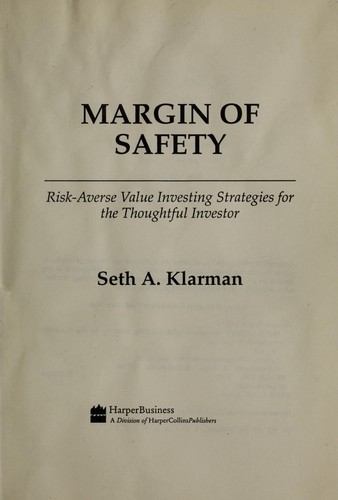
Margin of Safety is Seth Klarman's 1991 treatise on value investing, subtitled "Risk-Averse Value Investing Strategies for the Thoughtful Investor." The book has never been reprinted and used copies sell for hundreds to thousands of dollars, giving it a near-mythical status among serious investors.
Seth Klarman · 1991 · 6h 0m
Full summary and key takeaways →The 12 questions
- 1.
Klarman argues that most professional investors prioritize career safety over genuine performance. Does that critique ring true from what you've observed, and what would need to change for institutions to behave differently?
- 2.
The margin of safety concept requires estimating intrinsic value before knowing what price is safe. How do you handle the uncertainty in that estimate?
- 3.
Klarman equates risk with permanent capital loss, not volatility. How does that definition change how you evaluate a portfolio or a specific investment?
- 4.
The book was written in 1991. What parts of its analysis of institutional behavior, market inefficiency, or special situations feel most relevant today?
- 5.
Klarman insists on waiting for genuinely attractive prices and is willing to hold large cash positions. How does that approach square with the opportunity cost of cash in a rising market?
- 6.
Which is harder for you: identifying a cheap asset, or holding it through the period of underperformance before the market recognizes its value?
- 7.
Klarman's portfolio is concentrated. He argues that the diversification most investors practice reflects uncertainty about analysis, not genuine risk management. Do you agree?
- 8.
The book covers liquidations and distressed situations that most retail investors cannot access. What principles from those situations transfer to more accessible investments?
- 9.
Baupost Group has remained closed to most investors and keeps its holdings private. Does Klarman's own institutional behavior match his written philosophy?
- 10.
Klarman criticizes growth investors for paying for future earnings that may never materialize. How do you think about the tradeoff between quality, growth, and price?
- 11.
The book's rarity has made it a status symbol among investors. Does the difficulty of access to the book affect how you evaluate its ideas?
- 12.
If you took Klarman's risk-first framework seriously, what would you sell from your current portfolio and why?
How to run the discussion
- Pick six to eight, not all of them. An hour of real discussion covers fewer questions than anyone expects, and racing the list is what makes a book club feel like homework.
- Open with what people noticed, not what they concluded. Asking for a verdict first hardens opinions before anyone has heard each other.
- Let the disagreement run. The questions below that split a room are the ones worth the time; the ones everyone answers the same way can be skipped.
- Ask the quiet person a specific question. A direct, narrow question is far easier to answer than an open invitation to contribute.
Themes worth steering toward
If the conversation stalls, these are the threads that usually restart it.
Common questions
What are good book club questions for Margin of Safety?
Here are 12 book club questions for Margin of Safety by Seth Klarman, ordered to open easily and end somewhere worth arguing about. The strongest openers ask what each reader noticed rather than what they concluded, and the discussion usually turns on value investing, risk management, investment philosophy.
How long should a book club discussion of Margin of Safety last?
Most groups run 60 to 90 minutes of actual discussion. That is roughly six to eight questions, not all of them, so pick the ones that suit your group rather than working down the list in order.
What are the main themes in Margin of Safety?
Value investing, Risk management, Investment philosophy, Investor psychology, Capital preservation. Those are the threads most likely to divide a room, which makes them the useful places to steer a discussion that has gone quiet.
Picking the next one? See books like Margin of Safety or questions for other book club picks.
