Business · Book club
Measure What Matters book club questions
Here are 12 book club questions for Measure What Matters by John Doerr, ordered to open easily and end somewhere worth arguing about. Copy them, print them, or bring them up one at a time.
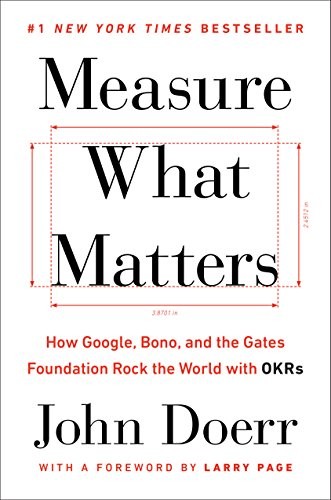
Measure What Matters is John Doerr's account of Objectives and Key Results — the goal-setting framework he learned from Andy Grove at Intel, carried to Google in 1999, and has since deployed across hundreds of companies and nonprofits.
John Doerr · 2017 · 4h 20m
Full summary and key takeaways →The 12 questions
- 1.
Doerr says the hardest part of OKRs is deciding what not to measure. What are three things your team or organization tracks that probably don't matter as much as you think?
- 2.
Think about the last goal you set for yourself or your team. Was it a committed OKR or an aspirational one? Did you treat it as the right kind?
- 3.
Grove's rule is no more than five objectives at once. How many real priorities does your organization actually have right now, and how do you know?
- 4.
Doerr argues that transparency — everyone seeing everyone else's OKRs — is essential. What would change in your workplace if all goals were visible across departments?
- 5.
The book warns against tying OKRs directly to compensation. Has your experience with performance reviews shaped how you set goals? In what way?
- 6.
What's the most ambitious goal you've set where 70% completion would still feel like success? What made it possible to frame it that way?
- 7.
Doerr credits Andy Grove as his model for how to lead with OKRs. Who in your own career has influenced how you think about what matters?
- 8.
The case studies include for-profits, nonprofits, and government. Does the OKR framework feel equally applicable across those contexts, or does something change?
- 9.
Where in your work right now is the team aligned on outputs but not on outcomes? What would it take to close that gap?
- 10.
Doerr says OKRs won't fix a broken strategy. What does a team need to get right before OKRs become useful?
- 11.
The book describes teams that sandbagged their OKRs to guarantee hitting them. What incentive structures produce that behavior, and how would you change them?
- 12.
If you had to write one personal OKR for the next quarter — a single objective and three key results — what would it be?
How to run the discussion
- Pick six to eight, not all of them. An hour of real discussion covers fewer questions than anyone expects, and racing the list is what makes a book club feel like homework.
- Open with what people noticed, not what they concluded. Asking for a verdict first hardens opinions before anyone has heard each other.
- Let the disagreement run. The questions below that split a room are the ones worth the time; the ones everyone answers the same way can be skipped.
- Ask the quiet person a specific question. A direct, narrow question is far easier to answer than an open invitation to contribute.
Themes worth steering toward
If the conversation stalls, these are the threads that usually restart it.
Common questions
What are good book club questions for Measure What Matters?
Here are 12 book club questions for Measure What Matters by John Doerr, ordered to open easily and end somewhere worth arguing about. The strongest openers ask what each reader noticed rather than what they concluded, and the discussion usually turns on goal-setting, organizational performance, leadership.
How long should a book club discussion of Measure What Matters last?
Most groups run 60 to 90 minutes of actual discussion. That is roughly six to eight questions, not all of them, so pick the ones that suit your group rather than working down the list in order.
What are the main themes in Measure What Matters?
Goal-setting, Organizational performance, Leadership, Accountability, Strategy execution. Those are the threads most likely to divide a room, which makes them the useful places to steer a discussion that has gone quiet.
Picking the next one? See books like Measure What Matters or questions for other book club picks.
