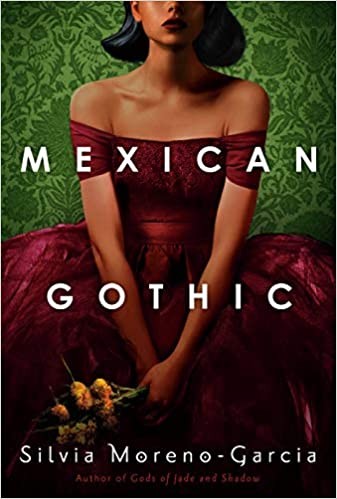
Talk to Mexican Gothic like its author wrote you back.
Get the ideas that fit your life — not generic summaries.
- Chat with the book
- Audiobook-style main ideas
- Adapts to your life and goals
- Helps you take action
Mexican Gothic, in detail
Mexican Gothic is set in 1950s Mexico, where Noemí Taboada — fashionable, sharp, and underestimated — travels to a remote manor in the Mexican countryside after receiving a disturbing letter from her newly-married cousin Catalina. The letter describes visions, threats, and a creeping dread. What Noemí finds at High Place is the Doyle family: English mining colonizers who have settled in Hidalgo, grown wealthy on silver extraction, and built themselves a rotting mansion full of secrets. Something in the house — something biological and ancient — is feeding on the women inside it.
Moreno-Garcia is interested in what gothic horror looks like when you filter it through Mexican history and the indigenous-colonialist relationship. The Doyles aren't just creepy aristocrats; they're eugenicists who have been conducting experiments in racial "improvement" using the indigenous population as raw material. The horror of the house is not supernatural in an arbitrary sense — it grows directly from the colonial project. The rot and the mold and the violence are what extraction and domination produce. This is what makes the book more than a competent haunted-house novel.
Stylistically, Moreno-Garcia draws on the classic Gothic tradition — Rebecca, The Turn of the Screw, the whole canon of threatening houses and menaced women — but Noemí is not passive. She investigates, argues, refuses, and fights back in ways that feel like a deliberate revision of the genre's usual treatment of its heroines. The prose is precise and controlled, and the house's biology — I'll say no more without spoilers — is genuinely original.
Horror readers and fans of gothic fiction will find this satisfying. Readers who want a fast thriller may feel the first half is slow. Those looking for something that is purely escapist should know that the book's colonial politics are inseparable from its horror logic — this is not a story about random evil, but about a specific, historically grounded one.
The big ideas
- 1.
The novel's horror is rooted in colonialism and eugenics rather than random supernatural menace — the Doyle family's evil is the evil of extraction and racial domination made literal.
- 2.
Noemí Taboada is a deliberate rewrite of the passive Gothic heroine. Her refusal to be diminished is a structural choice, not just a character trait.
- 3.
The house itself is the novel's most original creation — its biology and the way it connects the people inside it is genuinely unsettling and not easy to shake.
