Classics · Book club
Middlemarch book club questions
Here are 13 book club questions for Middlemarch by George Eliot, ordered to open easily and end somewhere worth arguing about. Copy them, print them, or bring them up one at a time.
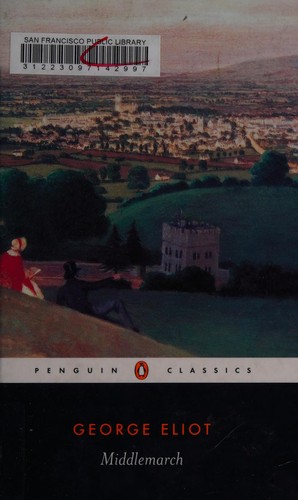
Middlemarch is the novel Virginia Woolf called the only English novel written for grown-up people, and the description is accurate if not entirely fair.
George Eliot · 1871 · 21h 0m
Full summary and key takeaways →The 13 questions
- 1.
Eliot's Prelude compares Dorothea to Saint Theresa and implies she has no adequate arena for her ambitions. Do you think the novel resolves that problem for Dorothea, or does it leave her diminished?
- 2.
Casaubon's point of view is given at length and with compassion in some chapters. Does access to his perspective change how you judge him, or does it confirm the judgment?
- 3.
Lydgate is presented as a serious scientist with genuine gifts. How does his marriage to Rosamond destroy him, and how much does his own character make that destruction inevitable?
- 4.
Rosamond is the novel's most disliked character among many readers. Is she the villain of Lydgate's story, a victim of her own upbringing, or something the novel refuses to simplify?
- 5.
Will Ladislaw is often called the novel's weakest element. Do you find him a credible love interest for Dorothea, or does he feel underdeveloped compared to the rest of the cast?
- 6.
The novel argues that goodness consists largely in private, unrecorded acts that make things slightly better for the people around you. Is that inspiring, or is there something sad about it?
- 7.
Bulstrode's past catches up with him. Is his punishment proportionate? Does the novel treat religious hypocrisy differently from other forms of hypocrisy?
- 8.
Fred Vincy's arc is the most conventional in the novel — he learns responsibility and earns the woman who refused him. Does it feel thin compared to the other plots, or does its ordinariness make a point?
- 9.
The town of Middlemarch itself — its gossip, hierarchies, politics — functions almost as a character. How does the community shape individual outcomes? Is Eliot critical of it?
- 10.
Dorothea's second marriage, which many readers find frustrating or worse, is framed by the novel as her choice. How do you read it?
- 11.
The final paragraph says Dorothea's influence on those around her was real but 'unhistoric.' Is that meant as consolation or as Eliot's honest assessment of what women's lives in that period amounted to?
- 12.
Middlemarch is often called the greatest English novel. Having read it, do you agree? What would you put against it?
- 13.
The novel was serialized in eight parts over 1871-72. Does it feel like a serialized novel to you — are there moments that feel like mini-climaxes designed to hold readers from one installment to the next?
How to run the discussion
- Pick six to eight, not all of them. An hour of real discussion covers fewer questions than anyone expects, and racing the list is what makes a book club feel like homework.
- Open with what people noticed, not what they concluded. Asking for a verdict first hardens opinions before anyone has heard each other.
- Let the disagreement run. The questions below that split a room are the ones worth the time; the ones everyone answers the same way can be skipped.
- Ask the quiet person a specific question. A direct, narrow question is far easier to answer than an open invitation to contribute.
Themes worth steering toward
If the conversation stalls, these are the threads that usually restart it.
Common questions
What are good book club questions for Middlemarch?
Here are 13 book club questions for Middlemarch by George Eliot, ordered to open easily and end somewhere worth arguing about. The strongest openers ask what each reader noticed rather than what they concluded, and the discussion usually turns on idealism and compromise, marriage and self-determination, provincial society and ambition.
How long should a book club discussion of Middlemarch last?
Most groups run 60 to 90 minutes of actual discussion. That is roughly six to eight questions, not all of them, so pick the ones that suit your group rather than working down the list in order.
What are the main themes in Middlemarch?
Idealism and compromise, Marriage and self-determination, Provincial society and ambition, Moral development, The limits of knowledge. Those are the threads most likely to divide a room, which makes them the useful places to steer a discussion that has gone quiet.
Picking the next one? See books like Middlemarch or questions for other book club picks.
