Thriller · Book club
Misery book club questions
Here are 12 book club questions for Misery by Stephen King, ordered to open easily and end somewhere worth arguing about. Copy them, print them, or bring them up one at a time.
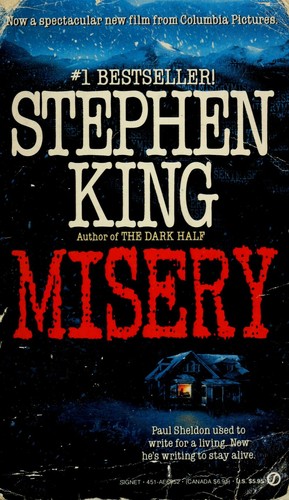
Paul Sheldon, a bestselling novelist, crashes his car in a Colorado blizzard.
Stephen King · 1987 · 7h 15m
Full summary and key takeaways →The 12 questions
- 1.
Annie argues, in her own way, that Paul betrayed Misery Chastain and betrayed her readers by killing the character off. Is she entirely wrong? What does a popular fiction writer owe the audience that made them successful?
- 2.
King has been explicit that Paul's captivity is partly an allegory for cocaine addiction. Does reading it as such change how you interpret Paul's relationship to the work he produces while imprisoned?
- 3.
Annie's love for the Misery novels is presented as real and complete, not as a delusion. What is the novel saying about the relationship between genuine literary love and the capacity for violence?
- 4.
The excerpts from Misery's Return are good. King writes them as intentionally competent commercial Victorian romance. Did you find yourself caring about Misery Chastain? What did that caring feel like?
- 5.
Paul is a writer who has always been somewhat ashamed of his most beloved work. The novel forces him into a full reckoning with it. By the end, does he come to respect it? Does the novel ask you to?
- 6.
Compare Annie Wilkes to other antagonists you've encountered — in King or elsewhere. What specifically makes her frightening: her intelligence, her sincerity, her unpredictability, or something harder to name?
- 7.
The hobbling scene is a structural inflection point. Why do you think King placed it where he did — what does it change about the dynamic between Paul and Annie, and between the reader and the novel?
- 8.
The novel was written in 1987, but its portrait of fan obsession reads very differently now. What has changed, and what does Misery look like as a text about contemporary celebrity culture?
- 9.
Paul's ability to produce the manuscript under duress is itself a form of power — the one thing Annie can't do without him. How does the novel use that dependency as a structural element?
- 10.
Is there a version of Annie's demand that Paul would have received sympathetically in other circumstances — a letter, a petition, a Twitter campaign? What makes the demand valid and the method monstrous?
- 11.
The ending gives Paul survival and, eventually, success. Does the novel earn that ending, or does it let him off too easily given what he was forced to confront about himself?
- 12.
King has said he doesn't remember writing parts of this novel because of his addiction at the time. Does knowing that shape how you read the captivity metaphor?
How to run the discussion
- Pick six to eight, not all of them. An hour of real discussion covers fewer questions than anyone expects, and racing the list is what makes a book club feel like homework.
- Open with what people noticed, not what they concluded. Asking for a verdict first hardens opinions before anyone has heard each other.
- Let the disagreement run. The questions below that split a room are the ones worth the time; the ones everyone answers the same way can be skipped.
- Ask the quiet person a specific question. A direct, narrow question is far easier to answer than an open invitation to contribute.
Themes worth steering toward
If the conversation stalls, these are the threads that usually restart it.
Common questions
What are good book club questions for Misery?
Here are 12 book club questions for Misery by Stephen King, ordered to open easily and end somewhere worth arguing about. The strongest openers ask what each reader noticed rather than what they concluded, and the discussion usually turns on creation and captivity, fan obsession, addiction and recovery.
How long should a book club discussion of Misery last?
Most groups run 60 to 90 minutes of actual discussion. That is roughly six to eight questions, not all of them, so pick the ones that suit your group rather than working down the list in order.
What are the main themes in Misery?
Creation and captivity, Fan obsession, Addiction and recovery, The writer's relationship to audience, Survival. Those are the threads most likely to divide a room, which makes them the useful places to steer a discussion that has gone quiet.
Picking the next one? See books like Misery or questions for other book club picks.
