Psychology · Book club
Mistakes Were Made (But Not by Me) book club questions
Here are 11 book club questions for Mistakes Were Made (But Not by Me) by Carol Tavris and Elliot Aronson, ordered to open easily and end somewhere worth arguing about. Copy them, print them, or bring them up one at a time.
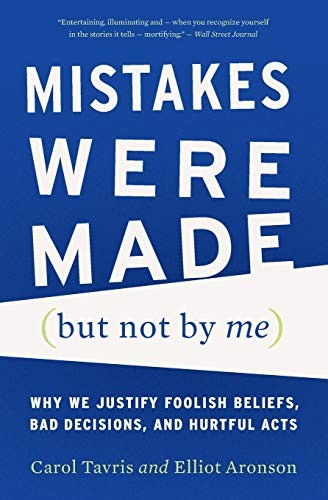
Carol Tavris and Elliot Aronson wrote this book about the mechanisms by which people protect their sense of themselves as competent, moral, and well-intentioned after they have done something that contradicts that self-image.
Carol Tavris and Elliot Aronson · 2007 · 5h 0m
Full summary and key takeaways →The 11 questions
- 1.
Think of a time you justified a mistake rather than acknowledging it. Can you trace the cognitive dissonance that drove the justification?
- 2.
The book argues that memory is reconstructed to fit current beliefs. Has there been a case in your life where your memory of an event shifted as your interpretation of it changed?
- 3.
Tavris and Aronson describe the pyramid of choice: small initial decisions that make later ones harder to reverse. Where in your life have you noticed that escalating commitment?
- 4.
They argue that confirmation bias means we rarely update beliefs on the basis of evidence. What is a belief you currently hold that you have genuinely updated in response to new evidence?
- 5.
The chapters on false memory and false confession suggest that sincere belief is not a reliable guide to truth. What are the implications for how we treat testimony and personal accounts?
- 6.
They discuss therapists and prosecutors who cannot acknowledge being wrong without dismantling their professional identity. How does professional identity make self-justification worse?
- 7.
What would it take to build an institutional culture where acknowledging error was less costly? Can you think of an organization that has done this successfully?
- 8.
The book argues couples are often trapped in mutual self-justification cycles. What would genuine accountability in a close relationship look like, and how is it different from blame?
- 9.
Is there a public figure whose self-justification you find particularly visible or particularly instructive?
- 10.
Tavris and Aronson suggest we can inoculate ourselves against self-justification by cultivating a psychology of error as information. What would that cultivation look like in practice?
- 11.
Which of the case studies in the book — politicians, therapists, prosecutors, couples — did you find most surprising, and why?
How to run the discussion
- Pick six to eight, not all of them. An hour of real discussion covers fewer questions than anyone expects, and racing the list is what makes a book club feel like homework.
- Open with what people noticed, not what they concluded. Asking for a verdict first hardens opinions before anyone has heard each other.
- Let the disagreement run. The questions below that split a room are the ones worth the time; the ones everyone answers the same way can be skipped.
- Ask the quiet person a specific question. A direct, narrow question is far easier to answer than an open invitation to contribute.
Themes worth steering toward
If the conversation stalls, these are the threads that usually restart it.
Common questions
What are good book club questions for Mistakes Were Made (But Not by Me)?
Here are 11 book club questions for Mistakes Were Made (But Not by Me) by Carol Tavris and Elliot Aronson, ordered to open easily and end somewhere worth arguing about. The strongest openers ask what each reader noticed rather than what they concluded, and the discussion usually turns on self-justification, cognitive dissonance, memory.
How long should a book club discussion of Mistakes Were Made (But Not by Me) last?
Most groups run 60 to 90 minutes of actual discussion. That is roughly six to eight questions, not all of them, so pick the ones that suit your group rather than working down the list in order.
What are the main themes in Mistakes Were Made (But Not by Me)?
Self-justification, Cognitive dissonance, Memory, Confirmation bias, Accountability. Those are the threads most likely to divide a room, which makes them the useful places to steer a discussion that has gone quiet.
Picking the next one? See books like Mistakes Were Made (But Not by Me) or questions for other book club picks.
