Economics · Book club
More Money Than God book club questions
Here are 11 book club questions for More Money Than God by Sebastian Mallaby, ordered to open easily and end somewhere worth arguing about. Copy them, print them, or bring them up one at a time.
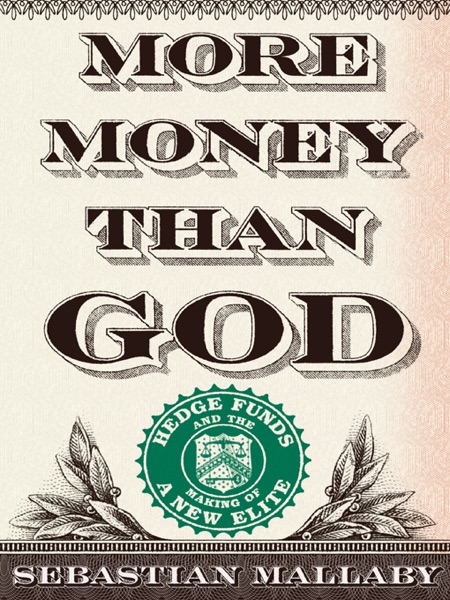
Sebastian Mallaby's history of hedge funds begins with Alfred Winslow Jones, who in 1949 invented the basic structure that still defines the industry: borrow money to buy what you think will go up, sell short what you think will go down, take a 20 percent cut of the profits.
Sebastian Mallaby · 2010 · 8h 0m
Full summary and key takeaways →The 11 questions
- 1.
Mallaby argues hedge funds generally stabilize markets rather than destabilize them. Does that claim match your prior assumptions about the industry? What evidence would change your view?
- 2.
George Soros made a billion dollars in a single day by betting against the British pound. Is that kind of trade socially productive, destructive, or simply neutral?
- 3.
The LTCM story features two Nobel laureates whose model was mathematically sophisticated and empirically well-supported, and who still blew up catastrophically. What does that suggest about the limits of formal models in finance?
- 4.
The performance fee structure (20 percent of profits) is defended as aligning manager and investor interests. What are the ways it misaligns them, and what would a better structure look like?
- 5.
Reflexivity — the idea that beliefs about markets affect the fundamentals those markets reflect — is Soros's central contribution. Can you think of a recent example where this feedback loop was visible?
- 6.
Mallaby profiles a series of men (almost exclusively men) with extreme, obsessive personalities. Is that personality type a cause of their success, a byproduct of it, or a coincidence?
- 7.
Tiger Management and Soros's Quantum Fund both collapsed or contracted sharply after long periods of dominance. What does their decline suggest about the sustainability of any investment edge?
- 8.
Hedge funds are largely inaccessible to retail investors because of regulatory minimums. Is that restriction a reasonable consumer protection or an unjustified barrier that keeps the best returns for the wealthy?
- 9.
Jim Simons's Renaissance Technologies uses quantitative models that its operators themselves don't fully understand. Does it matter whether a profitable strategy has a human-comprehensible explanation?
- 10.
The book was published in 2010. Which of Mallaby's conclusions do you think have aged well, and which have been complicated by developments since then?
- 11.
What would you take from the best practitioners Mallaby profiles and apply to investment decisions you make, even at a much smaller scale?
How to run the discussion
- Pick six to eight, not all of them. An hour of real discussion covers fewer questions than anyone expects, and racing the list is what makes a book club feel like homework.
- Open with what people noticed, not what they concluded. Asking for a verdict first hardens opinions before anyone has heard each other.
- Let the disagreement run. The questions below that split a room are the ones worth the time; the ones everyone answers the same way can be skipped.
- Ask the quiet person a specific question. A direct, narrow question is far easier to answer than an open invitation to contribute.
Themes worth steering toward
If the conversation stalls, these are the threads that usually restart it.
Common questions
What are good book club questions for More Money Than God?
Here are 11 book club questions for More Money Than God by Sebastian Mallaby, ordered to open easily and end somewhere worth arguing about. The strongest openers ask what each reader noticed rather than what they concluded, and the discussion usually turns on hedge funds, financial history, risk.
How long should a book club discussion of More Money Than God last?
Most groups run 60 to 90 minutes of actual discussion. That is roughly six to eight questions, not all of them, so pick the ones that suit your group rather than working down the list in order.
What are the main themes in More Money Than God?
Hedge funds, Financial history, Risk, Markets, Investing. Those are the threads most likely to divide a room, which makes them the useful places to steer a discussion that has gone quiet.
Picking the next one? See books like More Money Than God or questions for other book club picks.
