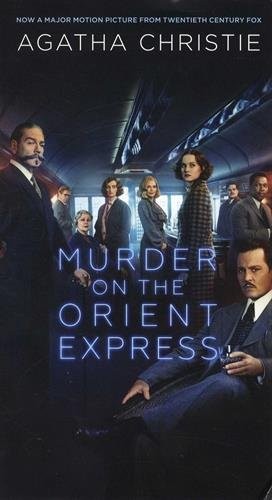
Talk to Murder on the Orient Express like its author wrote you back.
Get the ideas that fit your life — not generic summaries.
- Chat with the book
- Audiobook-style main ideas
- Adapts to your life and goals
- Helps you take action
What it argues
A man is found stabbed in his sleeping compartment on the snowbound Orient Express somewhere in Yugoslavia. Hercule Poirot, the famous Belgian detective, happens to be aboard. All twelve other passengers are suspects; none appears to have a motive; each has an alibi. Murder on the Orient Express is Christie's most celebrated novel, and its solution — one of the most famous in crime fiction — reframes everything that came before it in a single revelation.
The book is primarily a puzzle, and a very good one. Christie is working here in the classical fair-play tradition: every clue is present, every suspect is given appropriate screen time, and the solution requires only careful attention to what Poirot observes. The locked-space logic — a train stuck in snow, passengers who cannot leave — creates the same contained paranoia she would use even more efficiently in And Then There Were None five years later. The pleasure is less psychological than mechanical: watching an expert systematically dismantle false appearances and build a complete picture from fragments.
What it gets right
- 1.
The solution is not just a clever puzzle answer — it is a moral position about collective responsibility that Christie endorses carefully and without sentimentality.
- 2.
Poirot's two-solution presentation at the end is a structural choice that places the moral question squarely on the reader: which explanation do you prefer, and why?
- 3.
The Orient Express is not a glamorous backdrop — it is a closed space that Christie uses as efficiently as the island in And Then There Were None. Containment is her method.
What it covers
Who wrote it
Agatha Christie (1890-1976) is the best-selling fiction writer of all time after Shakespeare and the Bible, with estimated sales exceeding two billion copies. She is the creator of Hercule Poirot and Miss Marple and the author of 66 detective novels, 14 short story collections, and the longest-running play in history (The Mousetrap, still running in London). Murder on the Orient Express, published in 1934, remains one of her two or three most celebrated novels. Christie was made a Dame Commander of the Order of the British Empire in 1971.
