Philosophy · Book club
Natural Right and History book club questions
Here are 11 book club questions for Natural Right and History by Leo Strauss, ordered to open easily and end somewhere worth arguing about. Copy them, print them, or bring them up one at a time.
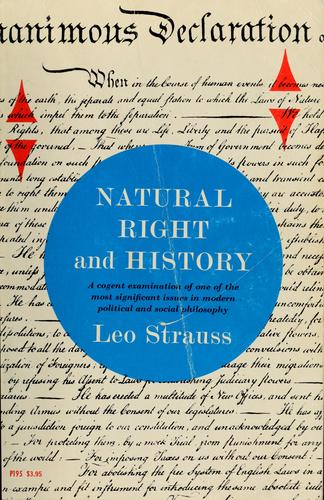
Natural Right and History is Leo Strauss's sustained argument that the modern rejection of natural right — the idea that there is a standard of justice discoverable by reason, independent of convention and history — represents a profound intellectual and political crisis.
Leo Strauss · 1953 · 6h 45m
Full summary and key takeaways →The 11 questions
- 1.
Strauss argues that historicism — the view that all thought is historically conditioned — is self-refuting. Is this a compelling argument, or can historicism be defended against it?
- 2.
Weber held that science cannot adjudicate between ultimate values. Do you agree, and if so, what follows for how we make political judgments?
- 3.
Strauss wrote Natural Right and History in the aftermath of World War II and the failure of Weimar democracy. How much does that historical context shape the argument, and how well does the argument travel to other contexts?
- 4.
Strauss's reading of Locke is controversial: he argues that Locke's natural right theory is a departure from classical natural right dressed up in theological language. What is at stake in this reading for how we understand liberal democracy?
- 5.
Is there a difference between saying 'there are no universal moral standards' and saying 'I cannot give you a rational proof that my moral standards are correct'? Does Strauss conflate these?
- 6.
Strauss argues that modern social science, by claiming to be value-neutral, actually undermines the rational defense of liberal democratic values. Is this still a live concern in your view?
- 7.
The distinction between ancient and modern natural right — between a politics oriented toward the common good and one oriented toward individual rights — is one of the book's major themes. Which framework do you find more defensible?
- 8.
How would you respond to someone who argues that Strauss's recovery of classical natural right is politically reactionary — that it was used by his students to justify neoconservative foreign policy?
- 9.
Is it possible to have a defensible basis for moral and political judgment without claiming access to natural right in Strauss's sense? What would that look like?
- 10.
Natural Right and History is a difficult text. Does the difficulty serve the argument — because the question is genuinely hard — or does it function to exclude non-specialist readers from a conversation about matters of broad importance?
- 11.
Strauss's influence extended to generations of political philosophers and policymakers, especially in the United States. What is the relationship between his academic argument and its political reception?
How to run the discussion
- Pick six to eight, not all of them. An hour of real discussion covers fewer questions than anyone expects, and racing the list is what makes a book club feel like homework.
- Open with what people noticed, not what they concluded. Asking for a verdict first hardens opinions before anyone has heard each other.
- Let the disagreement run. The questions below that split a room are the ones worth the time; the ones everyone answers the same way can be skipped.
- Ask the quiet person a specific question. A direct, narrow question is far easier to answer than an open invitation to contribute.
Themes worth steering toward
If the conversation stalls, these are the threads that usually restart it.
Common questions
What are good book club questions for Natural Right and History?
Here are 11 book club questions for Natural Right and History by Leo Strauss, ordered to open easily and end somewhere worth arguing about. The strongest openers ask what each reader noticed rather than what they concluded, and the discussion usually turns on natural right, political philosophy, historicism.
How long should a book club discussion of Natural Right and History last?
Most groups run 60 to 90 minutes of actual discussion. That is roughly six to eight questions, not all of them, so pick the ones that suit your group rather than working down the list in order.
What are the main themes in Natural Right and History?
Natural right, Political philosophy, Historicism, Justice, Classical thought. Those are the threads most likely to divide a room, which makes them the useful places to steer a discussion that has gone quiet.
Picking the next one? See books like Natural Right and History or questions for other book club picks.
