Psychology · Book club
Noise: A Flaw in Human Judgment book club questions
Here are 11 book club questions for Noise: A Flaw in Human Judgment by Daniel Kahneman, Olivier Sibony, and Cass R. Sunstein, ordered to open easily and end somewhere worth arguing about. Copy them, print them, or bring them up one at a time.
Bias gets most of the attention in discussions of judgment error.
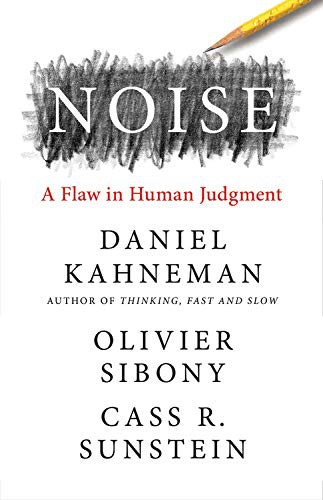
Daniel Kahneman, Olivier Sibony, and Cass R. Sunstein · 2021 · 6h 0m
Full summary and key takeaways →The 11 questions
- 1.
The book's central claim is that noise is as damaging as bias but gets far less attention. Why do you think bias has dominated the conversation?
- 2.
Occasion noise means your judgments vary based on what you ate for lunch, the weather, and other irrelevant factors. How do you feel about this finding? Does it change how you think about your own professional judgments?
- 3.
The three authors argue that algorithms, even imperfect ones, typically outperform human judges in predictive tasks. Where do you most want humans to maintain judgment authority, and why?
- 4.
The book recommends averaging multiple independent judgments as a noise-reduction strategy. What would this look like in your workplace for high-stakes decisions?
- 5.
They distinguish between objective noise (variability in judgments relative to ground truth) and error noise (variability relative to each other). What domains in your life have measurable ground truth that you are not measuring?
- 6.
Decision hygiene means building processes that reduce noise before measuring whether noise is actually reduced. What hygiene practices do you currently use in your most important decision contexts?
- 7.
The book argues that most professional training focuses on reducing bias but ignores noise. What would noise-reducing training look like?
- 8.
Kahneman wrote Thinking, Fast and Slow with a focus on cognitive biases. Does Noise feel like a revision of that framework or an extension of it?
- 9.
They discuss legal sentencing as a domain with enormous noise. What is your reaction to the prescription that sentencing guidelines and structured algorithms should replace or constrain judicial discretion?
- 10.
Where in your professional domain have you noticed noise that no one is measuring or addressing?
- 11.
The authors recommend postponing deliberation and collecting independent initial judgments before discussion. Have you seen this practice attempted? What happened?
How to run the discussion
- Pick six to eight, not all of them. An hour of real discussion covers fewer questions than anyone expects, and racing the list is what makes a book club feel like homework.
- Open with what people noticed, not what they concluded. Asking for a verdict first hardens opinions before anyone has heard each other.
- Let the disagreement run. The questions below that split a room are the ones worth the time; the ones everyone answers the same way can be skipped.
- Ask the quiet person a specific question. A direct, narrow question is far easier to answer than an open invitation to contribute.
Themes worth steering toward
If the conversation stalls, these are the threads that usually restart it.
Common questions
What are good book club questions for Noise: A Flaw in Human Judgment?
Here are 11 book club questions for Noise: A Flaw in Human Judgment by Daniel Kahneman, Olivier Sibony, and Cass R. Sunstein, ordered to open easily and end somewhere worth arguing about. The strongest openers ask what each reader noticed rather than what they concluded, and the discussion usually turns on decision-making, judgment, cognitive bias.
How long should a book club discussion of Noise: A Flaw in Human Judgment last?
Most groups run 60 to 90 minutes of actual discussion. That is roughly six to eight questions, not all of them, so pick the ones that suit your group rather than working down the list in order.
What are the main themes in Noise: A Flaw in Human Judgment?
Decision-making, Judgment, Cognitive bias, Consistency, Systems. Those are the threads most likely to divide a room, which makes them the useful places to steer a discussion that has gone quiet.
Picking the next one? See books like Noise: A Flaw in Human Judgment or questions for other book club picks.
