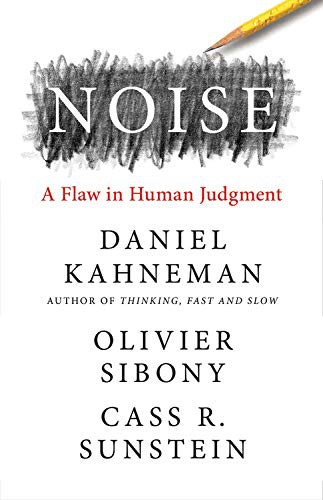
Noise: A Flaw in Human Judgment by Daniel Kahneman, Olivier Sibony, and Cass R. Sunstein is a 2021 psychology book about decision-making, judgment, cognitive bias. Noise — unwanted variability in judgments that should be identical — is a major and underappreciated source of error in professional judgment across all domains.
Summary
Bias gets most of the attention in discussions of judgment error. Kahneman, Sibony, and Sunstein's central claim in Noise is that a different and equally important source of error has been largely overlooked: noise, which is the variability in judgments that should be identical. Two doctors seeing the same X-ray give different diagnoses. Two judges given identical cases hand down sentences that differ by years. Two underwriters assessing identical insurance applications price them differently. Wherever professional judgment is involved, noise is present — and usually at levels that would be shocking if anyone measured them.
The book distinguishes several types of noise. Level noise is the variation between individuals in their average judgments — one judge is consistently harsher than another. Occasion noise is variation within the same individual across time — the same judge is harsher before lunch than after, harsher on cold days. Pattern noise is variation in how different people respond to the same specific case, independent of their average level. All three contribute to the total noise in a system.
Bias and noise are not the same problem and do not have the same solutions. Bias is a systematic directional error — a tendency to judge too high or too low. Noise is scatter around whatever center a person has. Bias causes errors in the same direction; noise causes errors in random directions. You can cancel noise by averaging over many judges, but averaging does not remove bias. The book argues that interventions designed to address bias — training, feedback, awareness — often do not reduce noise, and vice versa.
The prescriptions center on decision hygiene: structures and processes designed to reduce noise rather than eliminate it entirely. These include using algorithms and structured checklists, sequencing information to reduce anchoring, having judges make initial independent assessments before deliberation, and using scoring rubrics that break judgments into components. The book's most provocative claim is that mechanical rules and algorithms, even imperfect ones, will typically outperform unaided human judgment in most domains because they are noise-free — consistent in a way humans cannot be.
Talk to Noise: A Flaw in Human Judgment like its author wrote you back.
Get the ideas that fit your life — not generic summaries.
- Chat with the book
- Audiobook-style main ideas
- Adapts to your life and goals
- Helps you take action
Key takeaways
- 1.
Noise — unwanted variability in judgments that should be identical — is a major and underappreciated source of error in professional judgment across all domains.
- 2.
The three types of noise: level noise (consistent differences between judges), occasion noise (within-person variability over time and context), and pattern noise (idiosyncratic interaction of judge and case).
- 3.
Bias and noise are different problems. Bias is systematic directional error; noise is random scatter. Reducing one does not automatically reduce the other.
- 4.
Occasion noise means your judgment today is affected by irrelevant factors: the weather, recent lunch, what you just heard on the radio. Judges really are harsher before lunch.
- 5.
Algorithms outperform human judges in most predictive tasks not because they are smarter but because they are consistent. A noisy expert adds error that a mechanical rule does not.
- 6.
Decision hygiene practices — structured judgment, independent initial assessments, sequential information, explicit rubrics — reduce noise without requiring that individuals become less noisy themselves.
- 7.
Averaging reduces noise dramatically. The aggregate of multiple independent judgments is more accurate than any individual judgment, which is the statistical basis for prediction markets and multi-rater systems.
- 8.
Most organizations measure performance outcomes but not decision quality — they learn whether their judgments led to good results but not whether the judgment process was consistent or accurate.
Discussion questions
Use these on your own, with a book club, or as chat starters in Superbook. Book club version, ready to copy or print →
- 1.
The book's central claim is that noise is as damaging as bias but gets far less attention. Why do you think bias has dominated the conversation?
- 2.
Occasion noise means your judgments vary based on what you ate for lunch, the weather, and other irrelevant factors. How do you feel about this finding? Does it change how you think about your own professional judgments?
- 3.
The three authors argue that algorithms, even imperfect ones, typically outperform human judges in predictive tasks. Where do you most want humans to maintain judgment authority, and why?
- 4.
The book recommends averaging multiple independent judgments as a noise-reduction strategy. What would this look like in your workplace for high-stakes decisions?
- 5.
They distinguish between objective noise (variability in judgments relative to ground truth) and error noise (variability relative to each other). What domains in your life have measurable ground truth that you are not measuring?
- 6.
Decision hygiene means building processes that reduce noise before measuring whether noise is actually reduced. What hygiene practices do you currently use in your most important decision contexts?
- 7.
The book argues that most professional training focuses on reducing bias but ignores noise. What would noise-reducing training look like?
- 8.
Kahneman wrote Thinking, Fast and Slow with a focus on cognitive biases. Does Noise feel like a revision of that framework or an extension of it?
- 9.
They discuss legal sentencing as a domain with enormous noise. What is your reaction to the prescription that sentencing guidelines and structured algorithms should replace or constrain judicial discretion?
- 10.
Where in your professional domain have you noticed noise that no one is measuring or addressing?
- 11.
The authors recommend postponing deliberation and collecting independent initial judgments before discussion. Have you seen this practice attempted? What happened?
Themes
Frequently asked questions
-
What is the difference between noise and bias?
Bias is systematic directional error: a tendency to judge too high or too low in a consistent way. Noise is random variability: the same case judged differently at different times or by different people. Both reduce accuracy, but they require different interventions.
-
Is Noise a sequel to Thinking, Fast and Slow?
Not exactly, but it builds on the same research tradition. Thinking, Fast and Slow focused primarily on cognitive biases. Noise focuses on a distinct but related problem — variability in judgment — and argues that it has been neglected relative to bias.
-
What is decision hygiene?
A set of practices designed to reduce noise in judgment before it occurs. Includes having judges make independent initial assessments before deliberation, using structured scoring rubrics, sequencing information to reduce anchoring, and using averaging across multiple judges.
-
Do the authors recommend replacing human judgment with algorithms?
They recommend it in domains where algorithms have been shown to outperform, which is most predictive tasks. They are more cautious about domains involving novel situations, ethical judgment, and contexts where consistency itself has value independent of accuracy.
-
How readable is this book compared to Thinking, Fast and Slow?
Comparable accessibility, somewhat denser. The conceptual framework is introduced clearly, but there is more statistical content than in Thinking, Fast and Slow. Readers comfortable with the earlier book should find Noise manageable.
Similar books
Thinking, Fast and Slow
Daniel Kahneman
Misbehaving: The Making of Behavioral Economics
Richard H. Thaler
The Undoing Project
Michael Lewis
Thinking in Bets: Making Smarter Decisions When You Don't Have All the Facts
Annie Duke
