Psychology · Book club
Obedience to Authority book club questions
Here are 12 book club questions for Obedience to Authority by Stanley Milgram, ordered to open easily and end somewhere worth arguing about. Copy them, print them, or bring them up one at a time.
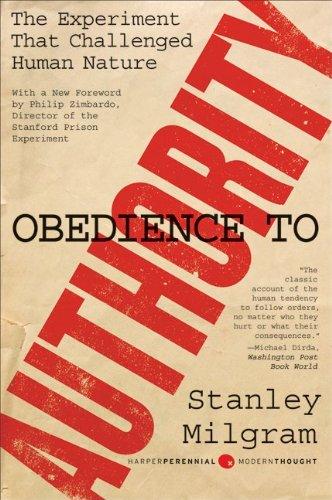
In the early 1960s, Stanley Milgram recruited ordinary people off the street and asked them to administer what they believed were increasingly severe electric shocks to another person on the orders of an experimenter in a lab coat.
Stanley Milgram · 1974 · 4h 40m
Full summary and key takeaways →The 12 questions
- 1.
Milgram's 65 percent figure is often cited to argue that most people will obey harmful orders. How do you respond to that claim when applied to yourself?
- 2.
What is the agentic state, and can you identify a situation in your own life where you entered it — where you acted on authority rather than your own judgment?
- 3.
The most effective way to break obedience was to see a peer defy the experimenter. What does that imply about how to design institutions or social situations to prevent harm?
- 4.
Milgram's research is widely cited but could not be run today under modern ethics rules. How do you weigh the value of what was learned against the cost to the participants?
- 5.
If physical proximity to a victim dramatically reduces obedience, what does that say about modern forms of harm that operate at a distance — drone strikes, financial instruments, supply chains?
- 6.
Many participants showed acute distress while still obeying. Does visible distress change your moral assessment of what they did?
- 7.
Milgram draws a parallel to the Holocaust. Does that parallel feel like an explanation or an excuse to you? What's the difference?
- 8.
The experimenter's authority came partly from the Yale setting and a lab coat, not from any formal power over participants. What does that say about how authority is constructed?
- 9.
Obedience rates dropped significantly when the experimenter gave orders by phone rather than in person. How does that finding apply to remote work, automated decision-making, or social media moderation?
- 10.
The participants were not selected for cruelty. They were ordinary people. Does that make the findings more or less disturbing to you?
- 11.
What conditions in your current work or life might inadvertently put you in a position of following harmful instructions without questioning them?
- 12.
If you had been a participant, at what point do you think you would have stopped? What would have made the difference?
How to run the discussion
- Pick six to eight, not all of them. An hour of real discussion covers fewer questions than anyone expects, and racing the list is what makes a book club feel like homework.
- Open with what people noticed, not what they concluded. Asking for a verdict first hardens opinions before anyone has heard each other.
- Let the disagreement run. The questions below that split a room are the ones worth the time; the ones everyone answers the same way can be skipped.
- Ask the quiet person a specific question. A direct, narrow question is far easier to answer than an open invitation to contribute.
Themes worth steering toward
If the conversation stalls, these are the threads that usually restart it.
Common questions
What are good book club questions for Obedience to Authority?
Here are 12 book club questions for Obedience to Authority by Stanley Milgram, ordered to open easily and end somewhere worth arguing about. The strongest openers ask what each reader noticed rather than what they concluded, and the discussion usually turns on authority, obedience, social conformity.
How long should a book club discussion of Obedience to Authority last?
Most groups run 60 to 90 minutes of actual discussion. That is roughly six to eight questions, not all of them, so pick the ones that suit your group rather than working down the list in order.
What are the main themes in Obedience to Authority?
Authority, Obedience, Social conformity, Moral agency, Situational behavior. Those are the threads most likely to divide a room, which makes them the useful places to steer a discussion that has gone quiet.
Picking the next one? See books like Obedience to Authority or questions for other book club picks.
