Science · Book club
On Immunity: An Inoculation book club questions
Here are 11 book club questions for On Immunity: An Inoculation by Eula Biss, ordered to open easily and end somewhere worth arguing about. Copy them, print them, or bring them up one at a time.
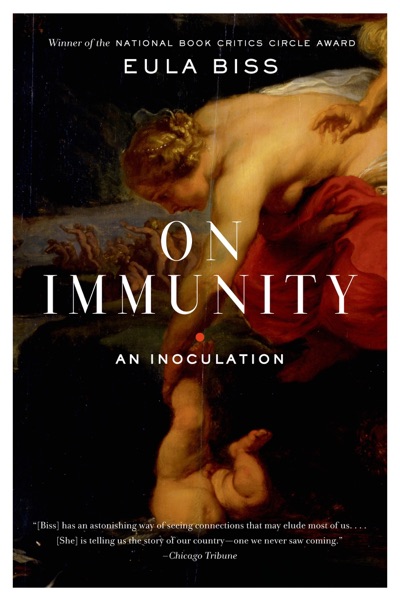
Eula Biss wrote On Immunity: An Inoculation in 2014 as an essay collection loosely structured around her experience as a new mother confronting the vaccination question.
Eula Biss · 2014 · 3h 45m
Full summary and key takeaways →The 11 questions
- 1.
Biss argues that fear of vaccines is rooted in distrust of institutions, not ignorance of science. Does that framing change how you think about effective public health communication?
- 2.
She traces vaccine skepticism to a long cultural tradition of suspecting artificial intervention in natural processes. Is that tradition ever a useful check? When does it become counterproductive?
- 3.
The concept of herd immunity frames vaccination as a social act. Does thinking of it that way change how you feel about vaccine refusal? Does it change the ethics?
- 4.
Biss is honest about her own ambivalence as a new mother, even as she ultimately follows the vaccine schedule. Does that ambivalence make the book more or less persuasive?
- 5.
The Tuskegee study and other episodes of medical harm are invoked to explain why distrust of public health institutions is historically grounded. Does that explanation require endorsing the conclusions drawn from it?
- 6.
She reads Bram Stoker's Dracula as a cultural text about contamination anxiety. Does the literary approach to a scientific question work for you? What does it add that a purely scientific argument wouldn't?
- 7.
The book was published in 2014. How has the landscape of vaccine hesitancy changed since then, and how well do Biss's arguments address the current form of the debate?
- 8.
Biss treats the body as porous and interconnected — inherently social, not private. What are the implications of that view for how we think about individual rights versus collective welfare in public health?
- 9.
She is careful to avoid condescension toward parents who hesitate. Is that care fully achieved in the book? Or does the essay form create a distance from the people she's writing about?
- 10.
Herd immunity requires a high threshold of vaccination in a population. At what point, if any, does the state have legitimate authority to mandate vaccination? What does Biss's framework suggest?
- 11.
The book is about vaccines but also about motherhood, risk, and the experience of new parenthood. How does framing a public health question through a personal experience change the argument?
How to run the discussion
- Pick six to eight, not all of them. An hour of real discussion covers fewer questions than anyone expects, and racing the list is what makes a book club feel like homework.
- Open with what people noticed, not what they concluded. Asking for a verdict first hardens opinions before anyone has heard each other.
- Let the disagreement run. The questions below that split a room are the ones worth the time; the ones everyone answers the same way can be skipped.
- Ask the quiet person a specific question. A direct, narrow question is far easier to answer than an open invitation to contribute.
Themes worth steering toward
If the conversation stalls, these are the threads that usually restart it.
Common questions
What are good book club questions for On Immunity: An Inoculation?
Here are 11 book club questions for On Immunity: An Inoculation by Eula Biss, ordered to open easily and end somewhere worth arguing about. The strongest openers ask what each reader noticed rather than what they concluded, and the discussion usually turns on vaccination and public health, fear and risk perception, motherhood.
How long should a book club discussion of On Immunity: An Inoculation last?
Most groups run 60 to 90 minutes of actual discussion. That is roughly six to eight questions, not all of them, so pick the ones that suit your group rather than working down the list in order.
What are the main themes in On Immunity: An Inoculation?
Vaccination and public health, Fear and risk perception, Motherhood, Bodily autonomy, Collective responsibility. Those are the threads most likely to divide a room, which makes them the useful places to steer a discussion that has gone quiet.
Picking the next one? See books like On Immunity: An Inoculation or questions for other book club picks.
