Economics · Book club
One Up On Wall Street book club questions
Here are 12 book club questions for One Up On Wall Street by Peter Lynch, ordered to open easily and end somewhere worth arguing about. Copy them, print them, or bring them up one at a time.
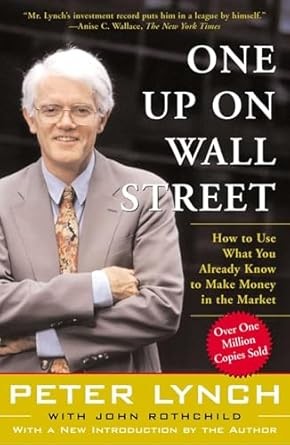
One Up On Wall Street is Peter Lynch's argument that ordinary investors have a genuine advantage over professional fund managers, and that the key to beating the market is paying attention to what you already know.
Peter Lynch · 1989 · 5h 0m
Full summary and key takeaways →The 12 questions
- 1.
Lynch argues individual investors have an informational edge through everyday life. What product, service, or company have you noticed recently that a professional analyst might not be paying attention to?
- 2.
Have you ever acted on a consumer observation as an investment thesis? How did the idea look when you actually examined the company's financials?
- 3.
Lynch distinguishes between a company you like and a company worth owning. Where do most people stop in that process, and why?
- 4.
Which of Lynch's six stock categories does most of your portfolio fit into? Does that match the kind of returns and risks you actually want?
- 5.
Lynch says the biggest mistake investors make is selling too early. Have you ever sold a winner quickly, then watched it continue to rise? What drove the decision to sell?
- 6.
The concept of 'diworsification' — a company expanding into businesses it doesn't understand — can also apply to an individual investor's portfolio. Are there holdings in your portfolio you don't actually understand?
- 7.
Lynch is candid about bad picks. What was your worst investment decision, and what did the story look like before the loss? Was the mistake visible in the fundamentals?
- 8.
Lynch describes doing research in shoe leather — visiting stores, talking to employees, reading trade publications. How much time do you actually spend researching a stock before buying?
- 9.
How do you know when to sell? Lynch's framework is: sell when the original reason you bought no longer holds. What is your actual decision rule?
- 10.
Lynch's approach assumes you can do meaningful financial analysis as an individual investor. Do you have the skills and time to do that, or is indexing the more realistic path for you?
- 11.
The book came out in 1989. Are the categories and analytical frameworks Lynch describes still applicable to technology-driven companies that were barely imaginable then?
- 12.
Lynch ran the Magellan Fund for thirteen years. What would it take to maintain the analytical discipline he describes for a decade, not just through one good run?
How to run the discussion
- Pick six to eight, not all of them. An hour of real discussion covers fewer questions than anyone expects, and racing the list is what makes a book club feel like homework.
- Open with what people noticed, not what they concluded. Asking for a verdict first hardens opinions before anyone has heard each other.
- Let the disagreement run. The questions below that split a room are the ones worth the time; the ones everyone answers the same way can be skipped.
- Ask the quiet person a specific question. A direct, narrow question is far easier to answer than an open invitation to contribute.
Themes worth steering toward
If the conversation stalls, these are the threads that usually restart it.
Common questions
What are good book club questions for One Up On Wall Street?
Here are 12 book club questions for One Up On Wall Street by Peter Lynch, ordered to open easily and end somewhere worth arguing about. The strongest openers ask what each reader noticed rather than what they concluded, and the discussion usually turns on stock picking, individual investing, growth investing.
How long should a book club discussion of One Up On Wall Street last?
Most groups run 60 to 90 minutes of actual discussion. That is roughly six to eight questions, not all of them, so pick the ones that suit your group rather than working down the list in order.
What are the main themes in One Up On Wall Street?
Stock picking, Individual investing, Growth investing, Consumer observation, Long-term thinking. Those are the threads most likely to divide a room, which makes them the useful places to steer a discussion that has gone quiet.
Picking the next one? See books like One Up On Wall Street or questions for other book club picks.
