Business · Book club
Only the Paranoid Survive book club questions
Here are 12 book club questions for Only the Paranoid Survive by Andrew S. Grove, ordered to open easily and end somewhere worth arguing about. Copy them, print them, or bring them up one at a time.
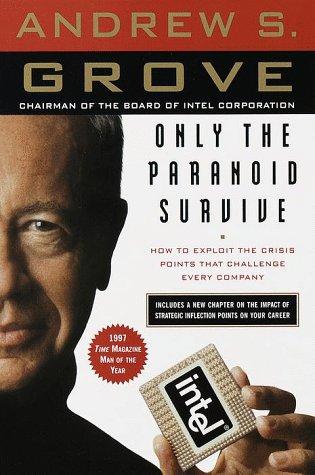
Only the Paranoid Survive is Andrew Grove's account of how he understood and navigated the most dangerous moments in a company's life — what he calls strategic inflection points.
Andrew S. Grove · 1996 · 4h 45m
Full summary and key takeaways →The 12 questions
- 1.
Grove defines the moment an inflection point arrives as the time when the old strategic picture dissolves and a new one must be built. Has your industry had one of those moments recently?
- 2.
His 10x force test asks whether any competitive factor — a new entrant, a technology, a distribution shift — has become ten times more powerful. Apply that test to your industry right now.
- 3.
Grove says middle managers often see strategic inflection points before senior leadership does. How does your organization capture and act on signals from people closest to customers?
- 4.
Think of a company you know well that failed to navigate a strategic inflection point. At what stage did denial give way to recognition, and was it too late?
- 5.
The 'walk out the door' thought experiment strips away sunk cost and attachment. Apply it to your current organization: what would an outside CEO do differently?
- 6.
Grove argues that ambiguity in the early stages of an inflection point is normal and not an excuse for inaction. How does your organization make decisions under genuine strategic uncertainty?
- 7.
He is candid that leading Intel through the memory-to-microprocessor transition was disorienting and costly. What would that kind of pivot cost your organization in terms of expertise, relationships, and culture?
- 8.
Grove distinguishes between noise and signal in early warning signs. What processes does your team use to decide which trends deserve serious attention versus which should be monitored passively?
- 9.
He says paranoia is an asset. Is there a version of that vigilance that tips into dysfunction — where constant threat-scanning prevents an organization from executing well?
- 10.
Which of the six competitive forces in your industry seems most likely to produce a 10x shift in the next five years?
- 11.
Grove wrote this in 1996. Which of his examples from the computing industry feel prescient about later shifts — in mobile, cloud, AI — that he couldn't have seen?
- 12.
The book argues that the difference between companies that survive inflection points and those that don't is often speed of recognition, not quality of response. Do you agree with that emphasis?
How to run the discussion
- Pick six to eight, not all of them. An hour of real discussion covers fewer questions than anyone expects, and racing the list is what makes a book club feel like homework.
- Open with what people noticed, not what they concluded. Asking for a verdict first hardens opinions before anyone has heard each other.
- Let the disagreement run. The questions below that split a room are the ones worth the time; the ones everyone answers the same way can be skipped.
- Ask the quiet person a specific question. A direct, narrow question is far easier to answer than an open invitation to contribute.
Themes worth steering toward
If the conversation stalls, these are the threads that usually restart it.
Common questions
What are good book club questions for Only the Paranoid Survive?
Here are 12 book club questions for Only the Paranoid Survive by Andrew S. Grove, ordered to open easily and end somewhere worth arguing about. The strongest openers ask what each reader noticed rather than what they concluded, and the discussion usually turns on strategic inflection points, leadership, competitive dynamics.
How long should a book club discussion of Only the Paranoid Survive last?
Most groups run 60 to 90 minutes of actual discussion. That is roughly six to eight questions, not all of them, so pick the ones that suit your group rather than working down the list in order.
What are the main themes in Only the Paranoid Survive?
Strategic inflection points, Leadership, Competitive dynamics, Decision-making, Change management. Those are the threads most likely to divide a room, which makes them the useful places to steer a discussion that has gone quiet.
Picking the next one? See books like Only the Paranoid Survive or questions for other book club picks.
