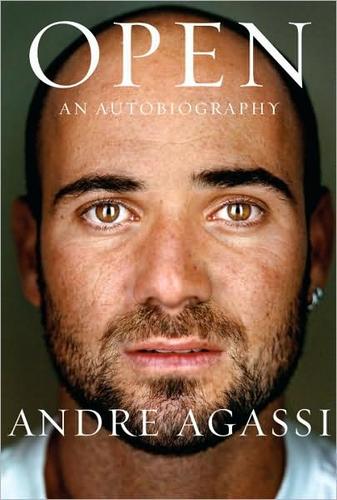
Open: An Autobiography by Andre Agassi is a 2009 memoir book about identity, sports, rebellion. Intrinsic motivation cannot be manufactured. Agassi's career demonstrates the costs of competing for external validation — his father's approval, public image, rankings — and the transformation that follows genuine purpose.
Summary
Andre Agassi's autobiography opens with one of the most famous confessions in sports memoir: he hates tennis. This is the book's central paradox, and Agassi and his collaborator J. R. Moehringer spend 400 pages exploring it — how a man who never chose his sport, was essentially conscripted into it by a domineering father, and spent years resenting it, managed to become one of its greatest players and eventually find in it something like meaning.
Agassi grew up in Las Vegas, the son of an Iranian immigrant father who had been obsessed with tennis and who decided before Andre's birth that his son would be a tennis champion. The training regime his father imposed was brutal and systematic: a ball machine named "the dragon" that fired 2,500 balls a day, hours of practice before school, a joyless perfectionism that left Agassi feeling that his value was entirely conditional on his performance. He was sent to Nick Bollettieri's tennis academy in Florida as a young teenager, an experience he describes as a combination of boot camp and Lord of the Flies.
The middle section of the book covers Agassi's career at its most self-destructive. He wore a hairpiece on the court for years to conceal early baldness and lived in terror of it falling off. He briefly used crystal methamphetamine during a period of depression in the late 1990s, tested positive for the drug, lied to the ATP, and was cleared on a technicality — a confession that generated enormous controversy when the book was published. He married and divorced Brooke Shields. His ranking fell outside the top hundred. Then, at an age when most tennis players have retired, he rebuilt his game and his motivation.
The rebuilding is the book's emotional climax and its most interesting argument. Agassi began working with children in Las Vegas through his Andre Agassi Foundation and eventually founded a charter school. He met and married Steffi Graf. He found, in the last years of his career, a genuine reason to compete that had nothing to do with his father's demands or his own ego. Open is a sports memoir, but its real subject is the question of how you build a life when the conditions of your formation were not of your choosing.
Talk to Open: An Autobiography like its author wrote you back.
Get the ideas that fit your life — not generic summaries.
- Chat with the book
- Audiobook-style main ideas
- Adapts to your life and goals
- Helps you take action
Key takeaways
- 1.
Intrinsic motivation cannot be manufactured. Agassi's career demonstrates the costs of competing for external validation — his father's approval, public image, rankings — and the transformation that follows genuine purpose.
- 2.
Identity imposed from outside is psychologically corrosive. Agassi did not choose tennis and spent years performing a self he had been assigned rather than one he had built.
- 3.
The body holds the history of performance. Agassi's knees, destroyed by decades of hard court tennis, are a recurring presence — the physical cost of a career that began before his body was ready.
- 4.
Recovery from self-destruction requires more than will. Agassi's return from a drug problem, a failed marriage, and a ranked outside the top hundred required structural changes — new coaches, new motivation, new relationships — not just resolve.
- 5.
Children's education as late-career meaning: the Andre Agassi Foundation and its charter school gave him a reason to compete that he had never had before. The philanthropy is not a footnote to the career but its explanation.
- 6.
Brooke Shields is treated with some complexity — the marriage is portrayed as two lonely people mistaking compatibility for love — but the book is ultimately more interested in Agassi than in her.
- 7.
Stefanie Graf appears late and is presented almost as a salvation, which may say more about the memoir's gender assumptions than about the relationship.
- 8.
Ghostwriting at its best: J. R. Moehringer's collaboration produced a prose voice — sharp, confessional, occasionally funny — that reads like authentic speech. The book is a model of how celebrity memoir can be literary.
Discussion questions
Use these on your own, with a book club, or as chat starters in Superbook. Book club version, ready to copy or print →
- 1.
Agassi says he hates tennis on page one. Does the book convince you that this is true, or does it eventually reveal a more complicated relationship?
- 2.
His father's parenting would today be described as abusive. Does Open engage seriously with that characterization, or does it find another framework?
- 3.
The crystal meth confession generated major controversy when the book was published. Does knowing about the drug use change how you think about his career?
- 4.
Agassi's marriage to Brooke Shields is portrayed as a mutual mistake. Is the portrait of Shields fair? Does Agassi take appropriate responsibility?
- 5.
The Andre Agassi Foundation and charter school appear as the turning point in his self-understanding. Is that transformation convincing?
- 6.
J. R. Moehringer is credited as collaborator. Does the knowledge that the book is ghostwritten change how you read it as autobiography?
- 7.
Agassi's main rival, Pete Sampras, appears throughout as a contrast — emotionally opaque where Agassi is emotionally exposed. What does the comparison reveal about both men?
- 8.
The book argues that performing for external validation is hollow. Is that a lesson the book actually teaches, or does it fall into its own trap by being partly a performance of authenticity?
- 9.
What does Open suggest about the ethics of raising children to be elite athletes? Where is the line between preparation and exploitation?
- 10.
Agassi found meaning in his career only at the end. Is that a hopeful story or a cautionary one?
- 11.
Which sections of the memoir did you find most surprising? Most honest?
Themes
Frequently asked questions
-
Is Open the best sports memoir ever written?
It is frequently described as the best or among the best. What distinguishes it from most sports memoirs is the level of psychological honesty — Agassi admits things (hating his sport, the drug use, the hairpiece, the hollow years) that most athletes would not disclose. The writing, shaped by Moehringer, is also unusually good for the genre.
-
Is the book entirely honest?
Agassi says it is. Some figures involved — particularly the ATP regarding the methamphetamine episode — disputed aspects of the account. Brooke Shields has not spoken extensively about how the marriage is portrayed. The confession about crystal meth has been the most scrutinized element.
-
Did the methamphetamine confession damage his legacy?
The immediate reaction was intense. Most tennis observers and fans appear to have absorbed the information without revising their overall view of his career. His records stand. The confession is now treated as part of the book's unusual honesty rather than as a primary fact about his life.
-
What is the book's relationship to Moehringer's other memoir, The Tender Bar?
Both books deal with absent or damaged fathers and with the search for authentic identity. Moehringer has spoken about the parallels. Reading both illuminates each. They share a confessional directness and a clean, fast prose style.
-
How long does Open take to read?
About seven to eight hours. The narrative moves quickly; Moehringer paces it like a novel. Most readers find themselves reading in long sittings.
Similar books
Shoe Dog: A Memoir by the Creator of Nike
Phil Knight
Unbroken: A World War II Story of Survival, Resilience, and Redemption
Laura Hillenbrand
A Heartbreaking Work of Staggering Genius
Dave Eggers
