History · Book club
Operation Mincemeat: How a Dead Man and a Bizarre Plan Fooled the Nazis and Assured an Allied Victory book club questions
Here are 12 book club questions for Operation Mincemeat: How a Dead Man and a Bizarre Plan Fooled the Nazis and Assured an Allied Victory by Ben Macintyre, ordered to open easily and end somewhere worth arguing about. Copy them, print them, or bring them up one at a time.
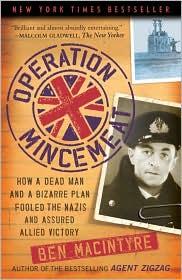
In 1943, British intelligence planted a dead man on a Spanish beach carrying fabricated documents designed to convince the Germans that the Allied invasion of southern Europe would target Greece and Sardinia rather than Sicily.
Ben Macintyre · 2010 · 6h 15m
Full summary and key takeaways →The 12 questions
- 1.
The success of Operation Mincemeat depended partly on German confirmation bias — they wanted to believe the documents. What does that suggest about how intelligence failures happen even with sophisticated analysis?
- 2.
Macintyre spends considerable time on Glyndwr Michael — the unknown man whose body was used. How did you respond to the ethics of that choice?
- 3.
The team that designed Mincemeat included novelists, eccentric officers, and lateral thinkers. Does that mix seem unusual for a military operation? Why do you think it produced better results than a conventional planning process might have?
- 4.
The fabricated identity was built from hundreds of mundane details. What does that level of commitment to consistency tell us about what makes deception convincing?
- 5.
Ian Fleming later drew on wartime intelligence for his James Bond novels. After reading this book, do you see the fictional spy differently?
- 6.
The Allies couldn't verify in real time that Mincemeat had worked. How do you think the operation's designers lived with that uncertainty during the months before the Sicily invasion?
- 7.
Mincemeat shortened the Sicilian campaign but didn't win the war by itself. Macintyre resists overclaiming. How does that intellectual honesty affect how you read the story?
- 8.
The Germans had sophisticated analysts who examined the documents carefully. Where exactly did their analysis fail, in Macintyre's account?
- 9.
What does Operation Mincemeat suggest about the role of improvisation and unorthodox thinking in high-stakes operations, military or otherwise?
- 10.
The full story wasn't public for decades. What do you think changed — in intelligence culture, in the law, in society — that made declassification possible?
- 11.
How does reading a story of successful strategic deception affect your sense of how honest you expect states to be with each other, or with their own citizens?
- 12.
Macintyre ends with the fate of those involved. Who did you find most compelling, and why?
How to run the discussion
- Pick six to eight, not all of them. An hour of real discussion covers fewer questions than anyone expects, and racing the list is what makes a book club feel like homework.
- Open with what people noticed, not what they concluded. Asking for a verdict first hardens opinions before anyone has heard each other.
- Let the disagreement run. The questions below that split a room are the ones worth the time; the ones everyone answers the same way can be skipped.
- Ask the quiet person a specific question. A direct, narrow question is far easier to answer than an open invitation to contribute.
Themes worth steering toward
If the conversation stalls, these are the threads that usually restart it.
Common questions
What are good book club questions for Operation Mincemeat: How a Dead Man and a Bizarre Plan Fooled the Nazis and Assured an Allied Victory?
Here are 12 book club questions for Operation Mincemeat: How a Dead Man and a Bizarre Plan Fooled the Nazis and Assured an Allied Victory by Ben Macintyre, ordered to open easily and end somewhere worth arguing about. The strongest openers ask what each reader noticed rather than what they concluded, and the discussion usually turns on deception, world war ii, intelligence.
How long should a book club discussion of Operation Mincemeat: How a Dead Man and a Bizarre Plan Fooled the Nazis and Assured an Allied Victory last?
Most groups run 60 to 90 minutes of actual discussion. That is roughly six to eight questions, not all of them, so pick the ones that suit your group rather than working down the list in order.
What are the main themes in Operation Mincemeat: How a Dead Man and a Bizarre Plan Fooled the Nazis and Assured an Allied Victory?
Deception, World War II, Intelligence, Improvisation, Identity. Those are the threads most likely to divide a room, which makes them the useful places to steer a discussion that has gone quiet.
Picking the next one? See books like Operation Mincemeat: How a Dead Man and a Bizarre Plan Fooled the Nazis and Assured an Allied Victory or questions for other book club picks.
