History · Book club
Ordinary Men: Reserve Police Battalion 101 and the Final Solution in Poland book club questions
Here are 12 book club questions for Ordinary Men: Reserve Police Battalion 101 and the Final Solution in Poland by Christopher R. Browning, ordered to open easily and end somewhere worth arguing about. Copy them, print them, or bring them up one at a time.
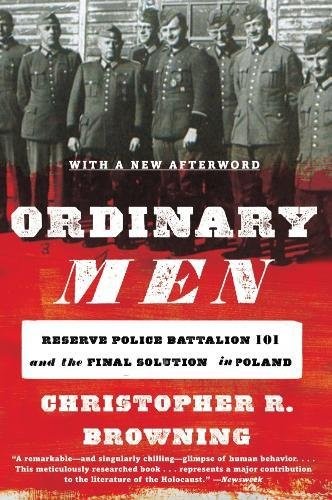
Ordinary Men is Christopher Browning's study of Reserve Police Battalion 101, a unit of middle-aged German men — not hardened SS officers but Hamburg policemen with civilian lives and families — who between 1942 and 1943 shot approximately 38,000 Jewish men, women, and children in occupied Poland and deported another 45,000 to the Treblinka death camp.
Christopher R. Browning · 1992 · 4h 15m
Full summary and key takeaways →The 12 questions
- 1.
Browning argues that the men had a genuine choice and that almost none took it. What conditions — social, institutional, psychological — would have made refusal more likely?
- 2.
The book draws on Stanley Milgram's obedience experiments. Do you find that framework convincing as an explanation for what the battalion did, or does it inadequately account for the specific ideological context?
- 3.
Browning and Goldhagen reached different conclusions about the role of antisemitism from largely similar evidence. What does this disagreement tell us about how historical interpretation works?
- 4.
The escalation model suggests that each small step made the next step easier. Can you identify analogous escalation dynamics in institutional settings you know, even far removed from violence?
- 5.
The men gave testimonies in legal proceedings decades later. How should historians weigh evidence from people who had strong incentives to minimize their own responsibility?
- 6.
Browning's conclusion — that ordinary people in the right circumstances can become mass killers — is disturbing. Does it change how you think about human nature, or does it confirm something you already believed?
- 7.
Several of the men expressed distress at the killings but continued anyway. What does the gap between emotional response and behavior tell us about the limits of empathy as a moral brake?
- 8.
The battalion was given an opportunity to refuse at the beginning. Why do you think so few people took it? What would you need to know about yourself to have confidence you would have been different?
- 9.
Browning resists using the word 'evil' to describe the perpetrators. Is this restraint historically useful, morally appropriate, or both?
- 10.
The men were not ideologically screened for the task they were given. Does this suggest something about the relationship between ideology and action, or does it simply reflect the practical limitations of wartime manpower?
- 11.
What are the institutional and social conditions most likely to produce ordinary perpetrators? Can those conditions be identified in advance and disrupted?
- 12.
How does Ordinary Men change the question the Holocaust asks of us? Does it make the event seem more explicable, less exceptional, or both?
How to run the discussion
- Pick six to eight, not all of them. An hour of real discussion covers fewer questions than anyone expects, and racing the list is what makes a book club feel like homework.
- Open with what people noticed, not what they concluded. Asking for a verdict first hardens opinions before anyone has heard each other.
- Let the disagreement run. The questions below that split a room are the ones worth the time; the ones everyone answers the same way can be skipped.
- Ask the quiet person a specific question. A direct, narrow question is far easier to answer than an open invitation to contribute.
Themes worth steering toward
If the conversation stalls, these are the threads that usually restart it.
Common questions
What are good book club questions for Ordinary Men: Reserve Police Battalion 101 and the Final Solution in Poland?
Here are 12 book club questions for Ordinary Men: Reserve Police Battalion 101 and the Final Solution in Poland by Christopher R. Browning, ordered to open easily and end somewhere worth arguing about. The strongest openers ask what each reader noticed rather than what they concluded, and the discussion usually turns on the holocaust, perpetrators, conformity.
How long should a book club discussion of Ordinary Men: Reserve Police Battalion 101 and the Final Solution in Poland last?
Most groups run 60 to 90 minutes of actual discussion. That is roughly six to eight questions, not all of them, so pick the ones that suit your group rather than working down the list in order.
What are the main themes in Ordinary Men: Reserve Police Battalion 101 and the Final Solution in Poland?
The Holocaust, Perpetrators, Conformity, Moral choice, Group psychology. Those are the threads most likely to divide a room, which makes them the useful places to steer a discussion that has gone quiet.
Picking the next one? See books like Ordinary Men: Reserve Police Battalion 101 and the Final Solution in Poland or questions for other book club picks.
