Psychology · Book club
Originals: How Non-Conformists Move the World book club questions
Here are 12 book club questions for Originals: How Non-Conformists Move the World by Adam Grant, ordered to open easily and end somewhere worth arguing about. Copy them, print them, or bring them up one at a time.
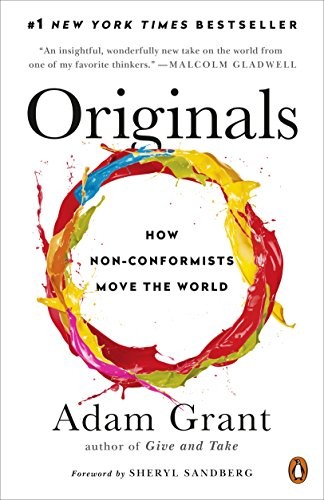
Originals is Adam Grant's examination of how people champion new ideas without losing their jobs, their relationships, or their nerve.
Adam Grant · 2016 · 5h 15m
Full summary and key takeaways →The 12 questions
- 1.
Grant argues that originals aren't reckless — they diversify risk rather than ignore it. Does that match the people you've seen successfully drive change in your own field?
- 2.
Have you ever had an idea you were confident in but failed to act on? Looking back, was it timing, coalition, or your own hesitation that held it back?
- 3.
The data shows first movers often lose to fast followers. Can you think of examples from your own industry where the first-mover was overtaken?
- 4.
Grant's finding that procrastination can be creative — letting ideas incubate — is uncomfortable for people who pride themselves on execution. How do you distinguish productive delay from avoidance?
- 5.
Have you ever led with your weaknesses in a pitch or proposal? What happened?
- 6.
The book argues that familiar-but-different is the sweet spot for new ideas. Where have you seen an idea fail because it was too unfamiliar, or get stolen because it wasn't different enough?
- 7.
When advocating for a change in an organization, Grant recommends starting with the most open-minded people rather than the most powerful. Have you seen that strategy work? Fail?
- 8.
Originals, Grant argues, express doubt strategically rather than hiding it. Where in your own life does projecting certainty when you feel uncertain seem to help you? Where does it hurt?
- 9.
The research on birth order suggests later-borns tend to be more rebellious and first-borns more conventional. Does that match your own family? Does it hold in organizations — do people who joined earlier act more defensively?
- 10.
Grant examines people who raised dissent in time to prevent organizational disasters and were ignored. What makes those situations so common? What would have to change for the dissenter to be heard?
- 11.
If you had to generate ten new ideas in a field you care about, how would you do it — and which of them would you expect to be worth developing?
- 12.
Grant says that strategic impatience (urgency about the goal) combined with tactical patience (flexibility about approach) characterizes effective originals. Where are you currently impatient when you should be patient, and vice versa?
How to run the discussion
- Pick six to eight, not all of them. An hour of real discussion covers fewer questions than anyone expects, and racing the list is what makes a book club feel like homework.
- Open with what people noticed, not what they concluded. Asking for a verdict first hardens opinions before anyone has heard each other.
- Let the disagreement run. The questions below that split a room are the ones worth the time; the ones everyone answers the same way can be skipped.
- Ask the quiet person a specific question. A direct, narrow question is far easier to answer than an open invitation to contribute.
Themes worth steering toward
If the conversation stalls, these are the threads that usually restart it.
Common questions
What are good book club questions for Originals: How Non-Conformists Move the World?
Here are 12 book club questions for Originals: How Non-Conformists Move the World by Adam Grant, ordered to open easily and end somewhere worth arguing about. The strongest openers ask what each reader noticed rather than what they concluded, and the discussion usually turns on creativity, innovation, risk-taking.
How long should a book club discussion of Originals: How Non-Conformists Move the World last?
Most groups run 60 to 90 minutes of actual discussion. That is roughly six to eight questions, not all of them, so pick the ones that suit your group rather than working down the list in order.
What are the main themes in Originals: How Non-Conformists Move the World?
Creativity, Innovation, Risk-taking, Conformity, Leadership. Those are the threads most likely to divide a room, which makes them the useful places to steer a discussion that has gone quiet.
Picking the next one? See books like Originals: How Non-Conformists Move the World or questions for other book club picks.
