Science · Book club
Our Mathematical Universe book club questions
Here are 11 book club questions for Our Mathematical Universe by Max Tegmark, ordered to open easily and end somewhere worth arguing about. Copy them, print them, or bring them up one at a time.
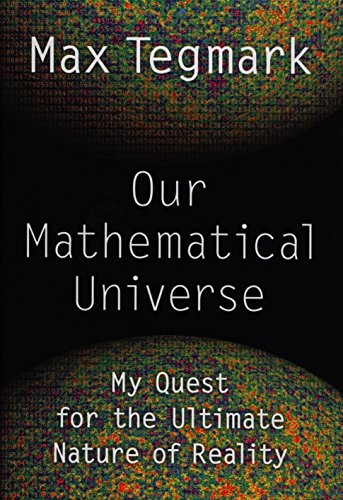
Our Mathematical Universe is Max Tegmark's argument for what he calls the Mathematical Universe Hypothesis: the bold claim that the universe is not merely described by mathematics but is a mathematical structure.
Max Tegmark · 2014 · 8h 45m
Full summary and key takeaways →The 11 questions
- 1.
The Mathematical Universe Hypothesis says reality is a mathematical structure. Can you state the strongest objection to that claim?
- 2.
Tegmark distinguishes 'described by mathematics' from 'is mathematics.' Does that distinction seem meaningful or like wordplay?
- 3.
Level IV multiverse says all mathematically consistent universes exist. Does that strike you as explanatory or as the maximal possible multiplication of entities?
- 4.
The anthropic principle says we observe life-permitting constants because we couldn't exist to observe others. Is that a real explanation or a tautology?
- 5.
Tegmark argues the multiverse is parsimonious — simpler to assert all mathematical structures than to specify one. Do you find the parsimony argument convincing?
- 6.
If physical reality is a mathematical structure, what is the status of qualia — subjective experiences like the redness of red? Do they exist as mathematical properties?
- 7.
How does the Mathematical Universe Hypothesis relate to Platonism — the view that mathematical objects have independent existence?
- 8.
The book mixes cosmology science with speculative philosophy. Does that combination feel like a strength or a category mistake?
- 9.
Tegmark's Level I and II multiverses arise from accepted physics (inflation). Does that make the Level IV multiverse seem more plausible by association?
- 10.
What would it take to falsify the Mathematical Universe Hypothesis? If it can't be falsified, should it count as science?
- 11.
The book is partly autobiographical. Does the personal narrative help or distract from the scientific argument?
How to run the discussion
- Pick six to eight, not all of them. An hour of real discussion covers fewer questions than anyone expects, and racing the list is what makes a book club feel like homework.
- Open with what people noticed, not what they concluded. Asking for a verdict first hardens opinions before anyone has heard each other.
- Let the disagreement run. The questions below that split a room are the ones worth the time; the ones everyone answers the same way can be skipped.
- Ask the quiet person a specific question. A direct, narrow question is far easier to answer than an open invitation to contribute.
Themes worth steering toward
If the conversation stalls, these are the threads that usually restart it.
Common questions
What are good book club questions for Our Mathematical Universe?
Here are 11 book club questions for Our Mathematical Universe by Max Tegmark, ordered to open easily and end somewhere worth arguing about. The strongest openers ask what each reader noticed rather than what they concluded, and the discussion usually turns on cosmology, mathematics, multiverse.
How long should a book club discussion of Our Mathematical Universe last?
Most groups run 60 to 90 minutes of actual discussion. That is roughly six to eight questions, not all of them, so pick the ones that suit your group rather than working down the list in order.
What are the main themes in Our Mathematical Universe?
Cosmology, Mathematics, Multiverse, Reality, Physics. Those are the threads most likely to divide a room, which makes them the useful places to steer a discussion that has gone quiet.
Picking the next one? See books like Our Mathematical Universe or questions for other book club picks.
