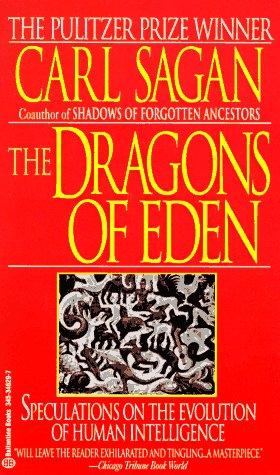
The Dragons of Eden by Carl Sagan is a 1977 science book about human intelligence, brain evolution, consciousness. Human intelligence is the product of evolutionary pressures acting on primate nervous systems over millions of years; it is continuous with animal cognition rather than categorically separate from it.
Summary
The Dragons of Eden, which won the Pulitzer Prize for General Nonfiction in 1978, is Carl Sagan's exploration of the evolution and nature of human intelligence. Sagan approaches the brain from multiple directions — evolutionary biology, comparative anatomy, neurophysiology, and psychology — to ask how we got our minds and what their structure reveals about our nature.
The book's central organizing framework is Paul MacLean's triune brain hypothesis: the idea that the human brain is, in effect, three brains stacked on top of one another — the reptilian complex (controlling basic survival behaviors), the limbic system (controlling emotion and memory, evolved in early mammals), and the neocortex (controlling higher cognition, strongly developed in primates and most fully in humans). Sagan uses this framework to explore the evolutionary roots of human behavior: why we are simultaneously rational and driven by impulse, why ancient fears and hierarchical instincts persist in people who know better.
He ranges widely across intelligence research: the attempts to teach sign language to chimpanzees, which he discusses with more enthusiasm than later evidence warranted; the nature of dreaming and what it might reveal about brain function; the parallels between computer science and neural architecture; the evolution of writing and the external storage of knowledge; and the implications of intelligence for extraterrestrial life. Throughout, Sagan is interested in what the evolved structure of the human brain implies about its limitations — the places where our cognitive architecture makes us systematically prone to error.
Some of the specific claims — particularly around chimpanzee language abilities — have since been significantly revised. The triune brain model, while influential, is now considered an oversimplification. But The Dragons of Eden remains valuable for the clarity of its evolutionary framing and for Sagan's characteristic refusal to treat human exceptionalism as self-evident.
Talk to The Dragons of Eden like its author wrote you back.
Get the ideas that fit your life — not generic summaries.
- Chat with the book
- Audiobook-style main ideas
- Adapts to your life and goals
- Helps you take action
Key takeaways
- 1.
Human intelligence is the product of evolutionary pressures acting on primate nervous systems over millions of years; it is continuous with animal cognition rather than categorically separate from it.
- 2.
The triune brain model — reptilian complex, limbic system, neocortex — suggests that human behavior reflects multiple evolutionary layers with different priorities that do not always agree.
- 3.
The neocortex, responsible for analytical thinking and long-range planning, is disproportionately large in humans compared to other primates and may be the primary biological basis for human technological and cultural achievement.
- 4.
Language is not unique to humans in the absolute sense: chimpanzees can acquire significant vocabularies in sign language. But the syntactic complexity of human language does appear to be qualitatively different.
- 5.
Dreams may be a mechanism for organizing and processing emotionally charged memories, a function that requires temporarily disabling the analytical neocortex.
- 6.
Writing externalized human memory, allowing knowledge to accumulate beyond what any individual brain could store and transmit across generations without distortion.
- 7.
The cosmic calendar — compressing 15 billion years of history into one year — shows that all of recorded human history fits into the last ten seconds of December 31, which is a genuinely perspective-shifting calculation.
- 8.
The fact that human brains evolved for survival in a specific ancestral environment, not for abstract reasoning, means they are systematically poorly calibrated for many modern challenges, including long-range risk assessment.
Discussion questions
Use these on your own, with a book club, or as chat starters in Superbook. Book club version, ready to copy or print →
- 1.
Sagan uses the triune brain to explain the tension between reason and emotion. Does that model ring true in your experience of making decisions?
- 2.
He argues that human intelligence is continuous with animal intelligence rather than categorically different. Does that continuity change how you think about animal rights or consciousness?
- 3.
The chimpanzee language research Sagan describes was later largely discredited. How do you read sections of a science book that have been superseded by subsequent research?
- 4.
The cosmic calendar shows all of human history in the last seconds of December 31. What do you do with that perspective? Does it change anything for you?
- 5.
Sagan suggests our evolved brains are poorly calibrated for modern challenges. Which specific modern challenges do you think our evolutionary heritage makes hardest to address?
- 6.
Writing is described as the externalization of human memory. How has digital technology extended that externalization, and what do we gain and lose?
- 7.
He discusses dreaming as a functional process rather than random noise. Does the idea that dreams serve a cognitive function change how you think about them?
- 8.
What is the most speculative claim in the book, and how does Sagan signal his uncertainty about it?
- 9.
Sagan connects the evolution of intelligence to the search for extraterrestrial life. Does his argument that intelligence will evolve elsewhere wherever life exists convince you?
- 10.
The book was written in 1977, well before modern neuroscience. How would you distinguish what has held up from what has been revised?
- 11.
He frames human exceptionalism as an empirical question rather than a given. Is that framing correct, or is there a genuine case for human uniqueness that evolutionary continuity doesn't capture?
Themes
Frequently asked questions
-
What is the Pulitzer Prize-winning book about?
The evolution of human intelligence — how the brain developed over millions of years of primate evolution, what its structure reveals about human behavior, and what intelligence implies for our place in the cosmos. It uses neuroscience, evolutionary biology, and comparative animal cognition.
-
Is the science still accurate?
Some sections have dated significantly. The triune brain model is now considered an oversimplification of brain anatomy. The chimpanzee language research Sagan discusses was later largely discredited. The evolutionary framework and the book's philosophical points hold better than the specific scientific claims.
-
Is it a hard read?
No. Sagan was a skilled popular writer, and the book is accessible to non-specialists. The science is explained clearly and the chapters are relatively short. Readers with no background in neuroscience will find it engaging.
-
What is the cosmic calendar?
A thought experiment in which all of cosmic history — roughly 15 billion years — is compressed into a single year. On this scale, the Milky Way forms in September, life on Earth appears in late September, humans appear on December 31, and all of recorded history fits into the last few seconds before midnight.
-
How does it compare to Sagan's other books?
Cosmos is more comprehensive and cinematic; The Demon-Haunted World is more focused on scientific skepticism. The Dragons of Eden is narrower in scope, focused on brain evolution and intelligence, and is the most psychological of his books. All share his characteristic voice.