Science · Book club
Pale Blue Dot: A Vision of the Human Future in Space book club questions
Here are 12 book club questions for Pale Blue Dot: A Vision of the Human Future in Space by Carl Sagan, ordered to open easily and end somewhere worth arguing about. Copy them, print them, or bring them up one at a time.
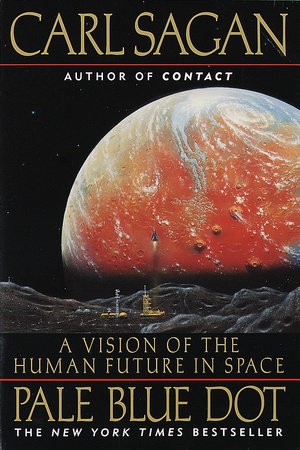
Pale Blue Dot takes its title from a photograph taken by Voyager 1 in 1990, as it left the solar system, at Sagan's request.
Carl Sagan · 1994 · 8h 45m
Full summary and key takeaways →The 12 questions
- 1.
How do you respond emotionally to the Pale Blue Dot photograph and Sagan's meditation on it? Does that kind of cosmic perspective change anything practically for you?
- 2.
Sagan argues for multi-planetary survival as a long-term necessity. How do you weigh that very long-term argument against the immediate costs of space exploration funding?
- 3.
Venus as a runaway greenhouse is a lesson about Earth's climate. Does the planetary comparison make climate change feel more or less abstract?
- 4.
He distinguishes between the value of scientific knowledge for its own sake and its practical applications. Which argument for space funding do you find more compelling?
- 5.
The overview effect — astronauts saying they felt changed by seeing Earth whole and borderless — is often cited as evidence that space travel could change human consciousness. Do you believe it, and what would it take to scale that effect?
- 6.
Sagan was writing in 1994 before the Hubble Space Telescope had produced its iconic images. Which subsequent development in space science do you think would have most affected his thinking?
- 7.
He argues that the impulse to explore is one of humanity's better traits. Do you agree, or is it sometimes a displacement of energy that could go to solving problems on Earth?
- 8.
The book argues against defunding space science. How has the balance between unmanned science missions, human spaceflight, and commercial space activity changed since Sagan wrote, and is he vindicated?
- 9.
If you could direct one current or future space mission to answer one question, what would it be?
- 10.
Sagan's writing is famous for its combination of scientific precision and emotional resonance. Which passage affected you most?
- 11.
The argument that Earth is a fragile world that needs protection is sometimes used to argue against space exploration (we should fix here first) and sometimes for it (we need a backup). Which direction do you find more persuasive?
- 12.
Sagan died in 1996 before the discovery of thousands of exoplanets. How would that discovery have affected his case in this book?
How to run the discussion
- Pick six to eight, not all of them. An hour of real discussion covers fewer questions than anyone expects, and racing the list is what makes a book club feel like homework.
- Open with what people noticed, not what they concluded. Asking for a verdict first hardens opinions before anyone has heard each other.
- Let the disagreement run. The questions below that split a room are the ones worth the time; the ones everyone answers the same way can be skipped.
- Ask the quiet person a specific question. A direct, narrow question is far easier to answer than an open invitation to contribute.
Themes worth steering toward
If the conversation stalls, these are the threads that usually restart it.
Common questions
What are good book club questions for Pale Blue Dot: A Vision of the Human Future in Space?
Here are 12 book club questions for Pale Blue Dot: A Vision of the Human Future in Space by Carl Sagan, ordered to open easily and end somewhere worth arguing about. The strongest openers ask what each reader noticed rather than what they concluded, and the discussion usually turns on space exploration, astronomy, human perspective.
How long should a book club discussion of Pale Blue Dot: A Vision of the Human Future in Space last?
Most groups run 60 to 90 minutes of actual discussion. That is roughly six to eight questions, not all of them, so pick the ones that suit your group rather than working down the list in order.
What are the main themes in Pale Blue Dot: A Vision of the Human Future in Space?
Space exploration, Astronomy, Human perspective, Planetary science, Future. Those are the threads most likely to divide a room, which makes them the useful places to steer a discussion that has gone quiet.
Picking the next one? See books like Pale Blue Dot: A Vision of the Human Future in Space or questions for other book club picks.
