History · Book club
Pale Rider book club questions
Here are 12 book club questions for Pale Rider by Laura Spinney, ordered to open easily and end somewhere worth arguing about. Copy them, print them, or bring them up one at a time.
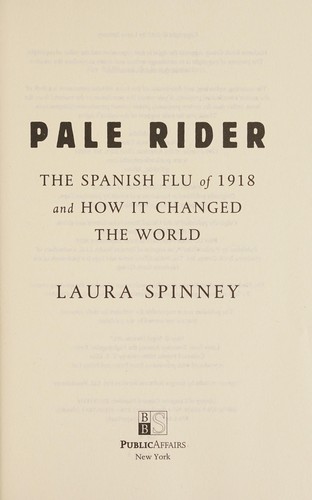
Pale Rider is Laura Spinney's account of the 1918–1919 influenza pandemic, with a distinctive emphasis on its global dimensions and on why the event so largely disappeared from collective memory.
Laura Spinney · 2017 · 7h 30m
Full summary and key takeaways →The 12 questions
- 1.
Spinney argues the 1918 pandemic was forgotten partly because World War I provided a more legible narrative for grief. What does this suggest about how we choose what to remember collectively?
- 2.
The pandemic had radically unequal effects across different populations. What were the structural reasons for that inequality, and which of them still exist today?
- 3.
Why was 'Spanish flu' a misnomer, and what does the naming tell you about wartime information control and its relationship to pandemic response?
- 4.
Spinney argues that suppressed collective memory of epidemic disease makes future epidemics harder to manage. Do you find that argument convincing?
- 5.
Some communities in Alaska and the Pacific lost majorities of their populations. How do you think about the relationship between that mortality and colonial infrastructure failure?
- 6.
The pandemic accelerated political movements in India, South Africa, and elsewhere. Can a disease event genuinely change political consciousness, or does it only accelerate changes already underway?
- 7.
How does Spinney's global account change how you understand the pandemic compared to U.S.-focused histories like Barry's?
- 8.
What's the difference between historical forgetting and historical suppression? Does Spinney make a clear case for which one happened with 1918?
- 9.
The W-shaped mortality curve — killing young adults disproportionately — is still not fully explained. What does it mean to live with that kind of scientific uncertainty?
- 10.
Spinney reconstructs dozens of individual experiences across many countries. Which one stayed with you most?
- 11.
How has reading Pale Rider changed how you think about COVID-19's place in history?
- 12.
Spinney writes that we can't afford to forget 1918. Who is the 'we' in that sentence, and what does remembering actually require?
How to run the discussion
- Pick six to eight, not all of them. An hour of real discussion covers fewer questions than anyone expects, and racing the list is what makes a book club feel like homework.
- Open with what people noticed, not what they concluded. Asking for a verdict first hardens opinions before anyone has heard each other.
- Let the disagreement run. The questions below that split a room are the ones worth the time; the ones everyone answers the same way can be skipped.
- Ask the quiet person a specific question. A direct, narrow question is far easier to answer than an open invitation to contribute.
Themes worth steering toward
If the conversation stalls, these are the threads that usually restart it.
Common questions
What are good book club questions for Pale Rider?
Here are 12 book club questions for Pale Rider by Laura Spinney, ordered to open easily and end somewhere worth arguing about. The strongest openers ask what each reader noticed rather than what they concluded, and the discussion usually turns on pandemic, global health, memory.
How long should a book club discussion of Pale Rider last?
Most groups run 60 to 90 minutes of actual discussion. That is roughly six to eight questions, not all of them, so pick the ones that suit your group rather than working down the list in order.
What are the main themes in Pale Rider?
Pandemic, Global health, Memory, Science history, Mortality. Those are the threads most likely to divide a room, which makes them the useful places to steer a discussion that has gone quiet.
Picking the next one? See books like Pale Rider or questions for other book club picks.
