Science fiction · Book club
Parable of the Sower book club questions
Here are 12 book club questions for Parable of the Sower by Octavia E. Butler, ordered to open easily and end somewhere worth arguing about. Copy them, print them, or bring them up one at a time.
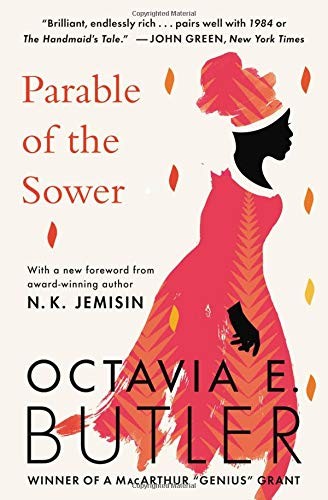
The 12 questions
- 1.
Lauren's hyperempathy makes her feel others' pain physically. Is that a disability that limits her or an advantage that motivates her? Does the novel decide?
- 2.
Earthseed's core principle is that God is Change. What does that theology do for the people who adopt it? Is it a comfort or a demand?
- 3.
Butler published this in 1993, set it in 2024, and described conditions that feel close to the present. How do you read a dystopia that has partially arrived?
- 4.
Lauren's father is a Baptist minister. What is Butler doing with the contrast between Lauren's new religion and her father's inherited one?
- 5.
The journal structure means we only know what Lauren knows. Are there moments in the novel where you felt her perspective was limited or wrong?
- 6.
The community Lauren builds recruits members partly by demographic diversity — different skills, different backgrounds. Is that a utopian vision or a pragmatic calculation?
- 7.
Violence is a recurring practical problem in the novel. How does Lauren's approach to it evolve, and does the novel endorse her conclusions?
- 8.
The corporations in the novel have privatized water, towns, and essentially indentured workers. Butler wrote this in 1993. Does the satire still feel sharp, or does it feel like history?
- 9.
Earthseed's ultimate goal is to spread human life to other worlds. Is that inspiring or does it feel like a way of giving up on Earth?
- 10.
Compare Lauren to another dystopian protagonist you know. What makes Butler's version of leadership different from, say, Katniss Everdeen?
- 11.
The novel has a sequel, Parable of the Talents. Does Parable of the Sower work as a standalone, or does it feel incomplete?
- 12.
The book's prescience has made it popular in conversations about climate change and political collapse. Does reading it as social commentary change how you read it as fiction?
How to run the discussion
- Pick six to eight, not all of them. An hour of real discussion covers fewer questions than anyone expects, and racing the list is what makes a book club feel like homework.
- Open with what people noticed, not what they concluded. Asking for a verdict first hardens opinions before anyone has heard each other.
- Let the disagreement run. The questions below that split a room are the ones worth the time; the ones everyone answers the same way can be skipped.
- Ask the quiet person a specific question. A direct, narrow question is far easier to answer than an open invitation to contribute.
Themes worth steering toward
If the conversation stalls, these are the threads that usually restart it.
Common questions
What are good book club questions for Parable of the Sower?
Here are 12 book club questions for Parable of the Sower by Octavia E. Butler, ordered to open easily and end somewhere worth arguing about. The strongest openers ask what each reader noticed rather than what they concluded, and the discussion usually turns on survival in civilizational collapse, community building, adaptability and change.
How long should a book club discussion of Parable of the Sower last?
Most groups run 60 to 90 minutes of actual discussion. That is roughly six to eight questions, not all of them, so pick the ones that suit your group rather than working down the list in order.
What are the main themes in Parable of the Sower?
Survival in civilizational collapse, Community building, Adaptability and change, Religion and ideology, Inequality and climate. Those are the threads most likely to divide a room, which makes them the useful places to steer a discussion that has gone quiet.
Picking the next one? See books like Parable of the Sower or questions for other book club picks.
