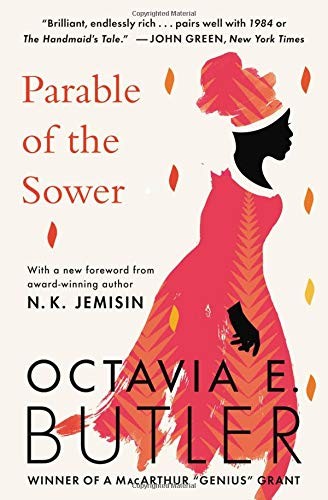
Parable of the Sower by Octavia E. Butler is a 1993 science fiction book about survival in civilizational collapse, community building, adaptability and change. Hyperempathy is both burden and feature: it makes Lauren unable to ignore others' suffering and therefore unusually motivated to address root causes rather than symptoms.
Summary
It is 2024 in California. Water costs more than food. Wildfires burn year-round. Gated neighborhoods of working poor defend themselves against the destitute and violent who live outside the walls. Lauren Olamina is a teenager living in one of those neighborhoods, the daughter of a Baptist minister, and she has hyperempathy syndrome — she physically feels the pain of others around her — which in the world Butler has built is somewhere between a disability and a superpower. Lauren is also quietly building a religion she has named Earthseed, whose central idea is that God is Change, and that humanity's destiny is the stars.
When Lauren's neighborhood is destroyed, she joins the streams of refugees walking north through a California that has become more post-apocalyptic than futuristic, and the novel follows her attempt to found a community around Earthseed's principles. The narrative is structured as her journal entries — dated, specific, noting resource counts and weather — which gives the collapse an operational texture that apocalyptic fiction often avoids. Butler is not interested in spectacle; she is interested in what you need to eat and where you sleep and who you can trust when social structures dissolve.
The parallels to Butler's real concerns — climate change, economic inequality, racial violence, the erosion of civil institutions — were so precise that the novel has been cited repeatedly as prophetic since its publication in 1993. When it was reissued in 2019, reviewers noted that the 2024 Butler described felt uncomfortably close to the present. This is not a comfortable coincidence; Butler did research, extrapolated trends, and described where they were going. The novel is, among other things, an argument that the collapse it depicts was preventable and was not prevented.
Lauren is one of Butler's most fully realized protagonists: pragmatic, idealistic, and willing to build a new world from scratch without waiting for permission. Readers who want to think about community, governance, and how values propagate in conditions of crisis will find this novel rewards discussion. Readers who find apocalyptic fiction too bleak should know that Butler's register is urgent rather than despairing — she is writing about building, not dying.
Talk to Parable of the Sower like its author wrote you back.
Get the ideas that fit your life — not generic summaries.
- Chat with the book
- Audiobook-style main ideas
- Adapts to your life and goals
- Helps you take action
Key takeaways
- 1.
Hyperempathy is both burden and feature: it makes Lauren unable to ignore others' suffering and therefore unusually motivated to address root causes rather than symptoms.
- 2.
Earthseed's central axiom — God is Change — is a philosophical position disguised as theology: the only constant is transformation, and adaptation is therefore the foundational virtue.
- 3.
Butler's 2024 California was built from trend extrapolation, not imagination. The economic collapse, climate catastrophe, and racial violence she describes were where 1993 trends were pointing.
- 4.
Community in the novel is not found or given — it is built, with effort, by extending trust strategically to people with complementary skills and shared need.
- 5.
The journal structure is a choice about epistemic humility: Lauren reports what she knows, when she knows it, and she is often wrong in real time.
- 6.
Butler is explicit that the disaster is man-made and ongoing: corporations have bought government, climate change was ignored, and the rich retreated behind walls while the rest was abandoned.
- 7.
Earthseed's vision of humanity spreading to the stars is not escapism — it's a response to the argument that Earth's problems are insurmountable; if you can't fix this place, build somewhere better.
- 8.
Violence in the novel is neither glorified nor sanitized — it is a resource problem: communities that can defend themselves survive, and the decision to become capable of violence has costs.
- 9.
Lauren's hyperempathy makes her a literal embodiment of what a community needs its leader to have: investment in the wellbeing of its members that is physically impossible to fake.
Discussion questions
Use these on your own, with a book club, or as chat starters in Superbook. Book club version, ready to copy or print →
- 1.
Lauren's hyperempathy makes her feel others' pain physically. Is that a disability that limits her or an advantage that motivates her? Does the novel decide?
- 2.
Earthseed's core principle is that God is Change. What does that theology do for the people who adopt it? Is it a comfort or a demand?
- 3.
Butler published this in 1993, set it in 2024, and described conditions that feel close to the present. How do you read a dystopia that has partially arrived?
- 4.
Lauren's father is a Baptist minister. What is Butler doing with the contrast between Lauren's new religion and her father's inherited one?
- 5.
The journal structure means we only know what Lauren knows. Are there moments in the novel where you felt her perspective was limited or wrong?
- 6.
The community Lauren builds recruits members partly by demographic diversity — different skills, different backgrounds. Is that a utopian vision or a pragmatic calculation?
- 7.
Violence is a recurring practical problem in the novel. How does Lauren's approach to it evolve, and does the novel endorse her conclusions?
- 8.
The corporations in the novel have privatized water, towns, and essentially indentured workers. Butler wrote this in 1993. Does the satire still feel sharp, or does it feel like history?
- 9.
Earthseed's ultimate goal is to spread human life to other worlds. Is that inspiring or does it feel like a way of giving up on Earth?
- 10.
Compare Lauren to another dystopian protagonist you know. What makes Butler's version of leadership different from, say, Katniss Everdeen?
- 11.
The novel has a sequel, Parable of the Talents. Does Parable of the Sower work as a standalone, or does it feel incomplete?
- 12.
The book's prescience has made it popular in conversations about climate change and political collapse. Does reading it as social commentary change how you read it as fiction?
Themes
Frequently asked questions
-
Is Parable of the Sower too bleak to read?
It is dark, but Butler's register is more urgent than despairing. The novel is about building something under terrible conditions, and Lauren's drive to create rather than just survive gives it forward momentum. Readers who find post-apocalyptic fiction cathartic rather than depressing will find it compulsive.
-
Was Parable of the Sower prophetic?
Butler would have objected to that framing — she was extrapolating from 1993 trends, not predicting. But the conditions she described (water privatization, climate fires, gated communities, political capture by corporations) have arrived close enough to her timeline that the novel has been described as prescient by reviewers repeatedly since 2019.
-
Do I need to read the sequel, Parable of the Talents?
The first book ends at a point of arrival, not resolution — Lauren has built something, but its fate is unresolved. The sequel continues and deepens the story. Most readers who finish Sower continue to Talents, and some consider the second book the stronger of the two.
-
What is Earthseed, and should I take it seriously as a religion?
Earthseed is Lauren's home-built theology, whose core proposition is that God is Change. Butler built it carefully enough that some readers treat it as a real philosophy. It's more interesting as a framework for thinking about adaptability and meaning-making under crisis than as a theology per se.
-
Who shouldn't read Parable of the Sower?
Readers who need resolution and comfort from their fiction. The world Butler describes is relentlessly harsh, the violence is unflinching, and the ending is more a beginning than a conclusion. Readers who want a conventional narrative arc will find the journal structure and open ending unsatisfying.