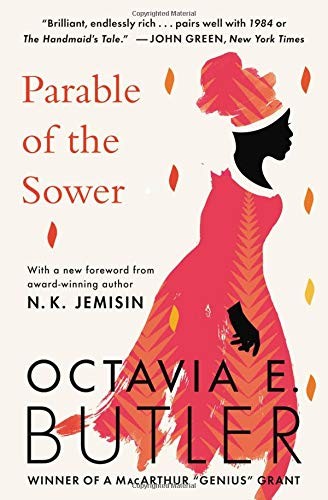
Talk to Parable of the Sower like its author wrote you back.
Get the ideas that fit your life — not generic summaries.
- Chat with the book
- Audiobook-style main ideas
- Adapts to your life and goals
- Helps you take action
What it argues
It is 2024 in California. Water costs more than food. Wildfires burn year-round. Gated neighborhoods of working poor defend themselves against the destitute and violent who live outside the walls. Lauren Olamina is a teenager living in one of those neighborhoods, the daughter of a Baptist minister, and she has hyperempathy syndrome — she physically feels the pain of others around her — which in the world Butler has built is somewhere between a disability and a superpower. Lauren is also quietly building a religion she has named Earthseed, whose central idea is that God is Change, and that humanity's destiny is the stars.
When Lauren's neighborhood is destroyed, she joins the streams of refugees walking north through a California that has become more post-apocalyptic than futuristic, and the novel follows her attempt to found a community around Earthseed's principles. The narrative is structured as her journal entries — dated, specific, noting resource counts and weather — which gives the collapse an operational texture that apocalyptic fiction often avoids. Butler is not interested in spectacle; she is interested in what you need to eat and where you sleep and who you can trust when social structures dissolve.
What it gets right
- 1.
Hyperempathy is both burden and feature: it makes Lauren unable to ignore others' suffering and therefore unusually motivated to address root causes rather than symptoms.
- 2.
Earthseed's central axiom — God is Change — is a philosophical position disguised as theology: the only constant is transformation, and adaptation is therefore the foundational virtue.
- 3.
Butler's 2024 California was built from trend extrapolation, not imagination. The economic collapse, climate catastrophe, and racial violence she describes were where 1993 trends were pointing.
What it covers
Who wrote it
Octavia E. Butler was an American science fiction writer and MacArthur Fellow. The Parable of the Sower and its sequel Parable of the Talents form her Earthseed series, and the Earthseed religion has become one of the more influential speculative philosophical frameworks in SF. Butler grew up in Pasadena, California, and died in 2006. Her work is known for its direct engagement with race, power, and survival, and has seen a significant reassessment since her death that has established her as one of the genre's most important figures.
