Religion & Spirituality · Book club
Peace Is Every Step book club questions
Here are 11 book club questions for Peace Is Every Step by Thich Nhat Hanh, ordered to open easily and end somewhere worth arguing about. Copy them, print them, or bring them up one at a time.
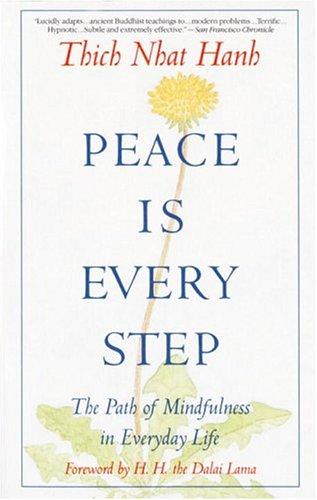
Peace Is Every Step is Thich Nhat Hanh's most accessible work — a short, warmly written invitation to bring mindfulness practice into the texture of daily life.
Thich Nhat Hanh · 1991 · 2h 20m
Full summary and key takeaways →The 11 questions
- 1.
Nhat Hanh says the present moment is the only moment available. How much of your waking time do you estimate you actually spend in the present moment versus planning or rehearsing?
- 2.
He describes ordinary activities — washing dishes, driving — as full mindfulness practices when done with attention. Have you ever experienced that quality of presence in a mundane task?
- 3.
The teaching on anger says to hold it like a mother holds a crying baby — not suppress it, not act it out, but tend to it. Have you ever tried that approach? What happened?
- 4.
Nhat Hanh connects individual peace practice to environmental responsibility and social justice. Is that connection convincing, or does it seem like he is adding politics to a personal practice?
- 5.
The book is made up of very short chapters with no sustained argument. Is that a feature or a limitation? What kind of reader does it suit best?
- 6.
He says most of us live cut off from our own experience through constant mental commentary. What does your internal commentary sound like, and what is it mostly about?
- 7.
Deep listening means being fully present to another person without planning your response. When was the last time someone listened to you that way? What was it like?
- 8.
The bell of mindfulness turns an ordinary event into a practice cue. What signal in your daily environment could serve that function?
- 9.
Nhat Hanh's writing style is completely non-confrontational — he makes no demands, passes no judgment. Does that register as respect or as evasion?
- 10.
If you practiced even ten minutes of mindful walking every day, what do you think would change over three months?
- 11.
The book says peace is available right now. What is the most honest obstacle between you and that availability?
How to run the discussion
- Pick six to eight, not all of them. An hour of real discussion covers fewer questions than anyone expects, and racing the list is what makes a book club feel like homework.
- Open with what people noticed, not what they concluded. Asking for a verdict first hardens opinions before anyone has heard each other.
- Let the disagreement run. The questions below that split a room are the ones worth the time; the ones everyone answers the same way can be skipped.
- Ask the quiet person a specific question. A direct, narrow question is far easier to answer than an open invitation to contribute.
Themes worth steering toward
If the conversation stalls, these are the threads that usually restart it.
Common questions
What are good book club questions for Peace Is Every Step?
Here are 11 book club questions for Peace Is Every Step by Thich Nhat Hanh, ordered to open easily and end somewhere worth arguing about. The strongest openers ask what each reader noticed rather than what they concluded, and the discussion usually turns on mindfulness, peace, present moment.
How long should a book club discussion of Peace Is Every Step last?
Most groups run 60 to 90 minutes of actual discussion. That is roughly six to eight questions, not all of them, so pick the ones that suit your group rather than working down the list in order.
What are the main themes in Peace Is Every Step?
Mindfulness, Peace, Present moment, Compassion, Daily life. Those are the threads most likely to divide a room, which makes them the useful places to steer a discussion that has gone quiet.
Picking the next one? See books like Peace Is Every Step or questions for other book club picks.
