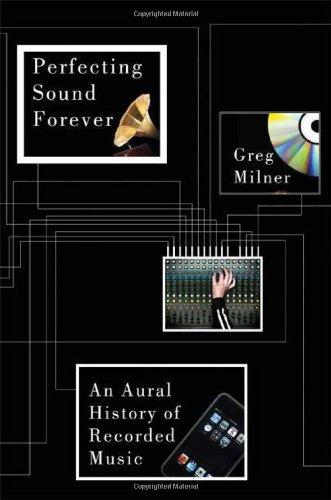
Perfecting Sound Forever by Greg Milner is a 2009 history book about music recording, technology, authenticity. Recorded music is not a transparent window onto performance. Every recording is a construction, shaped by the values and technologies of its moment.
Summary
Perfecting Sound Forever is Greg Milner's history of recorded music as a technology — and an argument about what that technology has cost. The book traces how recording engineers, producers, and musicians across a century of audio history have pursued different and often contradictory ideals: total fidelity to acoustic reality, total sonic control, total loudness, total presence. At each stage, the dominant definition of "perfect sound" reveals the cultural values of its moment as much as any technical fact about acoustics.
Milner begins with the invention of the phonograph and the early debates between Edison's "perfect" reproductions and the live performance he wanted to replicate, then moves through the introduction of magnetic tape (which allowed editing and overdubbing and thereby made recording an art distinct from performance), the rise of studio production in the 1960s and 1970s, and the arrival of digital audio. The jump from analog to digital — from continuous waveforms to discrete samples — is the book's central rupture. Milner examines the audiophile community's case that digital recording misses information present in analog signals, takes it seriously, and gives fair treatment to both sides of a debate that has not been definitively settled.
The most provocative section covers the loudness war: the progressive compression and limiting of commercial recordings from the 1980s onward, as mastering engineers competed to make albums louder than their competitors. The result was music whose average loudness approached its peaks — recordings with no dynamic range, no quiet moments, no contrast. Milner argues that this was not simply a technical problem but a cultural pathology: the reduction of music to something that could hold attention against the background noise of modern life by eliminating all variation.
The book closes with the MP3, auto-tune, and the digital present, asking what is left of recorded sound's relationship to acoustic reality. Milner is a skilled journalist and an attentive listener. He does not romanticize the analog era, and he acknowledges that manipulation and idealization have been present in recording from the beginning. But he makes a credible case that the industry's pursuit of perfection has at various points produced something that is in important ways less, not more, than the thing it was trying to perfect.
Talk to Perfecting Sound Forever like its author wrote you back.
Get the ideas that fit your life — not generic summaries.
- Chat with the book
- Audiobook-style main ideas
- Adapts to your life and goals
- Helps you take action
Key takeaways
- 1.
Recorded music is not a transparent window onto performance. Every recording is a construction, shaped by the values and technologies of its moment.
- 2.
The introduction of magnetic tape in the late 1940s was a turning point: it allowed editing, overdubbing, and layering that made the recording studio an instrument in its own right rather than a documentation device.
- 3.
The loudness war — the progressive compression of commercial recordings from the 1980s onward — destroyed dynamic range in popular music by engineering every moment to be as loud as the loudest moment.
- 4.
The debate between analog and digital audio is not simply a technical question. It involves different beliefs about what recorded sound is for and what 'accuracy' means.
- 5.
Auto-tune and pitch correction, like overdubbing and reverb before them, are technologies that alter the relationship between performance and recording in ways the listener rarely perceives.
- 6.
The MP3 compression algorithm discards audio information the human ear is unlikely to notice. Whether it discards anything important depends on what you think music is.
- 7.
Each generation's definition of 'perfect sound' reflects the cultural anxieties of its moment: Edison wanted immortality, 1950s hi-fi culture wanted domesticated grandeur, the loudness war wanted competitive attention.
Discussion questions
Use these on your own, with a book club, or as chat starters in Superbook. Book club version, ready to copy or print →
- 1.
Milner argues that every recording is a construction, not a capture. Does knowing this change how you listen to music you love?
- 2.
The loudness war compressed dynamic range to hold attention in noisy environments. What other design choices in modern media reflect the same imperative, and what do they cost?
- 3.
Where do you stand on the analog versus digital audio debate? Is the audiophile case for analog a principled position, nostalgia, or something in between?
- 4.
Auto-tune is now so common as to be nearly invisible. Is the widespread use of pitch correction a problem, a neutral technical fact, or simply the latest in a long series of acceptable manipulations?
- 5.
Milner traces how recording technology separated performance from document, allowing music to be made that could never be performed live. What has that freed artists to do, and what has it cost?
- 6.
The phonograph was initially presented as a device for preserving the voices of the dying. How much of the appeal of recorded music is still connected to the desire for a form of immortality or presence?
- 7.
The MP3 discards audio information your brain is unlikely to notice. Is the information that gets discarded important? What criterion would you use to decide?
- 8.
Perfecting Sound Forever focuses heavily on American and European popular music. How might the story look different from the perspective of musical traditions where live performance has a different relationship to recorded document?
- 9.
Milner treats the loudness war as a cultural pathology. Is that too strong, or does the destruction of dynamic range in commercial music have consequences for listeners that justify the criticism?
- 10.
What is the relationship between technological idealism — the pursuit of the 'perfect' recording — and the repeated production of something that doesn't sound like music?
- 11.
Since Milner published the book in 2009, streaming has become the dominant format. How has streaming changed the dynamics he describes around loudness, compression, and the economics of audio quality?
Themes
Frequently asked questions
-
What is Perfecting Sound Forever about?
A history of recorded music as a technology, tracing a century of debates about what 'perfect' recording means — from Edison's phonograph to digital audio and the loudness war — and arguing that each definition of perfection reveals as much about cultural values as about acoustics.
-
Do I need to know music theory to enjoy Perfecting Sound Forever?
No. Milner explains the relevant technical concepts clearly, and the book's central concerns — authenticity, manipulation, what we lose when we pursue sonic perfection — are accessible to anyone who listens to recorded music.
-
What is the loudness war?
The progressive compression and limiting of commercial recordings from the 1980s onward, as mastering engineers competed to make albums sound louder than competitors. The result was recordings with virtually no dynamic range — all loud, all the time — which Milner treats as a cultural and aesthetic failure as much as a technical one.
-
How long does Perfecting Sound Forever take to read?
About six to seven hours at an average pace. The book is narrative in structure and reads like long-form journalism. The denser sections on audio engineering can slow things down, but Milner keeps the technical material anchored to human stories.
-
Is Perfecting Sound Forever optimistic or pessimistic about recorded music?
Neither simply. Milner doesn't romanticize the past, and he acknowledges that manipulation has been present in recording from the beginning. But he makes a credible case that certain recent directions — the loudness war, the MP3's lossy compression — represent genuine losses, not just neutral change.