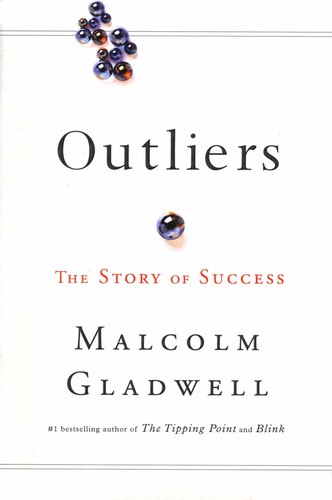
Outliers: The Story of Success by Malcolm Gladwell is a 2008 psychology book about success, opportunity, culture. Hidden advantages compound. What looks like natural talent often traces back to a timing or circumstance advantage that allowed more practice, more mentorship, or more opportunity at a critical age.
Summary
Outliers is Malcolm Gladwell's argument that exceptional success is less a product of individual genius or drive than it is of hidden advantages, timing, and accumulated opportunity. The book opens with a disorienting observation: the majority of elite Canadian junior hockey players are born in January, February, or March. The reason is a cutoff date in youth leagues that makes children born early in the year older and physically larger than their peers, so they get more coaching attention, more ice time, and more chances to develop. What looks like natural talent is largely a head start that compounds over years.
Gladwell builds the argument through stories. Bill Gates had rare access to a time-sharing terminal in 1968, at exactly the age and moment needed to accumulate ten thousand hours of programming before almost anyone else in the world. The Beatles played Hamburg clubs eight hours a night for years before their breakthrough. Robert Oppenheimer escaped expulsion from Cambridge through social savvy that poorer students never develop. In each case, Gladwell is pointing at the same thing: exceptional performers didn't just work harder. They were positioned in environments that let practice accumulate into mastery at a rate others couldn't match.
The ten-thousand-hour rule, drawn from research by Anders Ericsson, is the book's most cited idea: sustained deliberate practice at roughly that volume appears necessary to reach elite performance in any complex domain. Gladwell uses it to push back against the myth of the prodigy — the child who emerges fully formed from some genetic lottery. But he's also careful to say the rule is necessary, not sufficient. Hours alone don't explain who gets the opportunity to put in those hours, or why some cultures produce more of certain kinds of achievers than others. Chapters on math performance and rice farming trace how agrarian traditions in southern China may have contributed to the work ethic and numerical intuition that show up in test scores generations later.
The book's weakness is visible in its ambition. Gladwell is a storyteller, and the stories are compelling, but the causal chains sometimes stretch. Critics have pointed out that the ten-thousand-hour rule is more nuanced than the book suggests, and that cherry-picking outliers to build a unified theory of success risks the same mistake Gladwell is supposedly correcting — mistaking pattern for mechanism. What Outliers does well is harder to dismiss: it shifts the frame. If the circumstances around a person matter as much as the person, then the question is not just how to find exceptional individuals but how to build environments that produce more of them.
Talk to Outliers: The Story of Success like its author wrote you back.
Get the ideas that fit your life — not generic summaries.
- Chat with the book
- Audiobook-style main ideas
- Adapts to your life and goals
- Helps you take action
Key takeaways
- 1.
Hidden advantages compound. What looks like natural talent often traces back to a timing or circumstance advantage that allowed more practice, more mentorship, or more opportunity at a critical age.
- 2.
The ten-thousand-hour rule: reaching elite performance in any complex domain requires roughly ten thousand hours of deliberate practice. The rule is necessary but not sufficient.
- 3.
Birthdate effects shape entire cohorts. In age-cutoff systems — youth sports, school enrollment — children born just after the cutoff are persistently disadvantaged against older peers who appear more capable.
- 4.
The year of birth matters as much as how hard you work. Gates and Jobs both came of age in the mid-1950s, positioning them to ride the personal computer wave at exactly the right moment.
- 5.
Cultural legacy shapes performance. Gladwell traces how agrarian traditions emphasizing persistence and exactitude — particularly in rice-farming societies — surface in mathematical aptitude generations later.
- 6.
Practical intelligence, the social knowledge of how to navigate institutions, is as important as analytical ability. It is distributed by class, not by IQ.
- 7.
Elite environments can correct for circumstance. Programs that give disadvantaged students the hours and attention that affluent peers receive by default narrow the achievement gap significantly.
- 8.
Success stories obscure their own context. Retrospective accounts of exceptional achievement tend to strip out the environmental conditions that made the achievement possible.
Discussion questions
Use these on your own, with a book club, or as chat starters in Superbook. Book club version, ready to copy or print →
- 1.
Gladwell argues that most accounts of success obscure the role of circumstance. Think of a success story you've told about yourself. What hidden advantages were you not mentioning?
- 2.
The Canadian hockey birthdate effect suggests that arbitrary cutoff dates create compounding advantages. Where else in your own education or career have you seen a structural bias like this?
- 3.
The ten-thousand-hour rule implies that deliberate practice volume matters more than innate talent. How does that change how you evaluate your own potential in an area you've given up on?
- 4.
Gladwell profiles Chris Langan, a man with one of the highest IQs ever recorded who never broke through professionally. What does his story suggest about the limits of raw ability without practical intelligence?
- 5.
Practical intelligence — knowing how to work the system — is learned, not innate, and tends to correlate with class. Where in your own life have you benefited from knowing how to navigate institutions?
- 6.
The Bill Gates story depends on extraordinary access to a computer terminal in 1968. What rare resource did you have access to in formative years that shaped what you became good at?
- 7.
Gladwell argues that culture can transmit work habits across generations. Do you see that in your own family or ethnic background? Is the claim convincing to you?
- 8.
The book's rice-paddy chapter links a demanding agricultural tradition to mathematical aptitude. What's the strongest objection to that kind of long-range cultural causation argument?
- 9.
Outliers are defined partly by where they were born, when they were born, and who their parents were — factors they didn't choose. How does that sit with your intuitions about personal responsibility?
- 10.
Gladwell says we should build systems that create more outliers rather than hunt for exceptional individuals. What would that look like in an institution you know well — a school, a company, a sports program?
- 11.
Which person profiled in the book — Gates, the Beatles, Oppenheimer, Langan, or another — do you find most convincing as evidence for Gladwell's thesis? Which seems most like a stretch?
- 12.
If the ten-thousand-hour rule applies to your field, how far are you into those hours? Does the number feel motivating or deflating?
Themes
Frequently asked questions
-
Is Outliers worth reading?
Yes, particularly if you are interested in the sociology of achievement. The book is engaging and the stories are well chosen. Its weakness is that it sometimes overstates the causal claims. Read it as a provocation rather than a settled argument, and it holds up well.
-
How long does it take to read Outliers?
Around five to five-and-a-half hours at average reading pace. The chapters are largely self-contained case studies, so it works well in shorter sessions. The book is 309 pages and reads quickly given Gladwell's accessible narrative style.
-
What is the main idea of Outliers?
That exceptional success is less about individual talent and drive than about accumulated advantages, timing, and cultural legacy. Gladwell argues that the circumstances surrounding a person — when they were born, what access they had, what culture shaped them — determine performance as much as personal effort.
-
What is the ten-thousand-hour rule?
The claim, drawn from research by psychologist Anders Ericsson, is that elite performance in any complex domain requires roughly ten thousand hours of deliberate practice. Gladwell uses it to argue that outliers are made, not born — but critics note the rule is more conditional and domain-specific than the book implies.
-
Who should read Outliers?
Anyone curious about why some people succeed and others don't, particularly if they find purely talent-based explanations unsatisfying. It is also worth reading for people in education, coaching, or management who design the systems and environments that shape achievement.
Similar books
Thinking, Fast and Slow
Daniel Kahneman
Range: Why Generalists Triumph in a Specialized World
David Epstein
Grit: The Power of Passion and Perseverance
Angela Duckworth
Blink: The Power of Thinking Without Thinking
Malcolm Gladwell
Outliers vs.
Deciding between two books? Outliers vs Peak or Outliers vs Range .
