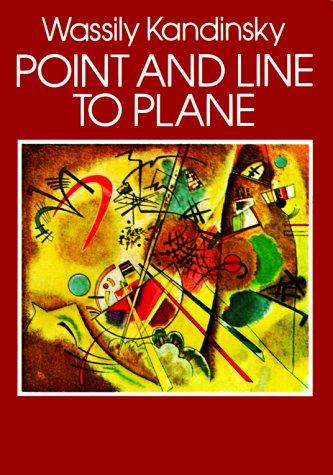
Talk to Point and Line to Plane like its author wrote you back.
Get the ideas that fit your life — not generic summaries.
- Chat with the book
- Audiobook-style main ideas
- Adapts to your life and goals
- Helps you take action
What it argues
Point and Line to Plane is Wassily Kandinsky's systematic attempt to build a grammar of visual art from the ground up. Written while he was teaching at the Bauhaus in Weimar and Dessau, the book treats the point, line, and plane not as geometrical abstractions but as living elements with psychological and emotional weight. A single point on a blank canvas creates tension; a line carries direction and force; a plane exerts pressure. Kandinsky wanted painting to have the same internal logic that music has — not representational meaning, but a direct, structured effect on feeling.
The book divides into two main sections. The first dissects the point: its size, its color, its relationship to the plane it occupies. Kandinsky distinguishes the geometric point from the painted point, noting that a small circle on canvas has warmth, temperature, and dramatic potential that a mathematical dot does not. Even the typographic period, as punctuation, carries a kind of terminal force. From this beginning the analysis gradually expands to lines — both straight and curved, thick and thin — treating each variation as expressive in a specific direction.
What it gets right
- 1.
The point, line, and plane are not neutral geometrical facts but charged elements that create tension, movement, and emotional tone in visual composition.
- 2.
A painted point is categorically different from a mathematical one. Its size relative to the canvas, its color, and its position each carry distinct expressive properties.
- 3.
Lines have personality: horizontal lines are calm and cold, vertical lines are warm and still, diagonal lines carry the most dynamic tension.
What it covers
Who wrote it
Wassily Kandinsky (1866–1944) was a Russian painter and art theorist widely credited as a pioneer of abstract painting. He taught at the Bauhaus from 1922 to 1933, where he developed the theoretical framework behind Point and Line to Plane. His major paintings, including the Composition series and the Improvisation series, are in the permanent collections of the Guggenheim Museum, the Centre Pompidou, and the Städtische Galerie im Lenbachhaus. He also wrote Concerning the Spiritual in Art, which preceded this volume and laid out his philosophical case for abstraction.
