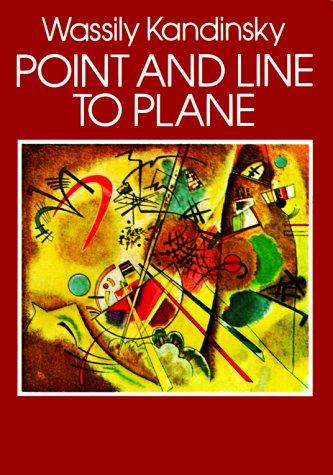
Point and Line to Plane by Wassily Kandinsky is a 1926 philosophy book about visual form, abstraction, artistic theory. The point, line, and plane are not neutral geometrical facts but charged elements that create tension, movement, and emotional tone in visual composition.
Summary
Point and Line to Plane is Wassily Kandinsky's systematic attempt to build a grammar of visual art from the ground up. Written while he was teaching at the Bauhaus in Weimar and Dessau, the book treats the point, line, and plane not as geometrical abstractions but as living elements with psychological and emotional weight. A single point on a blank canvas creates tension; a line carries direction and force; a plane exerts pressure. Kandinsky wanted painting to have the same internal logic that music has — not representational meaning, but a direct, structured effect on feeling.
The book divides into two main sections. The first dissects the point: its size, its color, its relationship to the plane it occupies. Kandinsky distinguishes the geometric point from the painted point, noting that a small circle on canvas has warmth, temperature, and dramatic potential that a mathematical dot does not. Even the typographic period, as punctuation, carries a kind of terminal force. From this beginning the analysis gradually expands to lines — both straight and curved, thick and thin — treating each variation as expressive in a specific direction.
The second part turns to the picture plane itself: its edges, its corners, the different emotional weight carried by the upper and lower portions of a canvas, the tension created when elements approach the borders. Kandinsky draws on synesthetic experience throughout — the sensation that certain colors feel warm or cool, that diagonal lines are more dynamic than horizontal ones, that the upper portion of a canvas feels lighter. These are treated not as personal metaphors but as shared perceptual facts grounded in the structure of human attention.
The book is dense and requires patience. Kandinsky's prose is painstaking and sometimes dry. But for anyone serious about visual composition — whether in painting, graphic design, typography, or filmmaking — the underlying framework remains genuinely useful. It teaches a way of seeing that goes below subject matter to ask: what does this element do to the viewer's attention, and why?
Talk to Point and Line to Plane like its author wrote you back.
Get the ideas that fit your life — not generic summaries.
- Chat with the book
- Audiobook-style main ideas
- Adapts to your life and goals
- Helps you take action
Key takeaways
- 1.
The point, line, and plane are not neutral geometrical facts but charged elements that create tension, movement, and emotional tone in visual composition.
- 2.
A painted point is categorically different from a mathematical one. Its size relative to the canvas, its color, and its position each carry distinct expressive properties.
- 3.
Lines have personality: horizontal lines are calm and cold, vertical lines are warm and still, diagonal lines carry the most dynamic tension.
- 4.
The picture plane exerts unequal pressure. The upper region feels light and airy; the lower region feels heavy and grounded; corners anchor or release energy.
- 5.
Visual art can aspire to the condition of music — not by depicting sound, but by developing an internal grammar of form that acts directly on perception.
- 6.
Composition is the arrangement of graphic elements such that their collective tensions and resolutions form a coherent whole, not just a pleasing arrangement.
- 7.
Kandinsky's method treats visual sensation as measurable and teachable, laying groundwork for how designers and artists think about layout, weight, and visual rhythm.
Discussion questions
Use these on your own, with a book club, or as chat starters in Superbook. Book club version, ready to copy or print →
- 1.
Kandinsky argues that a point on a canvas has emotional temperature independent of what it represents. Do you find this convincing when you look at abstract paintings?
- 2.
He treats diagonal lines as inherently more dynamic than horizontal or vertical ones. Can you think of examples in design or photography where this holds — or fails to hold?
- 3.
The book claims that the upper portion of a canvas feels lighter than the lower. Does this match your experience as a viewer, and what implications does it have for composition?
- 4.
Kandinsky wanted painting to work like music — directly, without representation. What would be lost in an art world where all painting was purely abstract?
- 5.
Point and Line to Plane was written as pedagogical material at the Bauhaus. Does it read differently knowing it was meant to teach working designers, not just fine artists?
- 6.
The book draws on synesthesia — the feeling that colors are warm or cool, that shapes have emotional weight. How much of this do you think is universal versus culturally conditioned?
- 7.
How useful is Kandinsky's vocabulary of points, lines, and planes when analyzing a piece of work you admire — a film, a photograph, a building, or a poster?
- 8.
Kandinsky's systematic approach to art theory is very different from more expressive or intuitive accounts of creativity. What are the costs and benefits of treating visual form as a grammar?
- 9.
The book was published in 1926 in German. Has its core argument aged well, or do contemporary understandings of perception and design supersede it?
- 10.
Kandinsky distinguishes between the geometric and the graphic — the abstract and the visual. Where does that distinction break down for you?
- 11.
If you were designing a page, a poster, or a room, which of Kandinsky's principles would you actually apply? Which feel too theoretical to be practical?
Themes
Frequently asked questions
-
What is Point and Line to Plane about?
It is Wassily Kandinsky's systematic theory of visual composition, treating the point, line, and picture plane as expressive elements with specific emotional and perceptual properties — an attempt to give abstract visual art the internal logic that music already has.
-
Is Point and Line to Plane worth reading for graphic designers?
Yes, particularly for understanding visual weight, tension, and composition at a foundational level. The vocabulary is dated and the prose is dense, but the underlying principles — how elements relate to the plane they occupy, how edges and corners function — remain relevant to layout, typography, and screen design.
-
How long is Point and Line to Plane?
It runs to roughly 180 pages in most editions. It is short but slow reading due to Kandinsky's careful, analytic prose and the number of diagrams. A careful reading takes two to three hours.
-
Do I need to know abstract art to understand this book?
No prior knowledge of Kandinsky's paintings is needed, but some familiarity with looking at abstract work helps. The concepts are self-contained; the book explains its own terms as it builds them up from first principles.
-
How does this relate to Kandinsky's other writing?
Point and Line to Plane is the more technical and analytical companion to Concerning the Spiritual in Art (1911), which is more mystical and philosophical in tone. Reading both together gives a fuller picture of his theoretical project, but this volume stands alone as the clearest expression of his compositional principles.