Business · Book club
Power and Prediction: The Disruptive Economics of Artificial Intelligence book club questions
Here are 12 book club questions for Power and Prediction: The Disruptive Economics of Artificial Intelligence by Ajay Agrawal, Joshua Gans, and Avi Goldfarb, ordered to open easily and end somewhere worth arguing about. Copy them, print them, or bring them up one at a time.
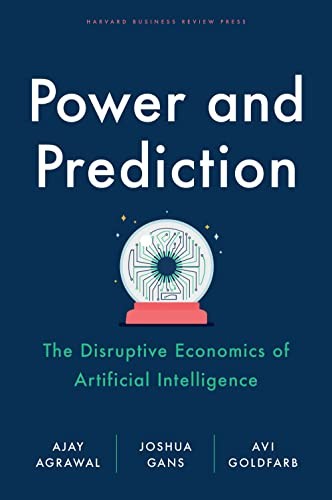
Power and Prediction is the second book from Ajay Agrawal, Joshua Gans, and Avi Goldfarb — the economists behind Prediction Machines — and it takes a more pointed look at what cheap AI-driven prediction actually disrupts.
Ajay Agrawal, Joshua Gans, and Avi Goldfarb · 2022 · 5h 0m
Full summary and key takeaways →The 12 questions
- 1.
The authors distinguish between point solutions and system solutions. Where in your industry is AI currently deployed as a point solution when the bigger opportunity is a system redesign?
- 2.
Which professional roles in your field derive their authority primarily from controlling access to prediction? How might cheap AI prediction affect that authority over time?
- 3.
The book argues incumbents often benefit first from AI efficiency gains, which can slow disruption. Is that a temporary advantage or a durable one?
- 4.
Think of a regulation or professional norm in your industry that was designed for a world of expensive prediction. Does it still make sense as AI makes prediction cheaper?
- 5.
The authors are optimistic that system-level AI disruption will eventually benefit end users. What would that look like in healthcare, law, or education specifically?
- 6.
Where do you see the transition from point solutions to system solutions already beginning in your industry or organization?
- 7.
They argue that the institutions resisting AI redesign are doing so for reasons that were once legitimate. Does that make the resistance more or less appropriate to challenge?
- 8.
The book is written by economists. Does the analytical framework of decision costs and prediction costs capture what feels most important about AI disruption, or does it miss something?
- 9.
What kind of organization — startup, incumbent, or regulator — is best positioned to drive system-level AI redesign in your sector?
- 10.
Cheap prediction doesn't eliminate the need for judgment. The authors are careful on this point. Where is human judgment most likely to remain valuable as prediction improves?
- 11.
Who in your professional network currently holds power because they control access to expensive prediction? How are they responding to AI tools in that domain?
- 12.
The authors wrote this in 2022, before the widespread deployment of large language models. Which of their predictions about system-level disruption seem most clearly confirmed now?
How to run the discussion
- Pick six to eight, not all of them. An hour of real discussion covers fewer questions than anyone expects, and racing the list is what makes a book club feel like homework.
- Open with what people noticed, not what they concluded. Asking for a verdict first hardens opinions before anyone has heard each other.
- Let the disagreement run. The questions below that split a room are the ones worth the time; the ones everyone answers the same way can be skipped.
- Ask the quiet person a specific question. A direct, narrow question is far easier to answer than an open invitation to contribute.
Themes worth steering toward
If the conversation stalls, these are the threads that usually restart it.
Common questions
What are good book club questions for Power and Prediction: The Disruptive Economics of Artificial Intelligence?
Here are 12 book club questions for Power and Prediction: The Disruptive Economics of Artificial Intelligence by Ajay Agrawal, Joshua Gans, and Avi Goldfarb, ordered to open easily and end somewhere worth arguing about. The strongest openers ask what each reader noticed rather than what they concluded, and the discussion usually turns on artificial intelligence, decision-making, disruption.
How long should a book club discussion of Power and Prediction: The Disruptive Economics of Artificial Intelligence last?
Most groups run 60 to 90 minutes of actual discussion. That is roughly six to eight questions, not all of them, so pick the ones that suit your group rather than working down the list in order.
What are the main themes in Power and Prediction: The Disruptive Economics of Artificial Intelligence?
Artificial intelligence, Decision-making, Disruption, Economics, Strategy. Those are the threads most likely to divide a room, which makes them the useful places to steer a discussion that has gone quiet.
Picking the next one? See books like Power and Prediction: The Disruptive Economics of Artificial Intelligence or questions for other book club picks.
