Powerful: Building a Culture of Freedom and Responsibility by Patty McCord is a 2018 business book about organizational culture, leadership, talent management. Treating employees as capable adults — giving them context, not rules — is more effective than managing through policies and procedures designed to catch bad behavior.
Summary
Powerful is Patty McCord's account of the people philosophy she developed as Chief Talent Officer at Netflix between 1998 and 2012. The book is an extended argument for treating employees as capable adults, eliminating performance theater, and building a culture where the expectation of excellent performance is explicit and non-negotiable. McCord's style is direct to the point of bluntness, which fits her argument: she has little patience for HR practices she sees as paternalistic, performative, or simply ineffective.
The central claim is that most companies manage people poorly not because they lack good intentions but because they mistake procedure for culture. Policies about vacation days, expense reports, and performance reviews signal distrust and create bureaucracy. Netflix eliminated most of them. What replaced them was a clear articulation of the behaviors and outcomes expected at each level, transparent access to business strategy and financials, and the expectation that managers would have direct, honest conversations rather than managing through formal processes.
McCord addresses the Netflix culture deck — the 127-slide presentation that Reed Hastings and she co-created and which went viral after being posted publicly in 2009 — and explains the philosophy behind each major principle. The section on compensation is particularly useful: Netflix's approach of paying top-of-market rates for each role and encouraging employees to know their market value was radical in 2009 and remains uncommon. The underlying logic is that retention should be built on job quality and growth, not on golden handcuffs.
The book's weakness is its specificity to a particular kind of company. Netflix in its early years was a high-performance, high-trust organization with a specific hiring profile. McCord's prescriptions can feel difficult to translate to companies with different economics, different talent pools, or different risk tolerances. She acknowledges this occasionally but doesn't dwell on it. Readers who work in manufacturing, government, or heavily regulated industries will need to do significant adaptation work.
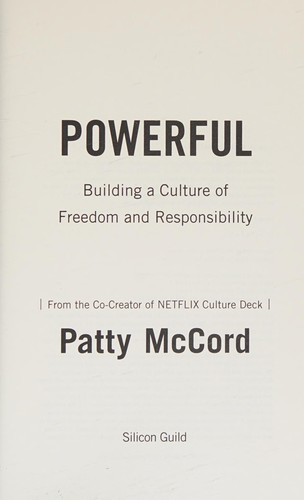
Talk to Powerful: Building a Culture of Freedom and Responsibility like its author wrote you back.
Get the ideas that fit your life — not generic summaries.
- Chat with the book
- Audiobook-style main ideas
- Adapts to your life and goals
- Helps you take action
Key takeaways
- 1.
Treating employees as capable adults — giving them context, not rules — is more effective than managing through policies and procedures designed to catch bad behavior.
- 2.
The purpose of a performance review should be to have a direct conversation about what excellent performance looks like, not to generate documentation for HR compliance.
- 3.
Paying top-of-market rates for each role and encouraging employees to understand their own market value reduces resentment and aligns retention with job quality rather than inertia.
- 4.
Most retention efforts are backward: companies spend resources keeping people who should probably leave rather than ensuring the people who should stay are thriving.
- 5.
Eliminating performative HR — unlimited vacation policies, expense reports reviewed line-by-line — signals trust and allows people to make decisions like adults.
- 6.
A great team is not a happy family. It is a group of people who are genuinely the best available for their roles and who understand exactly what is expected of them.
- 7.
Managers have a responsibility to tell employees honestly when their role is evolving beyond their current capabilities, rather than managing around the problem until a crisis forces the issue.
- 8.
Transparency about business strategy and financial performance enables employees to make better decisions and contributes to the sense that they are trusted partners rather than managed resources.
Discussion questions
Use these on your own, with a book club, or as chat starters in Superbook. Book club version, ready to copy or print →
- 1.
McCord argues most HR policies signal distrust. Which HR policies at places you've worked felt that way? Which felt genuinely useful?
- 2.
Netflix's culture deck went viral in 2009. What made it resonate with so many people, and what does that reveal about widespread dissatisfaction with workplace culture?
- 3.
McCord says direct, honest feedback is more respectful than cushioned performance reviews. Have you experienced feedback cultures that match this description? What made them work or fail?
- 4.
Is the 'adequate performance gets a generous severance' principle fair or brutal? What conditions would have to be true for it to be the right policy?
- 5.
McCord's philosophy requires managers who can have genuinely honest conversations about performance. How do you select for and develop that skill?
- 6.
How does paying top-of-market rates and encouraging employees to know their market value change the dynamic between employer and employee?
- 7.
Where does unlimited vacation actually work, and where does it turn into implicit zero vacation? What determines the outcome?
- 8.
The Netflix model is explicitly built for high performers in a high-performance environment. What happens to the people in the middle, and is that acceptable?
- 9.
McCord argues that retention built on incentives other than job quality is a trap. Have you seen examples of companies where this led to a performance problem?
- 10.
What does treating employees as capable adults require of the organization's communication practices? What would you have to actually change?
- 11.
Is there a version of freedom and responsibility culture that works in organizations with union contracts, government employment law, or other structural constraints?
- 12.
McCord left Netflix in 2012. What do you know about how Netflix's culture has evolved since the period she describes, and does it change how you read the book?
Themes
Frequently asked questions
-
Is Powerful worth reading?
Yes, particularly for managers and executives who suspect their company's HR practices are more about compliance than culture. McCord's ideas are provocative and specific enough to generate real debate about what you actually believe about how people should be managed.
-
How long does it take to read Powerful?
About three to four hours. The book is short and direct — McCord writes like she talks, which is to say without excess. Chapters are organized around specific management principles and can be read independently.
-
What is the main idea of Powerful?
That treating people as capable adults, being honest about expectations and business context, and eliminating performative HR practices produces better results than managing through rules and policies designed to catch bad behavior.
-
Who should read Powerful?
Managers, HR professionals, and founders building company culture from scratch. Also useful as a counterpoint if you find yourself reflexively defending HR processes that may have outlived their usefulness.
-
Does the Netflix model work at every company?
No, and McCord would be the first to say so. The model was built for a specific kind of company — high-growth, high-trust, with a defined hiring profile for performance orientation. Wholesale adoption without cultural readiness typically produces chaos rather than freedom.
Similar books
No Rules Rules: Netflix and the Culture of Reinvention
Reed Hastings and Erin Meyer
Dare to Lead
Brené Brown
Radical Candor
Kim Scott
First, Break All the Rules
Marcus Buckingham and Curt Coffman
