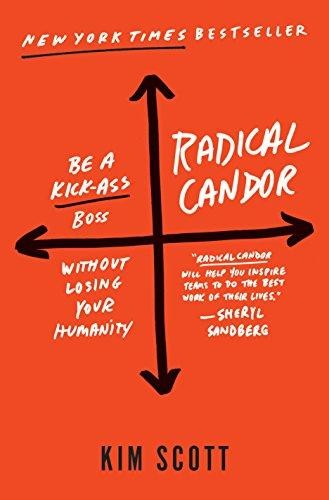
Radical Candor by Kim Scott is a 2017 business book about feedback, management, communication. Radical Candor means caring personally and challenging directly at the same time. Either one without the other produces a worse outcome than both together.
Summary
Radical Candor is Kim Scott's framework for the central management challenge: how to tell people what they need to hear without damaging the relationship. The book is built on a two-by-two matrix. One axis is "care personally" — genuine investment in the human being in front of you. The other is "challenge directly" — willingness to say difficult things rather than avoid them. Radical Candor sits in the upper-right quadrant, where both are present simultaneously.
The three failure modes are more interesting than the ideal. Ruinous Empathy is the most common — caring personally but failing to challenge directly, which produces false comfort and stunted growth. Manipulative Insincerity is caring neither about the person nor about honesty, which Scott associates with corporate politics. Obnoxious Aggression is challenging directly without caring about the person — honest feedback delivered with contempt.
Scott argues that most managers default to Ruinous Empathy because being liked feels safer than being useful. But withholding honest feedback is a form of disrespect — it treats people as too fragile to hear the truth and robs them of the chance to improve. The antidote is building enough personal trust that directness doesn't feel like an attack. Care first, then challenge.
The second half of the book is practical: how to run 1:1s, how to give and receive feedback, how to think about the different growth trajectories of your team members, and how to handle the political dynamics that make honesty difficult in large organizations. Scott is particularly useful on the distinction between "superstar" employees who want to grow fast and "rockstar" employees who want to do excellent work without taking on more responsibility — both are valuable, and most managers only know how to reward one type.
Talk to Radical Candor like its author wrote you back.
Get the ideas that fit your life — not generic summaries.
- Chat with the book
- Audiobook-style main ideas
- Adapts to your life and goals
- Helps you take action
Key takeaways
- 1.
Radical Candor means caring personally and challenging directly at the same time. Either one without the other produces a worse outcome than both together.
- 2.
Ruinous Empathy is the most common management failure — prioritizing someone's short-term comfort over their long-term development by withholding honest feedback.
- 3.
The goal of feedback is not to make someone feel good or bad but to help them be more effective. That goal requires enough personal trust that the feedback is heard rather than defended against.
- 4.
Criticism should always be given privately and in a way the other person can act on. Public criticism is almost always counterproductive.
- 5.
Not everyone on your team wants the same trajectory. 'Rockstars' want to do excellent work in a stable role; 'superstars' want growth. Both are valuable; recognize and reward them differently.
- 6.
The best way to give feedback is immediately, specifically, and humbly. 'When you did X, I noticed Y, and I think the impact was Z' is a structure that keeps feedback actionable.
- 7.
Leaders set the feedback culture. If you want your team to give you honest feedback, you have to create conditions where honest feedback doesn't get punished.
- 8.
Asking 'is there anything I could do differently?' is more powerful than 'do you have any feedback for me?' The first signals openness; the second often gets a polite no.
Discussion questions
Use these on your own, with a book club, or as chat starters in Superbook. Book club version, ready to copy or print →
- 1.
Scott says Ruinous Empathy is the most common failure mode. Think of a time you softened feedback so much the message disappeared — what were you actually protecting?
- 2.
What's the most direct piece of feedback you've ever given someone? Did it go the way you expected? What made it land or not land?
- 3.
Have you ever received feedback that was radically candid — honest and clearly motivated by genuine care? What made it feel that way rather than harsh?
- 4.
The book distinguishes between rockstars (stable excellence) and superstars (growth-oriented). Who on your current team falls into each category? Are you managing them accordingly?
- 5.
Scott argues that the relationship must come before the directness. How long do you typically invest in getting to know someone before giving them hard feedback?
- 6.
What's a situation in your work life where you're currently in Ruinous Empathy — not saying something you should say? What's stopping you?
- 7.
Obnoxious Aggression is sometimes mistaken for honesty. Have you worked with someone who used 'I'm just being direct' as cover for contempt? What was the difference between that and actual Radical Candor?
- 8.
If your team were honest with you right now about something you could improve, what do you think they would say? What's making it hard for them to say it?
- 9.
Scott recommends giving feedback immediately and specifically. What gets in the way of that in your actual working environment?
- 10.
How does feedback culture differ across organizations you've worked in? What created those differences — policy, or individual leaders?
- 11.
The book is primarily about managing down. Does the framework apply equally to managing up — giving honest feedback to your own manager?
- 12.
Scott warns against soliciting feedback in groups or all-hands meetings. Do you agree? When does public feedback serve a useful purpose?
Themes
Frequently asked questions
-
Is Radical Candor worth reading?
Yes, particularly for managers who find it hard to give direct feedback. The two-by-two framework is simple enough to remember and apply, and Scott is honest about the ways caring managers still get it wrong. The practical sections on running 1:1s and structuring feedback conversations are genuinely useful.
-
How long does it take to read Radical Candor?
About five hours for the 272-page book. The framework is introduced early and the rest develops and applies it. Many readers find the first third most valuable and skim the final chapters, which cover meeting structures and organizational dynamics.
-
What does radical candor actually mean?
Caring enough about a person to tell them something hard, directly, while making clear the feedback comes from investment in their success rather than indifference to their feelings. The 'radical' is relative to how most managers actually behave, not relative to any objective standard of bluntness.
-
Who should read Radical Candor?
Managers at every level, and anyone who gives or receives feedback regularly. It's particularly valuable for managers who know they should be more direct but don't know how to do it without damaging relationships.
-
What's the most actionable idea in Radical Candor?
The immediate, specific, humble feedback formula: 'When you did X, I noticed Y, and I think Z.' Applied consistently in the moment rather than saved for annual reviews, it changes how teams communicate about performance.