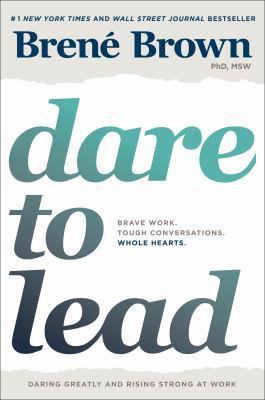
Dare to Lead by Brené Brown is a 2018 business book about vulnerability, courage, leadership. Daring leadership requires the willingness to be uncertain, ask for help, and show up without all the answers — behaviors that most organizational cultures still punish despite claiming otherwise.
Summary
Dare to Lead is Brené Brown's application of her research on vulnerability and courage to the specific context of leadership. Based on interviews with over 150 executives, it argues that daring leadership is not about having all the answers but about the willingness to be uncertain, to give and receive honest feedback, and to create conditions where people can bring their full selves to work without fear.
The book is organized around four "skill sets of courage": rumbling with vulnerability (sitting with discomfort rather than armoring up), living into values rather than just professing them, building trust through specific behaviors (not just through sentiment), and learning to rise from failure without armor. Brown is particularly detailed on what she calls the BRAVING inventory — a set of seven behaviors that constitute trust: Boundaries, Reliability, Accountability, Vault (confidentiality), Integrity, Non-judgment, and Generosity.
Brown pushes back against the idea that workplaces should be purely rational spaces where emotion is checked at the door. She argues that suppressing vulnerability doesn't eliminate it — it converts it into armor, and armor is the thing that makes people unavailable for genuine collaboration, honest feedback, and creative risk. Leaders who armor up teach their teams to armor up, and armored teams don't do great work.
The book is at its best when Brown is concrete — the distinction between values as words on a wall and values as actual decision-making criteria, the BRAVING inventory applied to specific management behaviors, the "square squad" concept of seeking feedback only from those who are also in the arena. It's at its weakest when the language becomes therapeutic without adding precision. Still, it addresses something most management books avoid: the emotional substrate beneath every leadership decision.
Talk to Dare to Lead like its author wrote you back.
Get the ideas that fit your life — not generic summaries.
- Chat with the book
- Audiobook-style main ideas
- Adapts to your life and goals
- Helps you take action
Key takeaways
- 1.
Daring leadership requires the willingness to be uncertain, ask for help, and show up without all the answers — behaviors that most organizational cultures still punish despite claiming otherwise.
- 2.
Armor — perfectionism, cynicism, intellectualizing — doesn't protect leaders; it disconnects them from the teams and problems they're trying to lead.
- 3.
The BRAVING inventory identifies seven trust-building behaviors: Boundaries, Reliability, Accountability, Vault, Integrity, Non-judgment, and Generosity. Trust is built through consistent small actions, not through declarations.
- 4.
Values that don't guide decisions under pressure are not actually values. Leaders who want to build values-driven cultures must be able to name two core values and explain how they showed up in a hard recent decision.
- 5.
Giving honest feedback requires courage. 'Clear is kind; unclear is unkind' — softening a message until the recipient can't use it is not compassion, it's self-protection dressed up as care.
- 6.
Shame and guilt are not the same thing. Guilt says 'I did something bad'; shame says 'I am bad.' Shame doesn't motivate change — it motivates hiding.
- 7.
The 'square squad' is the small group of people whose feedback you actually weight. If that group isn't also in the arena — also taking risks and failing — their input isn't calibrated to what you're facing.
- 8.
Belonging requires that people can be who they actually are. Organizations that require people to cover or perform can access their labor but not their best thinking.
Discussion questions
Use these on your own, with a book club, or as chat starters in Superbook. Book club version, ready to copy or print →
- 1.
Brown distinguishes between professing values and living them. What are your two core values, and what's a recent decision you made that tested them? Did they guide you?
- 2.
What does armoring up look like for you specifically? Cynicism? Perfectionism? Intellectualizing? When in your work day does the armor come on?
- 3.
Think about the last time you gave feedback that was 'unclear' because you were protecting someone's feelings. What were you actually protecting?
- 4.
Apply the BRAVING inventory to a key relationship at work — a manager, a direct report, or a peer. Where is the trust strong? Where is there a gap?
- 5.
Brown says daring leadership requires showing up without all the answers. What signals in your organization still punish not-knowing? What's the cost of those signals?
- 6.
Who is in your 'square squad' — the people whose feedback you actually weight? Are they in the arena themselves? Do they actually know you and your work?
- 7.
What's the last failure you experienced at work? How did you handle the aftermath — with armor, or with genuine reflection and learning?
- 8.
Brown argues that belonging requires people to show up as themselves. What does your organization do — intentionally or inadvertently — that requires people to cover or perform?
- 9.
Where in your leadership are you avoiding a difficult conversation by telling yourself it's not the right time or the other person isn't ready?
- 10.
The book connects vulnerability to creativity and innovation — the argument that you can't have one without the other. Do you see evidence of this in your own organization?
- 11.
What would have to change in your team's meeting culture for genuine uncertainty to be expressed safely rather than managed out?
- 12.
Brown says clear is kind. What's something you could say more clearly to your team or your manager that you've been softening because it feels unkind?
Themes
Frequently asked questions
-
Is Dare to Lead worth reading?
Yes, if you're open to the premise that good leadership requires emotional honesty. It addresses the psychological substrate beneath management decisions in a way that more technically-focused books don't. Skeptics of the vulnerability framing may find it easier to engage with the concrete tools like the BRAVING inventory and the values clarification exercises.
-
How long does it take to read Dare to Lead?
Around five hours for the 320-page book. The writing is accessible but not always tight — some sections benefit from skimming once you've absorbed the core argument.
-
What does 'daring leadership' actually mean?
Brown's term for leadership that embraces uncertainty and vulnerability rather than performing certainty and invulnerability. It means being willing to say 'I don't know,' to give and receive honest feedback, to have hard conversations, and to create environments where people can take genuine risks without shame.
-
Who should read Dare to Lead?
Leaders who already have the technical skills but feel like something is missing in their teams — engagement, honesty, creative risk-taking, or trust. Also useful for anyone who wants to understand why some cultures feel psychologically safe and others feel performative.
-
What's the most actionable idea in Dare to Lead?
The BRAVING inventory applied to your key workplace relationships. Working through each of the seven trust components for a specific person reveals exactly where the trust gaps are and what specific behavior would close them — which is far more useful than a general sense that things feel off.
Similar books

Dare to Lead vs.
Deciding between two books? Dare to Lead vs Daring Greatly .
